Walk into a switchgear panel shop or a transformer factory’s busbar corner, and you will see the same three operations repeated all day: cut the bar to length, punch the holes, bend it to shape. A 3-in-1 busbar machine puts all three on a single frame — one hydraulic power pack, one footprint, one operator. For small and mid-size production, that combination changes the economics of busbar fabrication completely.
This guide explains what a 3-in-1 busbar machine actually is, how each station works, which specifications define the class, and when you should step up to dedicated machines instead. For the full equipment category overview, see our busbar processing machine guide.
What a 3-in-1 Busbar Machine Is
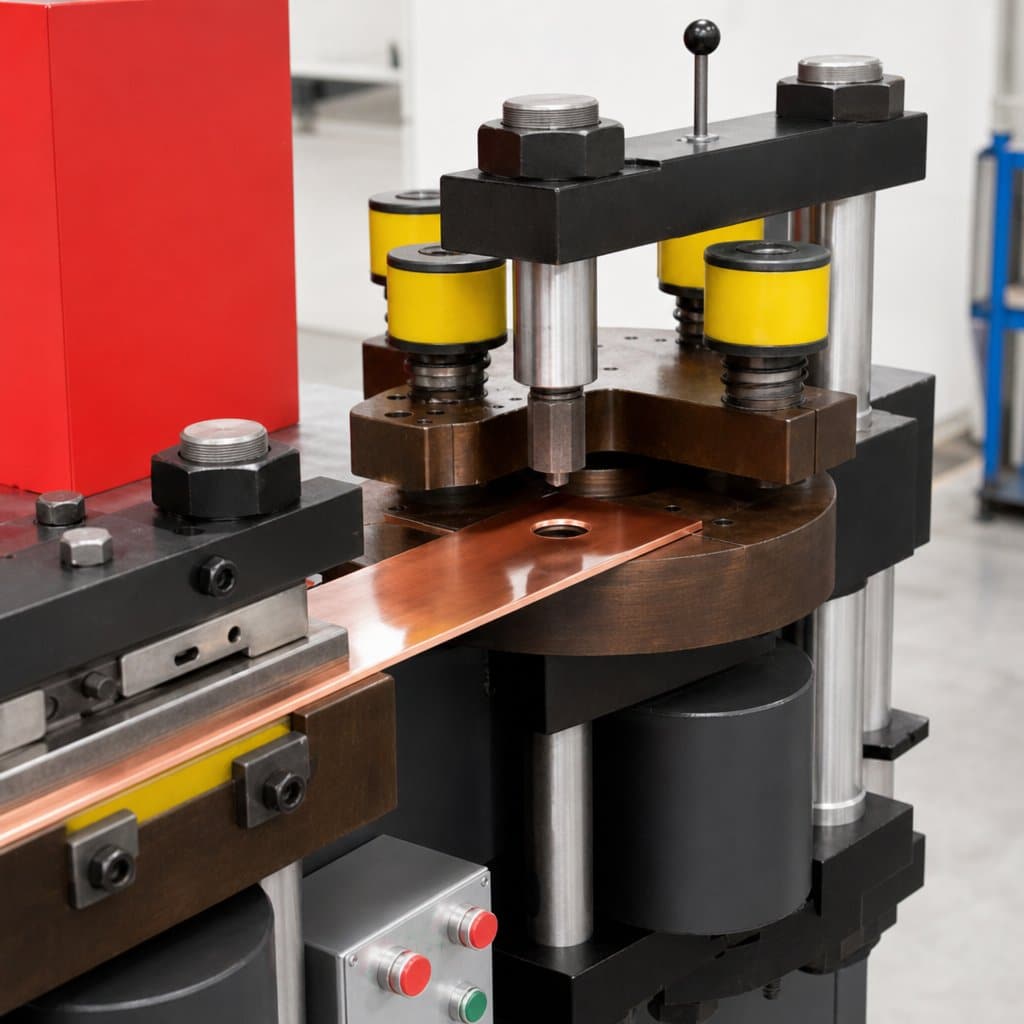
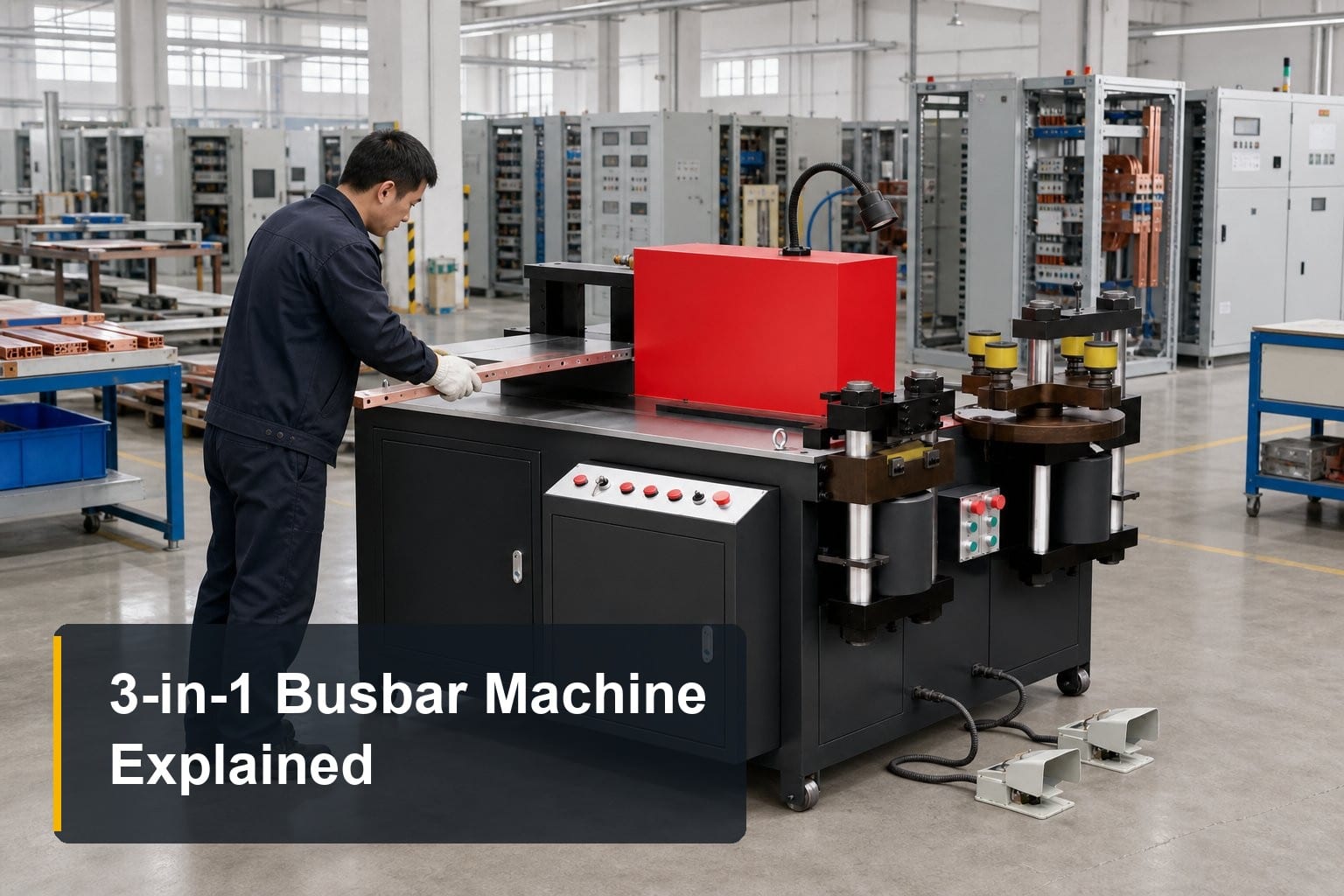
A 3-in-1 busbar machine — sometimes called a busbar punching, shearing and bending machine — integrates three workstations on one compact chassis:
- Shearing station — cuts copper or aluminum busbar to length with a flat, low-burr cut face.
- Punching station — punches round, oval, or shaped holes for bolted joints, using a rotary die turret for fast changeover.
- Bending station — performs flat bends, vertical (edge) bends, U-bends, embossing, and cable lug pressing with interchangeable dies.
The machines dominate in transformer factories, switchgear and control-panel production, distribution box assembly, and custom busbar workshops — anywhere busbar parts come in moderate volumes with high part variety. Instead of three machines, three operators, and three times the floor space, one workstation handles the complete cut-punch-bend sequence.
A defining design detail of the class: the three stations can work simultaneously. On the DGWMX303E-3, for example, a double-worktable layout lets one operator shear the next blank while another punches or bends — the stations share the hydraulic system but not the working zone, so they never interfere with each other.
How Each Station Works
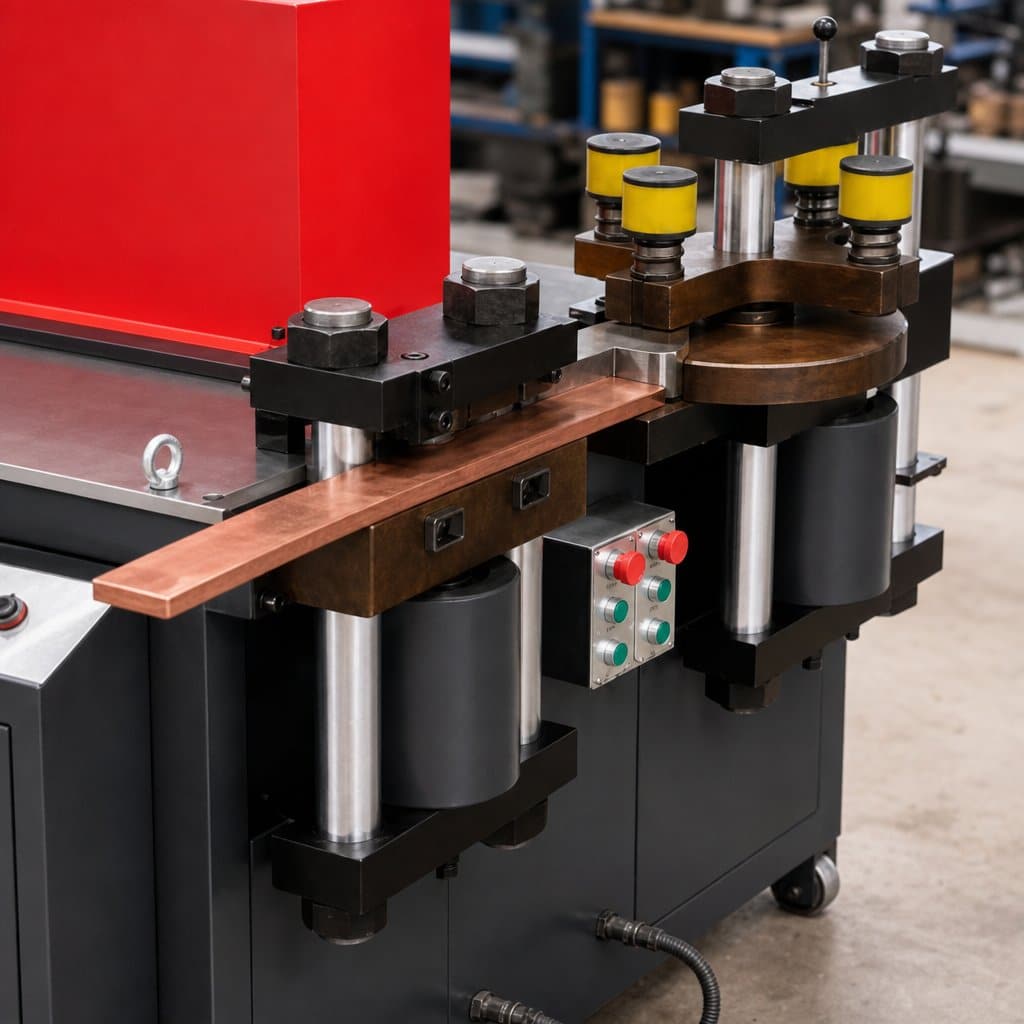
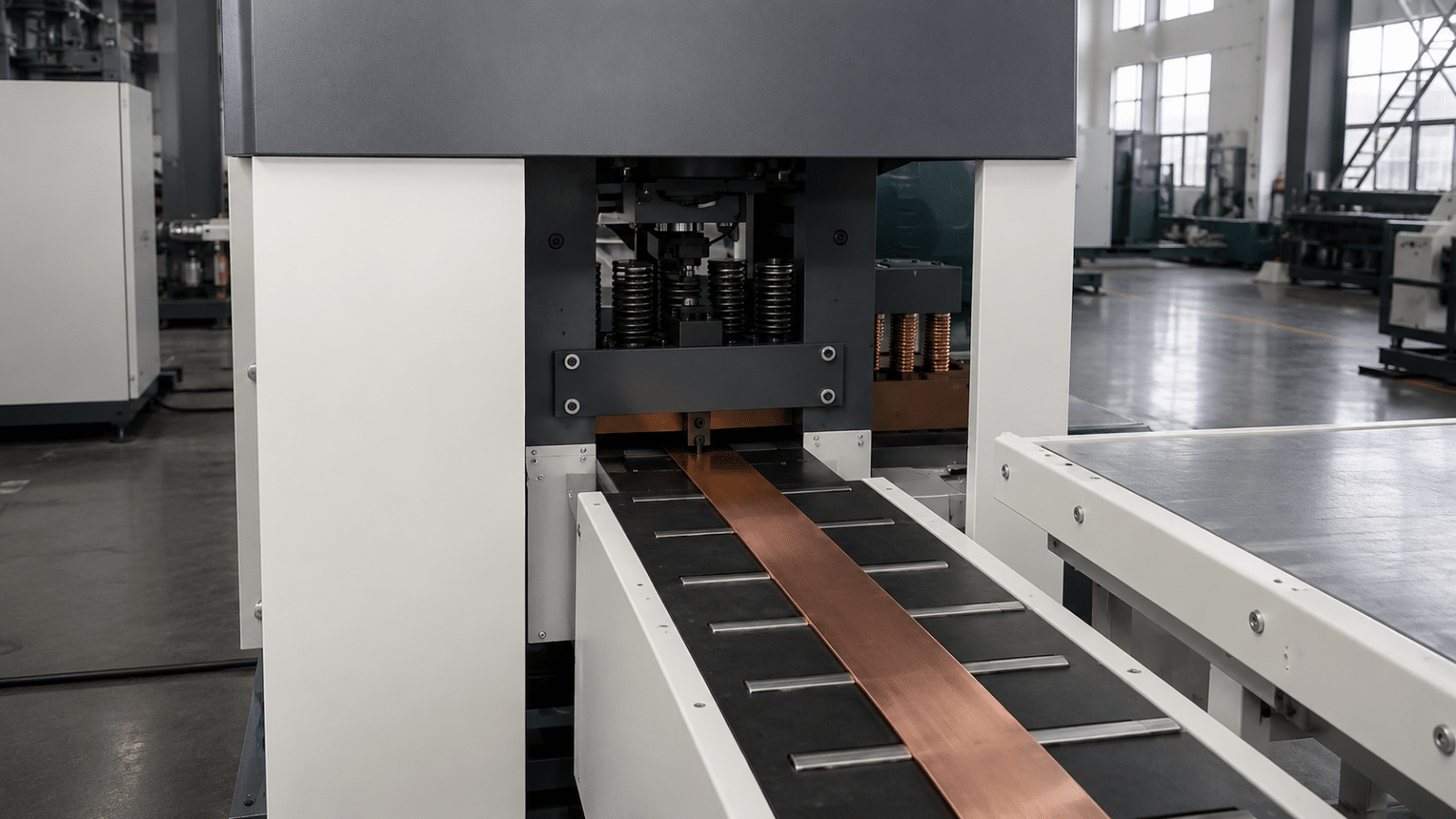
Shearing — double-column structure. The shearing station uses a double-column guided blade rather than a single-pivot cropper. The guided vertical stroke keeps the blade square to the bar throughout the cut, which is what produces a flat cut face with minimal burr and almost no edge distortion. On copper bar this matters twice: once for joint contact resistance (a flat face means full contact area), and once for plating quality if the bar is tinned afterward.
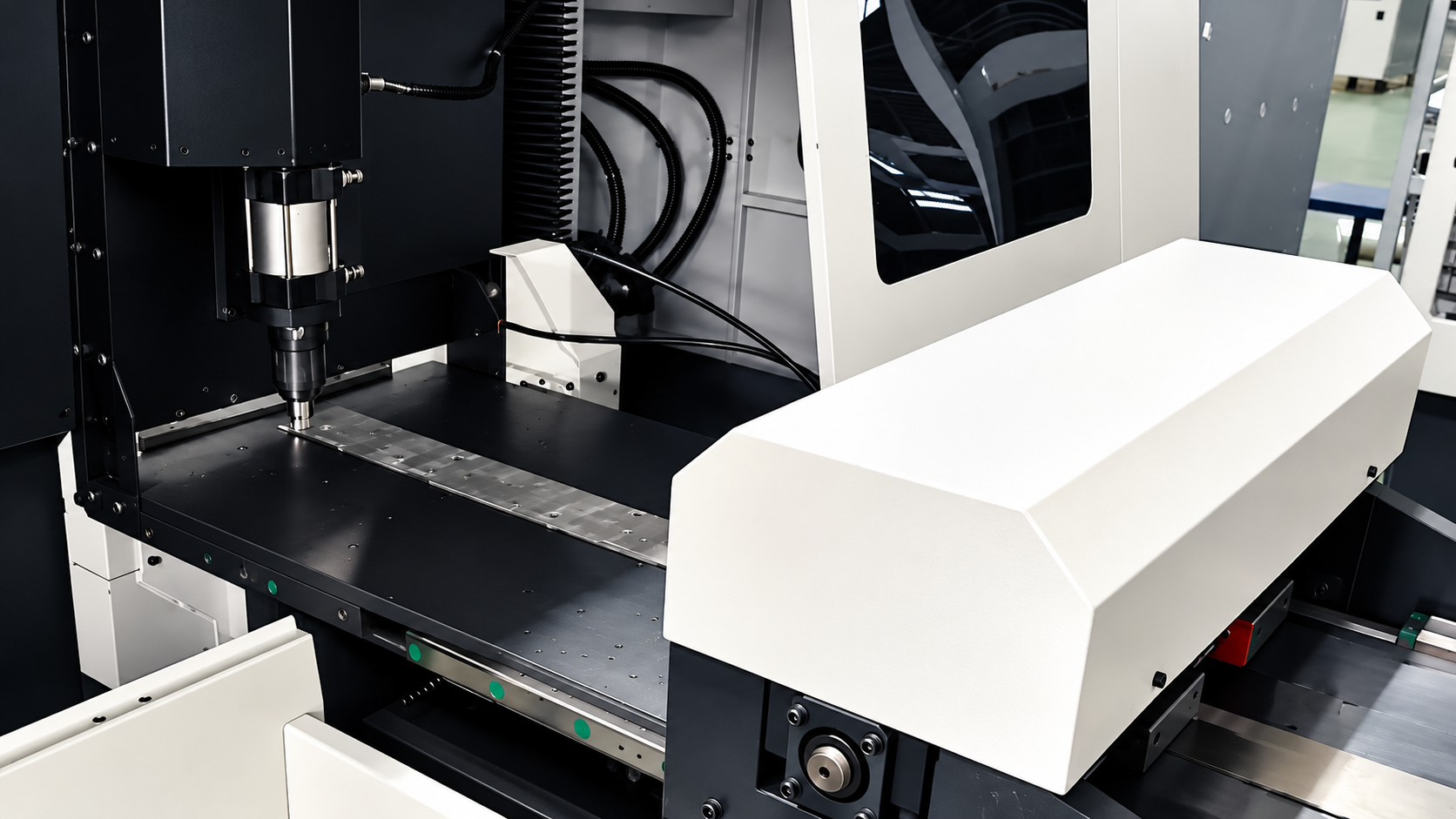
Punching — turret die carrier with mechanical double positioning. The punching station carries its dies on a ductile cast-iron integral turntable — six or eight positions depending on configuration. The one-piece turret keeps die concentricity tight (worn or misaligned dies are the main cause of oval holes and slug pull), and changeover is a rotation rather than a wrenched-out die swap. The mechanical double-positioning stop is the productivity feature: the operator sets the stop once and punches hole patterns without marking or measuring each bar. On a batch of identical connection bars, this is where most of the labor saving actually comes from.
Bending — closed bending structure. The bending station uses a closed (O-frame) structure rather than an open C-frame. Under a 350 kN bending load, an open frame springs measurably, and frame spring shows up directly as angle scatter across a batch. The closed frame’s rigidity is what keeps flat bends consistent across a shift’s worth of parts — and it provides the stiffness needed for cable lug pressing, which is essentially a controlled coining operation.
The whole machine runs under PLC control rather than relay logic — more stable day to day, and simpler to fault-find. Three foot switches (one per station) leave both hands free to handle the bar.
Key Specifications That Define the Class
Using the DGWMX303E-3 as a reference point for the 350 kN class:
| Parameter | Value | What It Decides |
|---|---|---|
| Nominal pressure | 350 kN | Maximum thickness × width combination you can punch and bend cleanly |
| Maximum processing size | 12 × 160 mm | Covers the standard busbar range for distribution transformers and MV/LV switchgear |
| Punching diameter range | Φ4.3–25 mm | From small terminal holes to large bolted joints on main busbar |
| Punch die capacity | 8-station turret (6 optional) | How many hole sizes run without a die change |
| Worktable | 1500 × 1200 mm + 940 × 420 mm | Support for long bars during punching and bending |
| Simultaneous stations | Yes (double worktable) | Effective throughput with two operators |
| CNC bending angle control | No (manual angle stop) | Angle repeatability depends on operator + stop; CNC variants exist for tighter tolerances |
| Machine size / weight | 1750 × 1350 × 1500 mm / 1370 kg | Footprint — roughly one-third of three separate machines |
Two honest limitations come with the class. First, bending angle control is manual — a mechanical stop, not a CNC axis. For distribution-class work this is entirely adequate; if your parts need ±0.2° repeatability across thousands of bends, a servo CNC busbar bending machine is the right tool. Second, 350 kN tops out at 12 × 160 mm. If you regularly process 16 × 200 mm or heavier bar, look at the 500-800 kN class — our 400 kN vs 600 kN punching and shearing comparison covers that decision in detail.
3-in-1 vs. Separate Machines: Which Setup Wins?
| 3-in-1 Busbar Machine | Separate Punch / Shear / Bend Machines | |
|---|---|---|
| Best for | Small-mid batches, high part variety, 1-2 operators | High-volume production of standardized parts |
| Investment | One machine, one power pack | 3× machines + 3× installation |
| Floor space | ~2.4 m² | 3 separate stations + handling space |
| Throughput | High for mixed work; stations run simultaneously | Higher per-operation rate on dedicated lines |
| Changeover | Turret rotation + die swap, minutes | Depends on each machine’s tooling |
| CNC capability | Limited (manual angle stop typical) | Full CNC available on dedicated lines |
The decision rule is volume-versus-variety. If your shop makes hundreds of different busbar part numbers in batches of tens — the typical profile for transformer lead bars, switchgear connections, and panel builders — the 3-in-1 wins on capital cost, space, and labor. If you stamp thousands of identical bars per week, dedicated CNC lines win on cycle time. Many factories run both: a 3-in-1 for prototypes, spares, and small batches, feeding volume work to CNC equipment. For on-site installation and maintenance work, a portable busbar machine extends the same cut-punch-bend capability to the job site — we cover that class in our portable busbar machine guide.
Who Should Buy One
The 3-in-1 class earns its keep fastest in four situations:
- Transformer factories making lead-connection bars and internal conductive assemblies in low-to-mid volume — the cut-punch-bend sequence describes nearly every part.
- Switchgear and control-panel manufacturers where every job is a different drawing and setup time dominates.
- Custom busbar workshops serving multiple equipment OEMs — flexibility is the whole business.
- Facilities and retrofit teams that currently outsource busbar parts; bringing cut-punch-bend in-house typically pays back in 12-18 months on parts cost alone.
When evaluating a specific machine, ask for a demo on your thickest bar — a clean 12 × 160 mm shear cut and a burr-free Φ25 punch tell you more than any brochure. Also check what ships in the crate: a proper package includes the shear blades, a full punching die set, flat/U/embossing bending dies, and tooling for maintenance, not just the bare machine.
Conclusion
A 3-in-1 busbar machine is the highest-utilization single purchase in busbar fabrication: one frame, three stations, simultaneous operation, and a footprint a third of separate machines. Size it to your thickest bar (12 × 160 mm covers most distribution work), accept manual angle control as the class’s honest trade-off, and step up to dedicated CNC machines only when volume justifies it. For the complete picture — punching/shearing lines, servo bending, portable units, and connection-plate automation — start from the busbar processing machine guide, or send us your busbar drawings and we’ll recommend a configuration.