End rings, platens, conductor clamps, and insulation shields are the slowest parts to make in most transformer insulation workshops. They are large, geometrically complex, and unforgiving: a ring groove that runs 0.5 mm off true becomes a winding-fit problem that no amount of downstream adjustment can fix. A CNC insulation parts processing center exists to take exactly these parts off the router table and the manual drill press — and onto one programmable gantry machine.
This guide is written for production engineers and factory owners who are evaluating an insulation parts processing center for pressboard and laminated wood components. It covers what the machine actually does, which specifications matter (and which are marketing), and how it compares with smaller combined machines. For the full map of insulation workshop equipment, see our transformer insulation parts processing equipment guide.
What a CNC Insulation Parts Processing Center Actually Does
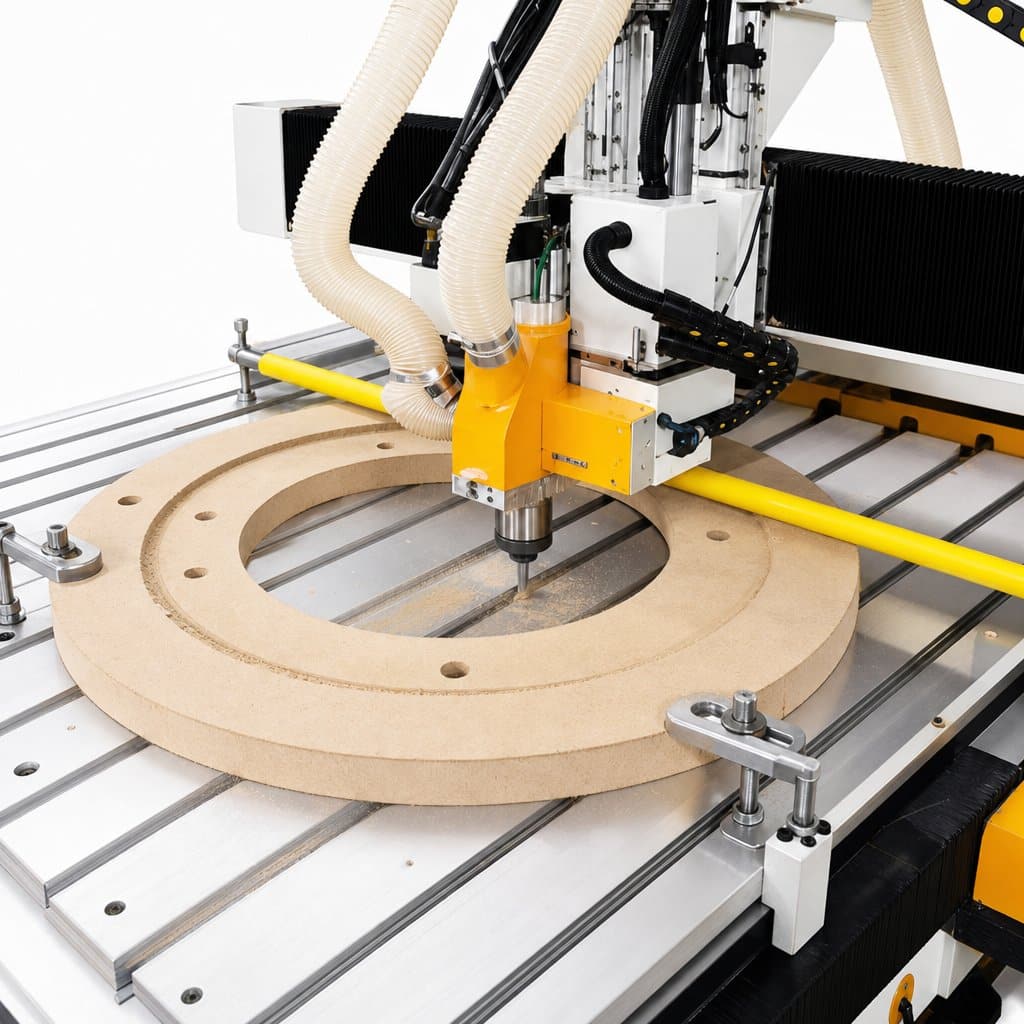
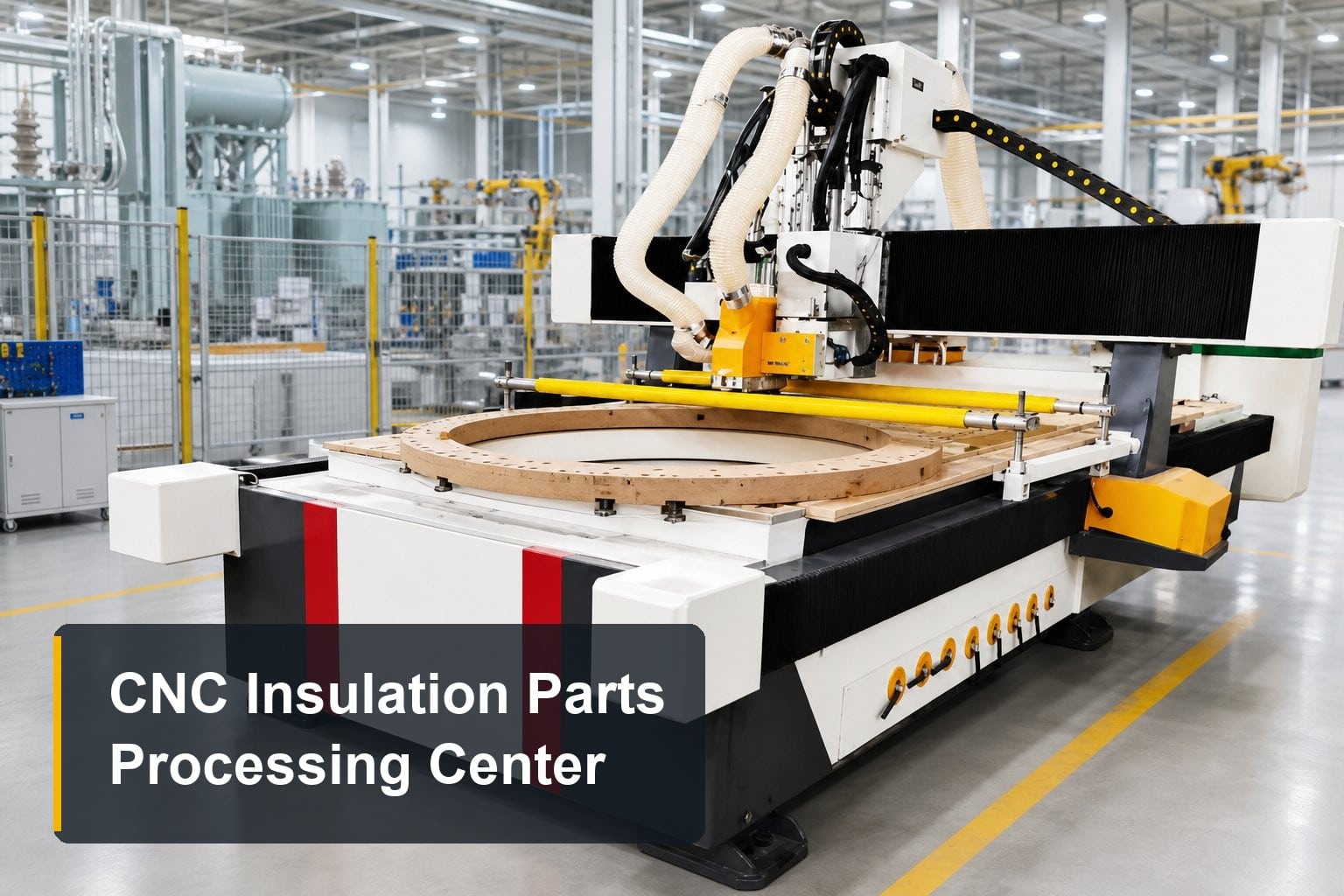
At its core, this is a large-format CNC gantry router engineered specifically for transformer insulation materials — pressboard, laminated pressboard, and densified wood — rather than for metal or generic woodworking. That distinction drives the whole design: spindle speeds, dust handling, and contamination control are all tuned to insulation material behavior.
On a single setup, the machine performs four operation families:
- Milling — inner and outer diameters of end rings, edge profiles of platens, complex contours programmed directly from CAD drawings.
- Grooving — circular grooves on end rings for winding location, straight slots and dovetail-style channels, machined to consistent depth across the full part.
- Drilling — bolt patterns and lead-exit holes in clamps and platens, positioned from the same program as the contour so hole-to-edge relationships stay exact.
- Surface machining — local surfacing and thickness correction on large laminated parts where manual planing cannot hold flatness.
The practical result is that parts which previously moved between a band saw, a drill press, and a hand router — with re-marking and re-clamping at each station — are finished in one clamping, from one program. For end rings and conductor clamps in high-voltage transformers, where a single part can carry dozens of features, this is where the cycle-time and scrap-rate gains come from.
Key Specifications to Compare Before You Buy
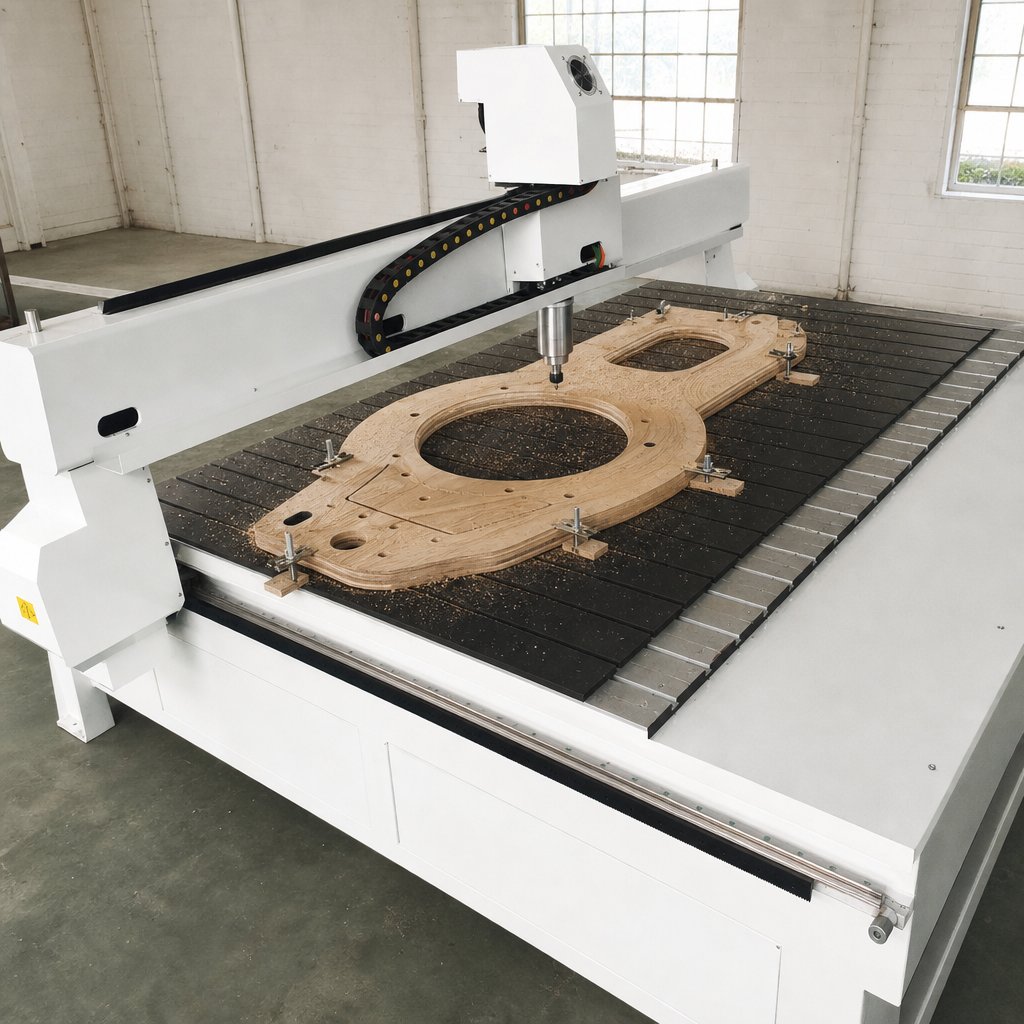
Spec sheets for gantry machining centers look similar across suppliers. These are the rows that actually determine whether the machine fits your parts:
| Parameter | Model A | Model B | What It Decides |
|---|---|---|---|
| Effective stroke (mm) | 1500 × 3000 | 3300 × 3300 | Maximum end ring OD and platen size you can machine in one setup |
| Max. processing thickness (mm) | 100 | 120 | Thickest laminated clamp or stacked assembly you can through-machine |
| XY fast traverse (m/min) | 12 | 40 | Non-cutting time between features — matters on parts with many holes |
| Z fast traverse (m/min) | 3 | 8 | Retract/plunge overhead per hole or groove start |
| XY positioning accuracy (mm) | 0.2 | 0.2 | Ring concentricity and groove position repeatability |
| Z positioning accuracy (mm) | 0.05 | 0.05 | Groove depth consistency — critical for winding fit |
| Spindle speed (r/min) | 0–24,000 | 0–18,000 | Surface finish on pressboard vs. torque for thick laminated wood |
| Spindle power (kW) | 6 | 11 | Ability to hold feed rate in 100–120 mm laminated stock |
| Worktable | Aluminum alloy T-slot | Aluminum alloy T-slot | Clamping flexibility for odd-shaped rings and clamps |
Two selection rules fall out of this table. First, size the stroke to your largest ring, not your average part — a 3300 × 3300 mm table covers power-transformer end rings that a 1500 × 3000 mm machine simply cannot clamp. Second, look at Z-axis accuracy (0.05 mm) before XY accuracy: groove depth errors show up directly as winding height variation, while a 0.2 mm XY tolerance is already well inside what pressboard assembly requires.
Spindle choice follows material. The 24,000 rpm spindle gives cleaner edge finish on thin pressboard with small-diameter tools; the 11 kW / 18,000 rpm spindle is the right call if your workload is thick laminated wood clamps where tool load, not surface speed, is the constraint.
Why Dust Removal and Anti-Metal Contamination Design Matter
Insulation parts live inside the transformer, in contact with oil and winding conductors. Two contamination risks are unique to this application and are worth asking any supplier about specifically:
- Pressboard dust is hygroscopic and conductive-adjacent. Fine dust left in grooves and holes carries moisture into the drying process and can lodge in oil ducts. A machining center for insulation work needs a high-volume extraction system shrouding the spindle — not a bolt-on shop vacuum. Look for enclosed dust hoods around the cutting zone and extraction rated for continuous fine-particle duty.
- Metal particle contamination is a failure mode, not a nuisance. Tramp metal embedded in an insulation part becomes a partial-discharge site in service. Machines repurposed from metalworking bring this risk with them — residual chips in T-slots, steel swarf in coolant channels. A purpose-built insulation machining center uses dry cutting, non-ferrous contact surfaces where possible, and an anti-metal-contamination design philosophy throughout the work zone.
These two points rarely appear in generic CNC router specifications, and they are the clearest line between a machine built for transformer insulation and a general-purpose router with a new paint job.
Processing Center vs. Sawing-Milling Combo: Which Do You Need?
Not every insulation workshop needs a full gantry center. The honest comparison is against the smaller insulation parts sawing and milling combined machine, which handles strips, spacers, and small parts at lower cost:
| CNC Processing Center | Sawing-Milling Combined Machine | |
|---|---|---|
| Best for | End rings, platens, conductor clamps, large contoured parts | Strips, spacers, blocks, small batch parts |
| Workpiece size | Up to 3300 × 3300 mm | Small to medium parts |
| Operations | Milling, drilling, grooving, surfacing from one program | Sawing + milling + drilling in sequence |
| Programming | Full CNC, CAD-driven contours | Simpler CNC or guided manual operation |
| Investment level | Higher — justified by high-voltage product mix | Lower — fast payback for distribution transformer shops |
The decision is driven by your product mix. If you build power transformers with large end rings and machined clamps, the processing center pays for itself in scrap reduction and cycle time. If your volume is distribution-class strips and spacers, the combined machine — or dedicated strip equipment like the insulation strip shaping machine — is the better capital allocation. Many factories end up running both: the center for large parts, smaller dedicated machines for high-volume simple parts.
One upstream note: the quality of what goes onto the machining center table depends on the sheet preparation. Parts beveled on a dedicated pressboard beveling machine and bonded assemblies from an end insulation bonding machine arrive flat and dimensionally stable, which is what lets the CNC program hold its 0.05 mm Z accuracy in practice.
Questions to Ask a Supplier Before Buying
Before signing, put these to any insulation parts processing center manufacturer:
- Show me a machined end ring from your machine, with a measurement report. Ask for groove depth readings around the full circle — this tests real Z-axis repeatability, not the spec-sheet number.
- How is the dust extraction system sized, and where does it discharge? Request the extraction volume (m³/h) and filtration class; ask whether the hood design is standard or an option.
- What is the anti-metal-contamination design, concretely? A serious answer names specific design features — dry cutting, sealed way covers, non-ferrous fixtures — not a generic assurance.
- Which CAD/CAM workflow ships with the machine? Confirm that ring grooves and bolt circles can be programmed parametrically (diameter in, toolpath out) rather than drawn feature by feature.
- What spindle tooling do you recommend for 100+ mm laminated wood, and what feed rates hold up? The answer tells you whether the supplier has real process experience in insulation materials.
- What installation foundation and power supply does the 3300 × 3300 model need? Gantry machines of this size have real civil and electrical requirements that affect your layout and budget.
Conclusion
A CNC insulation parts processing center is the right investment when large end rings, platens, and conductor clamps are bottlenecks or scrap sources in your insulation workshop. Size the stroke to your largest ring, prioritize Z-axis accuracy and spindle torque over headline traverse speeds, and treat dust extraction and anti-metal contamination as must-have design features rather than options. For the wider equipment picture — beveling, bonding, strip shaping, and marking — start from the complete insulation parts processing equipment guide, or tell us your part drawings and we’ll recommend a configuration.