Not every busbar job happens in a fabrication shop. Transformer installation crews, switchgear retrofit teams, and maintenance departments regularly need to cut, punch, and bend copper bar on site — in a substation, in a basement switchroom, on a retrofit job where the drawings no longer match reality. Hauling bar back to the shop for a single bracket costs a day; a portable busbar machine costs 165 kg of floor space and a 220 V outlet.
This guide covers what the portable busbar processing machine does, the specifications that define the class, and how to decide between a portable unit, a floor-standing 3-in-1, and a full CNC line. For the category overview, see our busbar processing machine guide.
What a Portable Busbar Machine Is
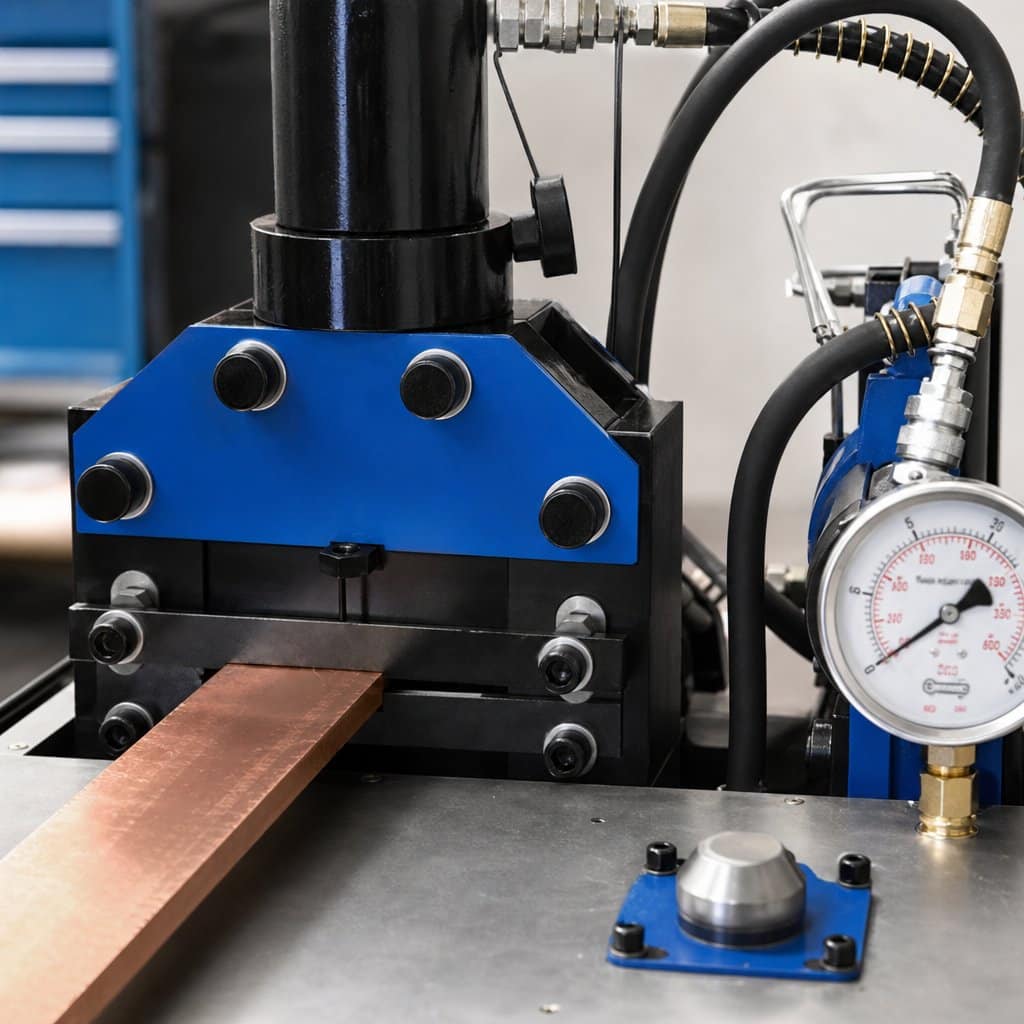
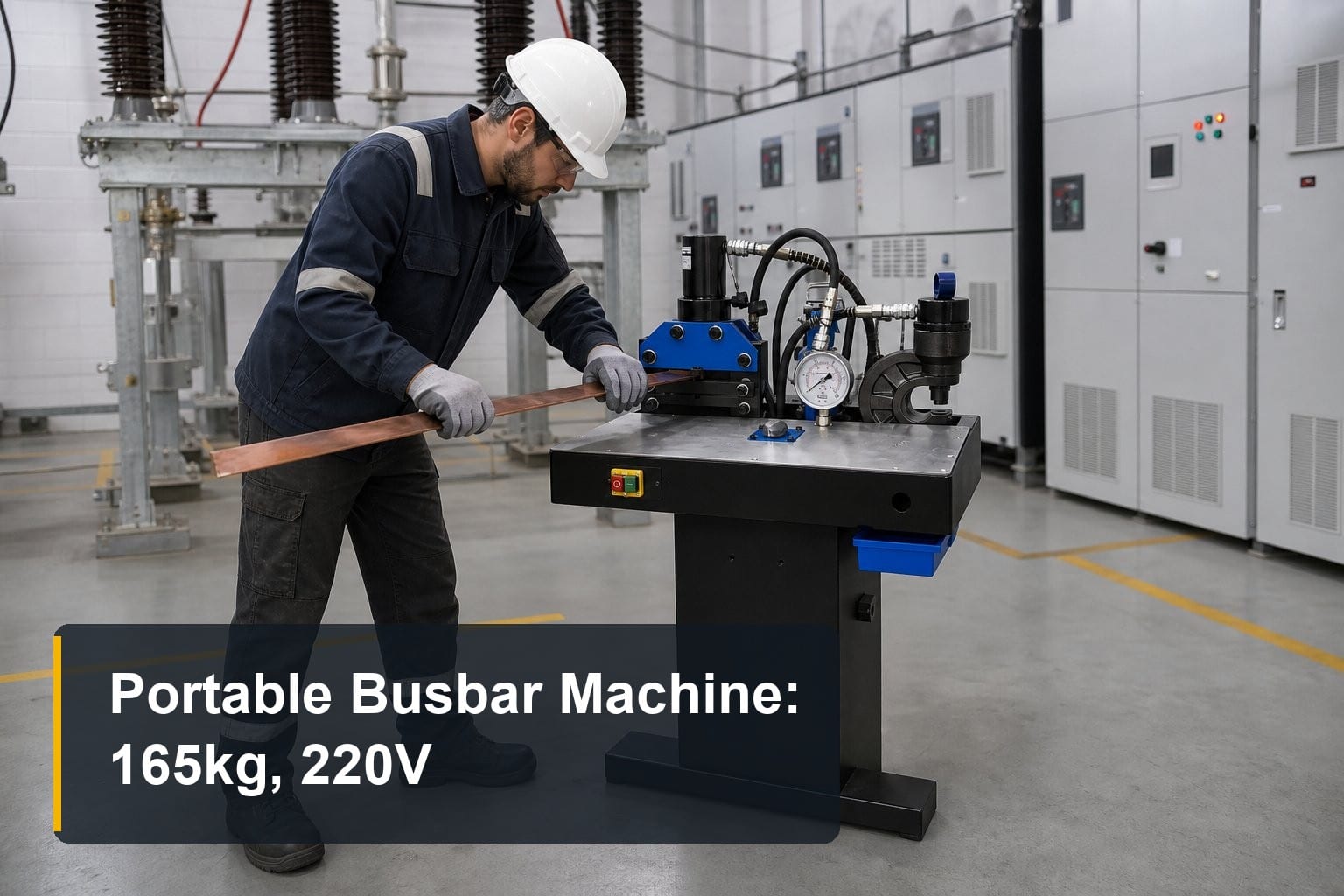
A portable busbar machine is a compact hydraulic 3-in-1 — shearing, punching, and flat bending — built onto a single pedestal roughly the size of a workshop bench (700 × 700 × 1100 mm). It is not a cut-down version of a floor machine; it is designed around a different job: the machine goes to the work, not the other way round.
Three design choices make that possible:
- Weight: 165 kg. Two people can move it; a small van can carry it. Compare that with 1370 kg for a floor-standing 3-in-1.
- Single-phase 220 V, 50 Hz power. It runs from any standard site supply — no three-phase drop, no electrician visit before first use. For site work and developing-market installations, this is often the deciding spec.
- Self-contained hydraulics. The pump, gauge, and stations are mounted on one frame; setup on arrival is wheeling it into place and plugging it in.
The typical users: transformer factories processing lead-connection bars, MV/LV switchgear workshops, electrical panel builders, and — the use case no stationary machine covers — on-site installation, maintenance, and retrofit crews fabricating busbar to fit as-built conditions.
Capabilities and Key Specifications
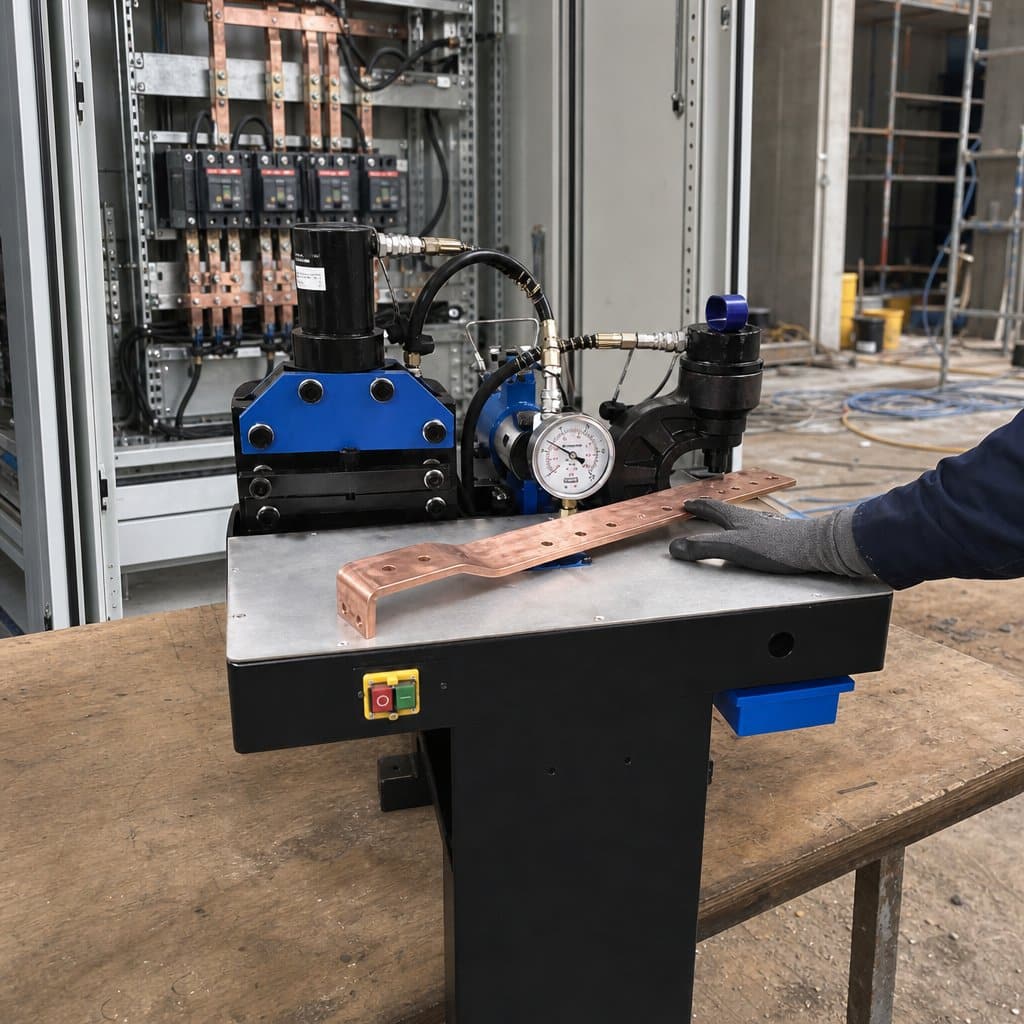
Honest specifications for the portable class, using the standard model as reference:
| Parameter | Value | What It Decides |
|---|---|---|
| Functions | Shearing + punching + flat bending | The complete cut-punch-bend sequence in one unit |
| Max. busbar size (shear & bend) | 150 × 10 mm copper | Covers most distribution transformer and switchgear connection bars |
| Bending angle range | 0°–135° | Flat bends for connection layouts and cabinet wiring |
| Hole center-to-edge distance | 95 mm / 110 mm | How far inboard a hole can sit on wide bar |
| Standard dies | 6 punching die sets + 1 flat bending die | Hole sizes covered out of the crate |
| Input voltage | Single-phase 220 V, 50 Hz | Runs anywhere; no three-phase required |
| Machine weight | 165 kg | Two-person move; van transportable |
| Footprint | 700 × 700 × 1100 mm | Fits a maintenance room corner |
Two boundaries to respect. First, the 150 × 10 mm ceiling is real — hydraulics sized for portability cannot shear 12 × 160 mm bar; if your regular work exceeds the rating, this is the wrong machine. Second, bending is flat bending only — no vertical (edge) bending, no U-bends, no lug pressing. For those operations you need a floor-standing machine like the 3-in-1 busbar machine with its closed bending structure.
Portable vs. Floor-Standing 3-in-1 vs. CNC Line
| Portable (165 kg) | Floor 3-in-1 (350 kN) | CNC Punching & Shearing Line | |
|---|---|---|---|
| Where it works | On site, maintenance rooms, small shops | Fabrication workshop | Production floor |
| Busbar capacity | ≤150 × 10 mm | ≤12 × 160 mm | Up to 16 × 200 mm+ |
| Bending | Flat bends 0–135° | Flat, vertical, U-bend, embossing, lug pressing | Pair with servo CNC bender |
| Power | Single-phase 220 V | Three-phase | Three-phase |
| Setup | Wheel in, plug in | Foundation-free but fixed | Installed line |
| Best for | Site work, spares, small batches | Mixed small-mid batch production | Daily volume production |
The pattern we see in practice: factories running a CNC line or floor 3-in-1 for production still keep a portable unit for the installation team — the two are complements, not competitors. If you are sizing a production line rather than a site tool, our 400 kN vs 600 kN comparison is the right starting point.
A Typical On-Site Workflow
The value of the portable class shows up in the sequence of a real job. A retrofit crew arrives at a switchroom where an added feeder needs a new connection bar — and the as-built dimensions differ from the drawing by 20 mm. With a portable machine on site, the workflow is: measure the as-built span, cut the bar to length on the shearing station, set the punching stop and punch the mounting holes (no marking-out, no drill press, no deburring afterward), then flat-bend to the required offset angle. One operator, one machine, and the part is test-fitted within the hour.
The same job without the machine means measuring, sending dimensions to the fabrication shop, waiting for the part, and a second site visit if anything is off. For service businesses, the portable machine typically pays for itself not in parts cost but in eliminated return trips — the most expensive line item in field work.
In the factory, the same machine earns its floor space differently: as a spares-and-prototypes station that keeps the production line running. When the CNC line is busy with a volume order, small-batch and one-off parts go to the portable unit instead of interrupting the production setup.
What to Check Before Buying
- Confirm your largest bar against the 150 × 10 mm rating — with margin. A machine running at its limit every day wears its hydraulic seals fast.
- Count the dies in the crate. Six punching die sets plus a flat bending die should be standard; ask which hole diameters they cover and what additional dies cost.
- Check the hole center-to-edge distance (95/110 mm) against your widest bar’s hole pattern — this is the spec that quietly rules machines out.
- Verify the plug and voltage for your market. Single-phase 220 V / 50 Hz is standard; confirm plug type and any 60 Hz requirement before shipping.
- Ask about spare seals and wear parts. A portable machine on a remote site needs a seal kit in the toolbox, not a service visit.
Conclusion
A portable busbar machine is the cheapest way to stop sending busbar work back to the shop: 165 kg, single-phase 220 V, and the full cut-punch-bend sequence for bar up to 150 × 10 mm. Buy it for site work, maintenance, and small-batch flexibility; look to a floor-standing 3-in-1 or CNC line when volume or bar size outgrows it. To compare all the configurations side by side, start from the busbar processing machine guide — or tell us your bar sizes and work scenario, and we’ll point you to the right machine.