TL;DR: A foil winding machine builds transformer coils from continuous copper or aluminum foil instead of round wire, integrating foil feeding, tension control, edge alignment (±0.5 mm), TIG welding, and insulation insertion in one automated pass. Foil-wound coils achieve near-100% fill factor, better heat dissipation, and stronger short-circuit withstand than wire-wound coils — which is why foil winding is the standard for distribution transformer LV windings from roughly 50 kVA to several MVA.
What is a foil winding machine? It is an automated system that forms transformer coils from continuous metal foil rather than round or rectangular wire. Within the wider family of transformer coil winding machines, foil winders occupy the low-voltage, high-current niche. This article explores what the machine does, how it operates, and why manufacturers increasingly choose foil-wound coils — a key stage in the overall transformer manufacturing process.
Understanding Foil Winding Machines
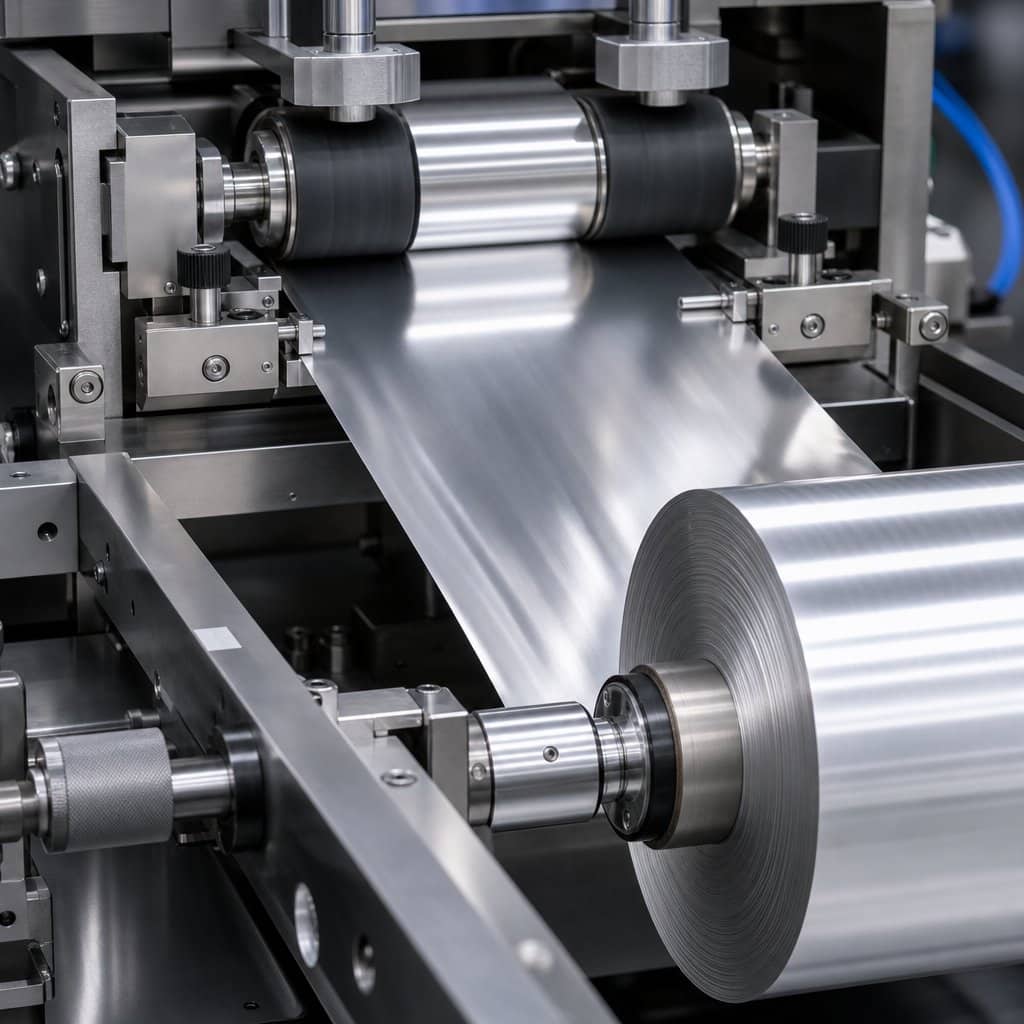
A foil winding machine is a specialized production asset used primarily for low-voltage windings in distribution transformers. Understanding what the machine is and the components it relies on makes its value clear before examining how it runs.
Definition and Core Function
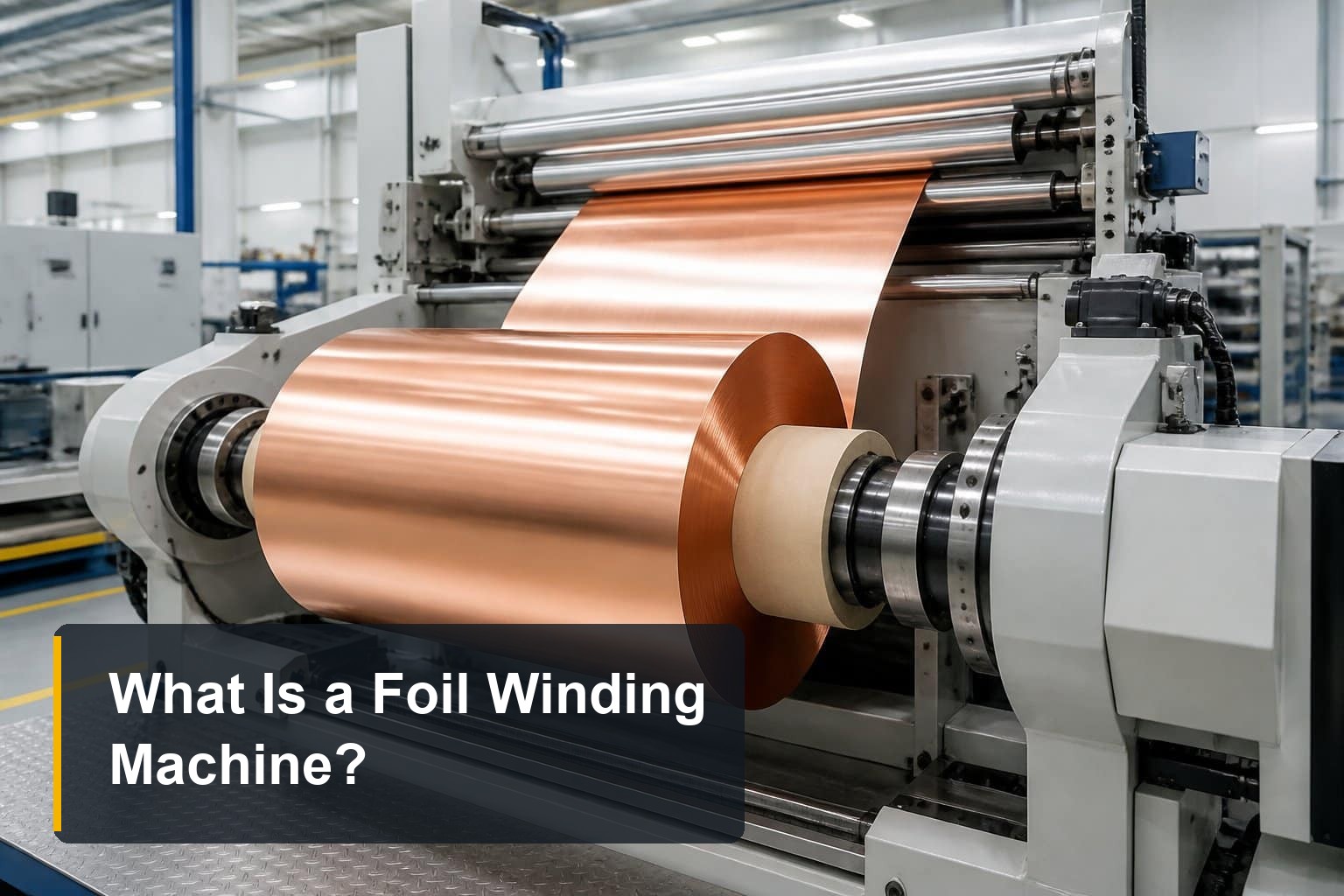
In the simplest terms, a foil winding machine winds a flat, wide conductor around a mandrel to create a coil. Unlike wire winding, where many thin conductors are laid side by side, foil winding uses a single strip of copper or aluminum. The foil width corresponds to the coil’s axial height, so a complete layer forms with each single turn. This construction produces compact, mechanically robust coils with excellent electrical properties.
Key Components
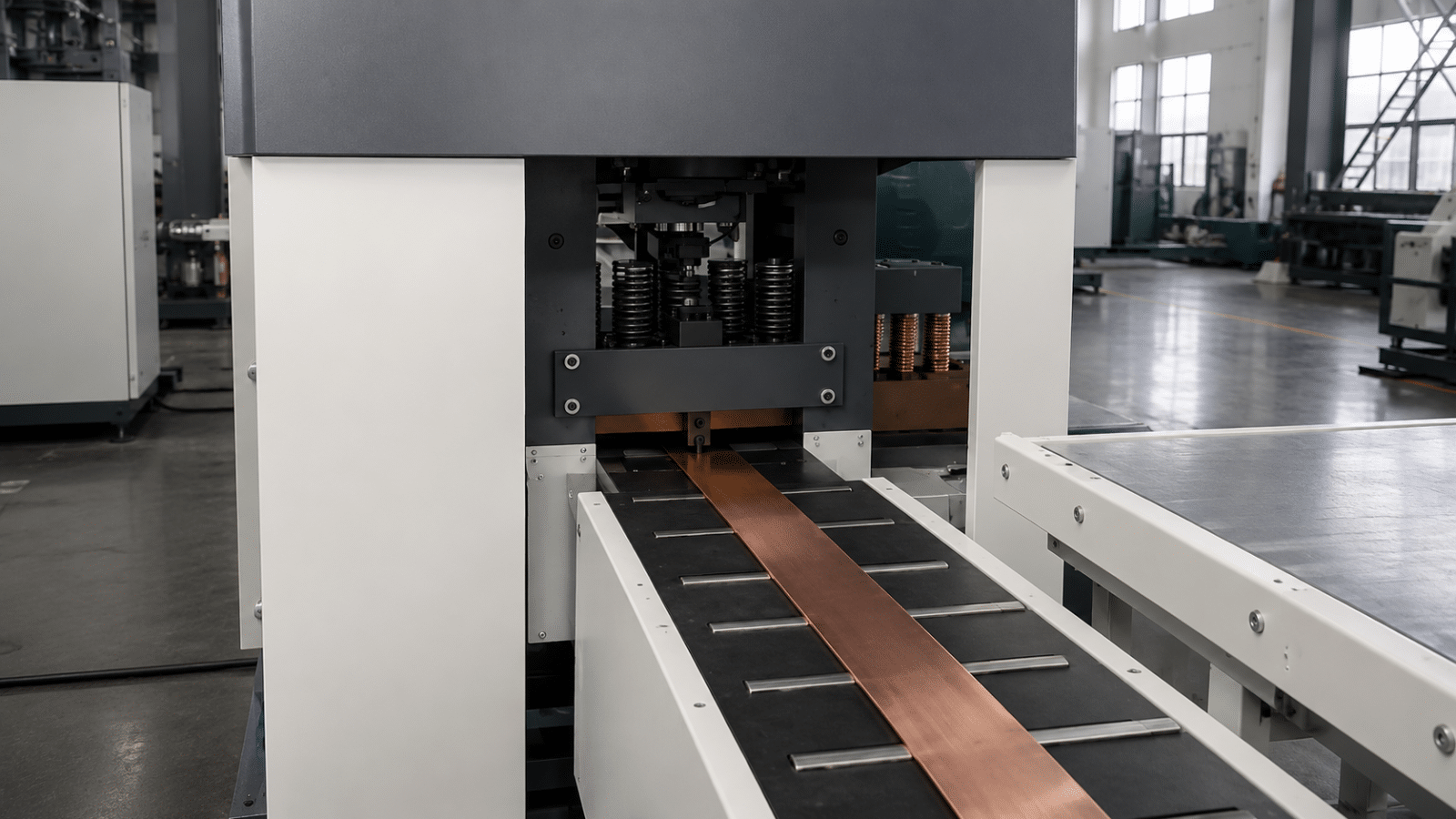
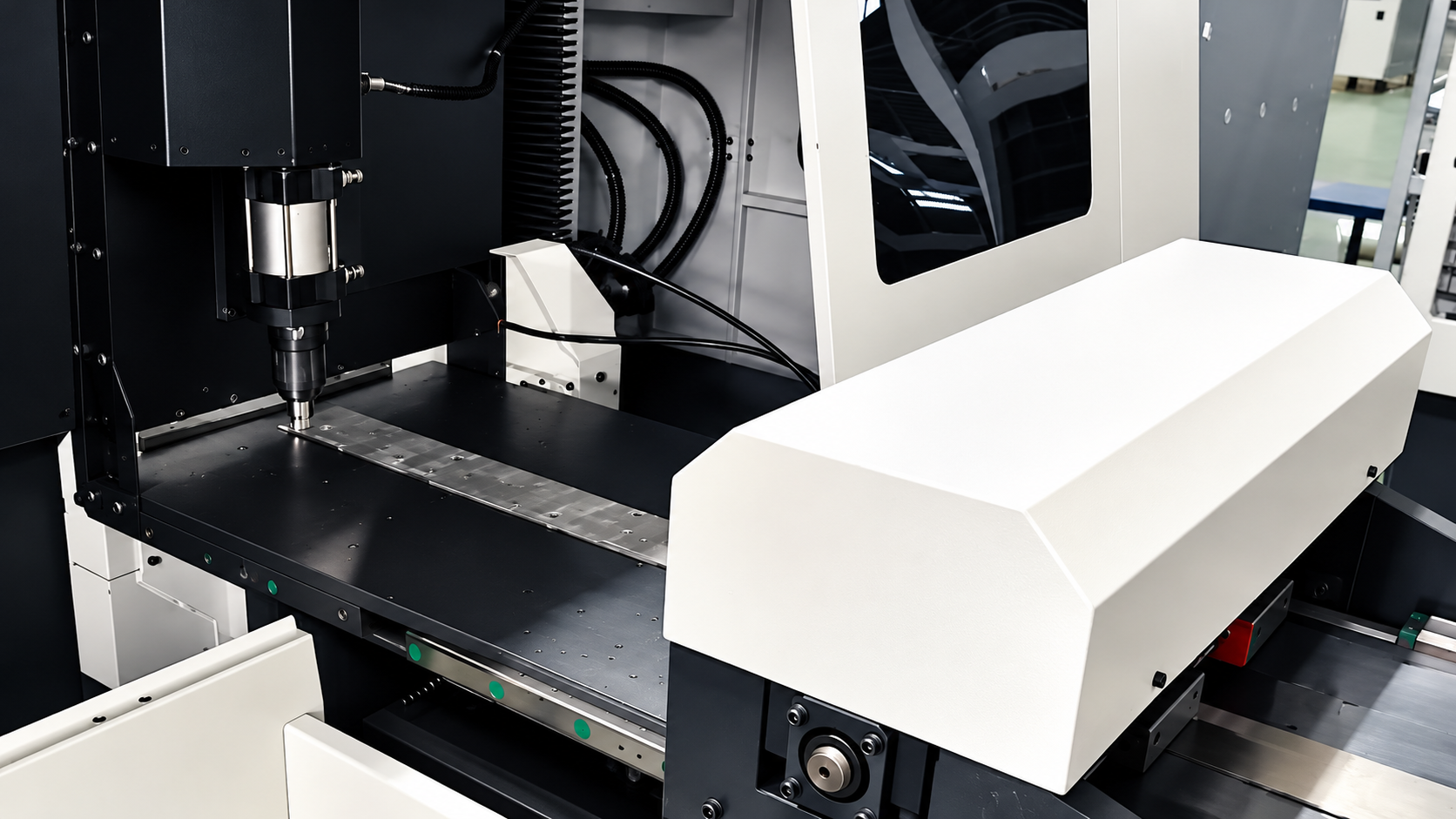
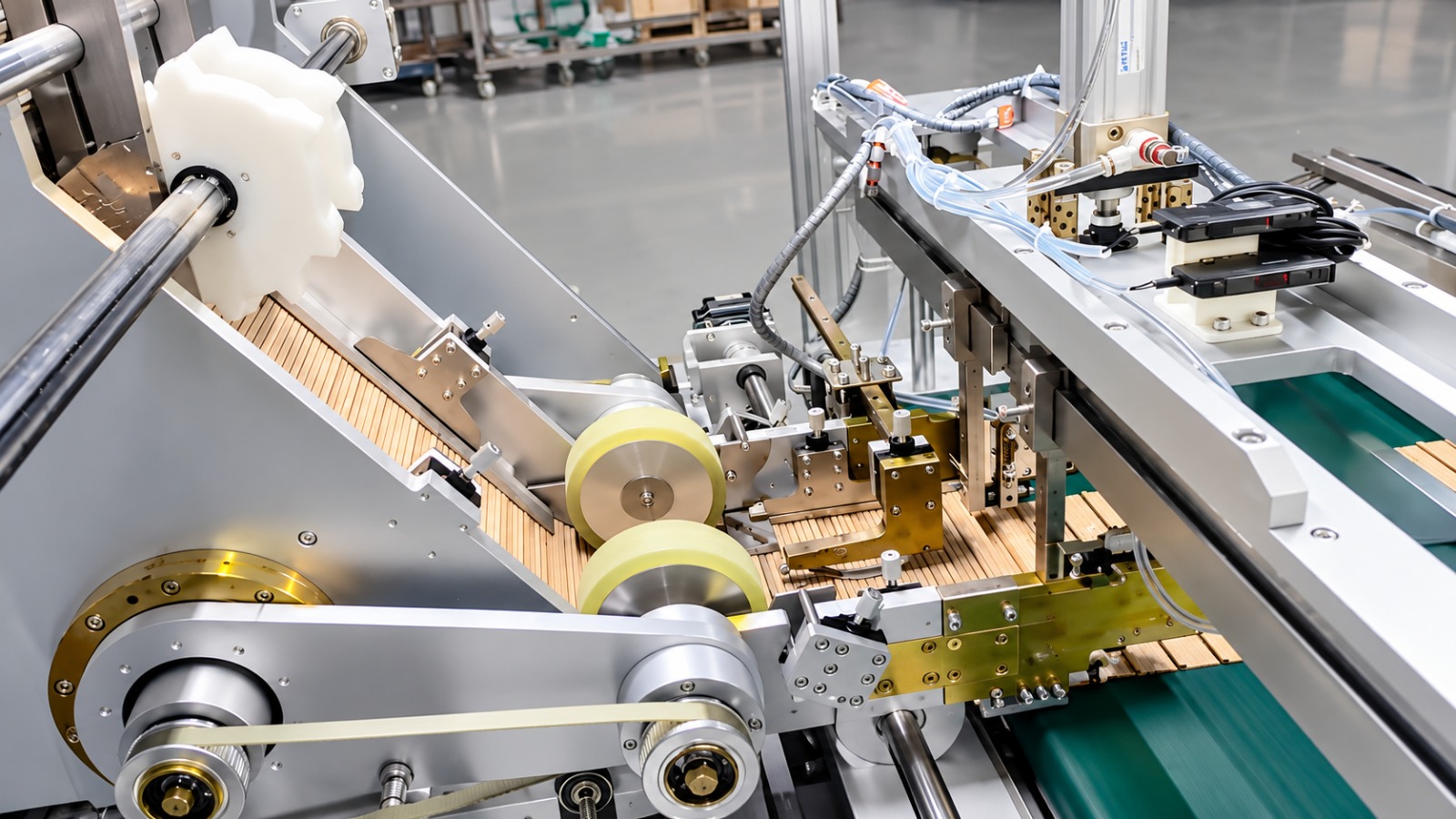
Every foil winding machine combines several subsystems into one line. A decoiler feeds foil from a spool, while a tension control system keeps the strip uniformly tight. Edge alignment sensors guide the foil so its edges stay flush. A welding station attaches leads and cross-over connections, and an insulation feeding unit inserts paper or film between layers. A winding mandrel and clamping system form the coil body, all coordinated by a PLC controller.
Types of Foil Winding Machines
Machines are broadly divided by configuration and automation level — vertical or horizontal axis, single- or double-head, semi-automatic or full CNC. The most practical distinction for buyers is layer count: a single-layer foil winding machine winds one foil at a time (copper 0.35–2.2 mm, aluminum 0.35–2.6 mm), while a double-layer foil winding machine winds two foils simultaneously (0.7–4.4 mm combined copper) for higher throughput and coil strength. Both handle coils up to 1000 mm outer diameter and 1600 mm axial height with ±0.5 mm edge correction accuracy.
How a Foil Winding Machine Works
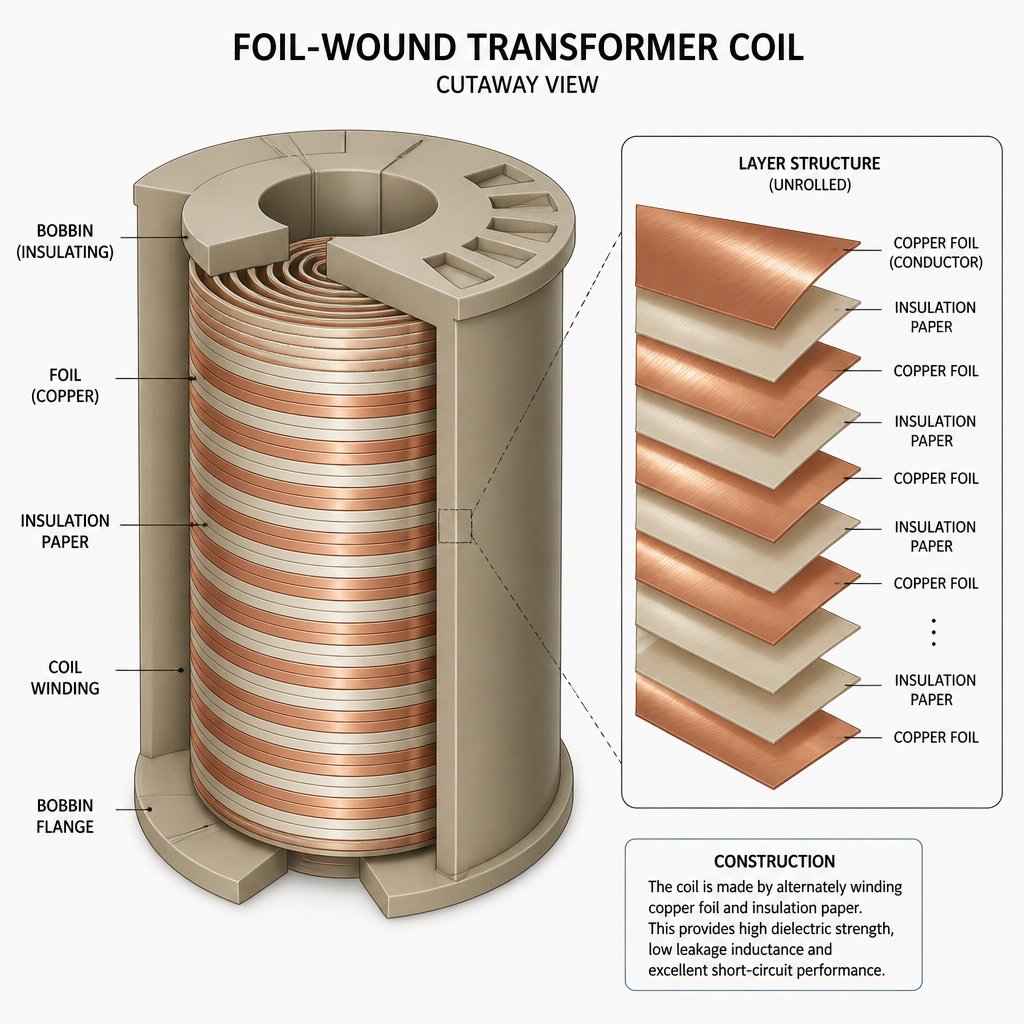
The working principle centers on precisely controlled feeding and winding of foil under constant tension. Each stage must be tightly synchronized so that every layer is uniform, flat, and properly insulated.
The Foil Winding Process Step by Step
The process begins when the decoiler feeds foil through a straightening unit and into the tension zone. The foil then passes edge alignment sensors before reaching the mandrel, where it is wound under preset tension at speeds up to 30 rpm. As the coil builds, the insulation feeder lays a paper or film layer between each foil turn. When a layer or the coil is complete, the welding station attaches the required lead, and the cycle continues until the specified turns are reached.
Tension and Edge Alignment Control
Consistent tension is critical because uneven pulling causes wrinkles or loose turns that weaken the coil. Modern machines use pneumatic or magnetic powder brakes with closed-loop feedback to hold tension within a narrow band. Edge alignment is equally important: if the foil edge wanders, the insulation margin shrinks and shorted turns become possible. Optical sensors continuously correct lateral drift, holding edges flush within ±0.5 mm.
Welding and Insulation Layer Insertion
Foil winding machines incorporate welding stations to join lead bars to the foil and to create cross-over connections between layers. TIG welding at 0–0.7 m/min is the common choice for copper and aluminum foil, selected by foil material and thickness. At the same time, the insulation feeder supplies paper or polyester film of a preset width between turns, guaranteeing electrical separation and the required creepage distance in the finished coil.
Why Foil Winding Improves Transformer Performance
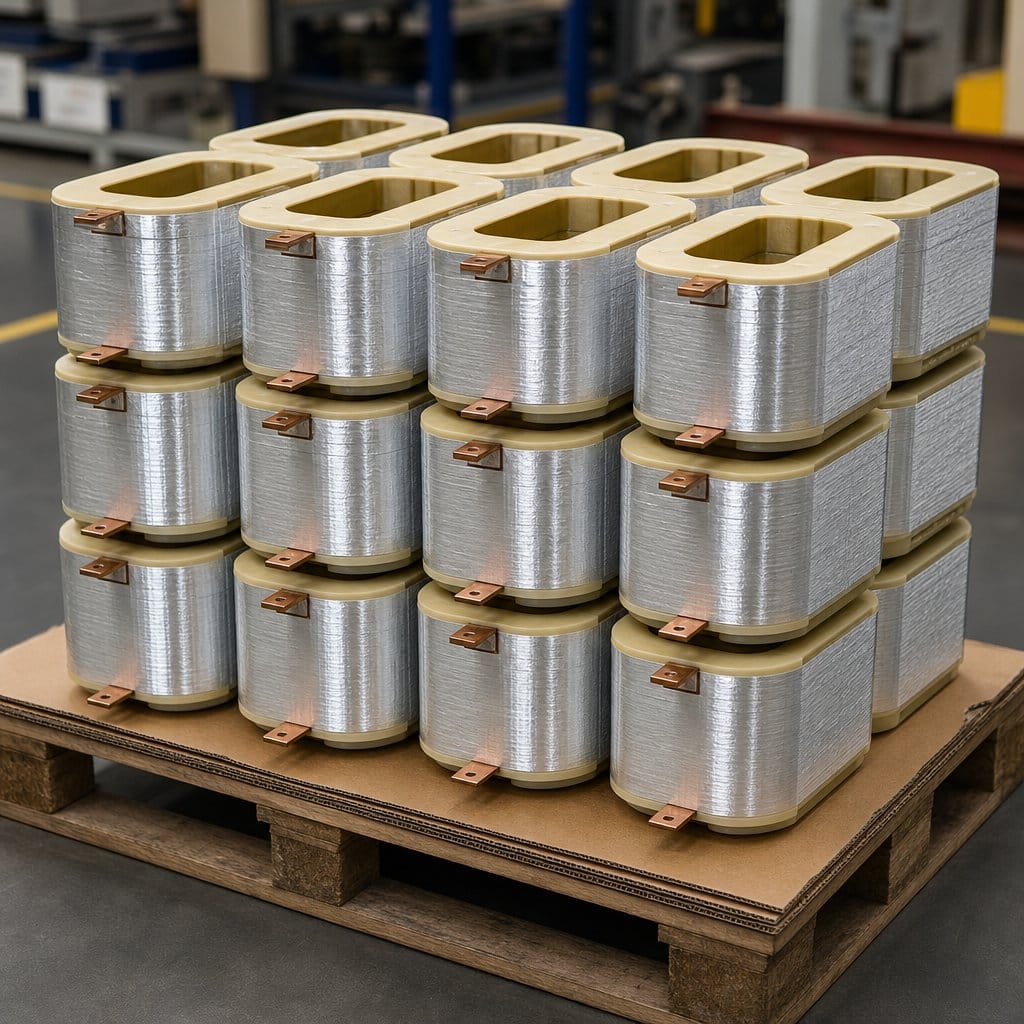
Manufacturers adopt foil winding because it delivers measurable gains in electrical, thermal, and mechanical performance while lowering production cost. These benefits explain why the technology became dominant in distribution transformer manufacturing.
Higher Fill Factor and Efficiency
A foil conductor fills nearly the entire winding window, whereas round wire leaves gaps between adjacent conductors. This near-100% fill factor shortens the magnetic path, reduces stray losses, and improves cooling because the foil’s large flat surface conducts heat away efficiently. The result is a smaller, lighter, and more efficient transformer for the same rating.
Stronger Short-Circuit Withstand
Short-circuit forces act axially on transformer windings and are among the most common causes of field failure. Foil-wound coils are inherently strong in the axial direction because each turn is a solid band of metal rather than many separate strands. This construction distributes mechanical stress evenly and dramatically improves the transformer’s ability to survive through-faults without deformation.
Faster Production and Lower Cost
Because a single foil turn covers an entire layer, foil winding is far faster than laying dozens of wire strands. Automated tension, alignment, and insulation handling also reduce manual labor and rework — modern single-layer machines can be installed and in production within hours. The combined effect lowers per-unit manufacturing time and cost, which is why most distribution transformer producers run foil winding machines for their low-voltage coils.
Frequently Asked Questions
What materials can a foil winding machine handle?
Foil winding machines most commonly process copper and aluminum foil. Aluminum is popular for low-voltage distribution coils because of its lower cost and weight, while copper is used where higher conductivity or smaller size is required. Typical ranges are 0.35–2.2 mm for single-layer copper foil (0.35–2.6 mm aluminum) and up to 4.4–5.4 mm combined on double-layer machines.
How is foil winding different from wire winding?
Wire winding places many thin round or rectangular conductors side by side, while foil winding uses a single wide strip. Foil winding delivers a higher fill factor, better short-circuit strength, and faster production, but it is generally limited to low-voltage, high-current windings. Wire winding remains common for high-voltage windings where many turns and fine insulation grading are needed.
How much does a foil winding machine cost?
Price depends on configuration, automation level, foil width and thickness range, and coil size capacity. A basic semi-automatic machine costs considerably less than a fully automatic CNC line with integrated welding and double-head capability. Buyers should request a detailed quotation that matches the machine specification to their coil designs rather than comparing headline prices alone.
How do I choose a reliable foil winding machine supplier?
Look for a supplier with verifiable experience in transformer manufacturing equipment, not just general machinery. Evaluate machine rigidity, tension and edge alignment accuracy, welding quality, and after-sales support. A supplier that also understands transformer process know-how can help you match the machine to your specific coil specifications and production volume.
Summary
A foil winding machine is a specialized automated system that builds transformer coils from continuous metal foil, integrating tension control, edge alignment, welding, and insulation insertion into one process. The result is a coil with a high fill factor, excellent short-circuit strength, and lower manufacturing cost — which is why foil winding dominates low-voltage distribution transformer production.
Choosing between single-layer and double-layer foil winding? Send us your coil drawings and target output — we will recommend the configuration that fits.
📞 Phone: +86-15958243831
📧 Email: sales@tranfovia.com
💬 WhatsApp: https://wa.me/8615958243831
🌐 Website: tranfovia.com
References
- IEC 60076-1: Power transformers — General
- IEEE C57.12.00 — General Requirements for Liquid-Immersed Transformers
- ASTM B209/B209M — Aluminum and Aluminum-Alloy Sheet and Plate
- Magnet Wire and Winding Conductor Fundamentals
- Copper Development Association — Copper in Transformers
- Tranfovia — Transformer Manufacturing Equipment