TL;DR: Vapour phase drying (VPD) heats transformer insulation with condensing solvent vapour instead of hot air — and condensation transfers heat so efficiently that large and ultra-high-voltage units dry faster, more uniformly, and more deeply. Hot-air vacuum drying remains the economical choice for distribution-class transformers, but once voltage class and unit size climb, VPD’s cycle time, deep-moisture removal, and ability to reprocess oil-impregnated repair units make it the standard. This comparison explains the physics, the head-to-head differences, and when each technology earns its place.
Ask any UHV transformer manufacturer what sits at the heart of their insulation process and you will hear the same answer: the vapour phase drying plant. Yet many factories still specify conventional hot-air vacuum drying by default — sometimes past the point where it stops making sense. This article compares the two technologies honestly: where hot air wins, where vapour phase drying equipment wins, and how to tell which side of the line your production sits on. It is part of our transformer drying, impregnation and casting equipment guide.
How Each Technology Actually Heats the Insulation
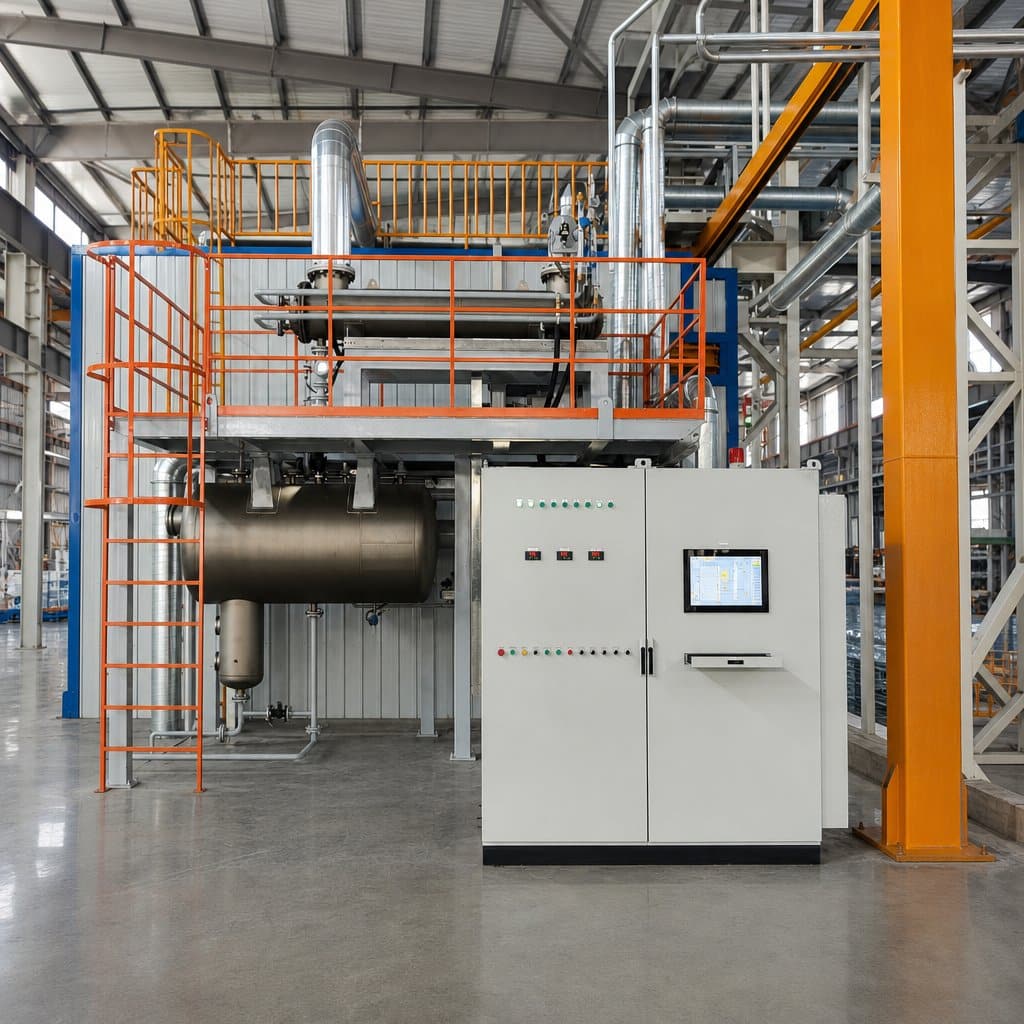
Hot-air vacuum drying circulates heated air (or uses heating plates) inside a vacuum chamber. Heat travels from the chamber to the winding surface, then conducts slowly inward through layers of cellulose. It works — but the heat transfer coefficient of hot gas is low, so large masses of insulation take a long time to reach target temperature all the way through.
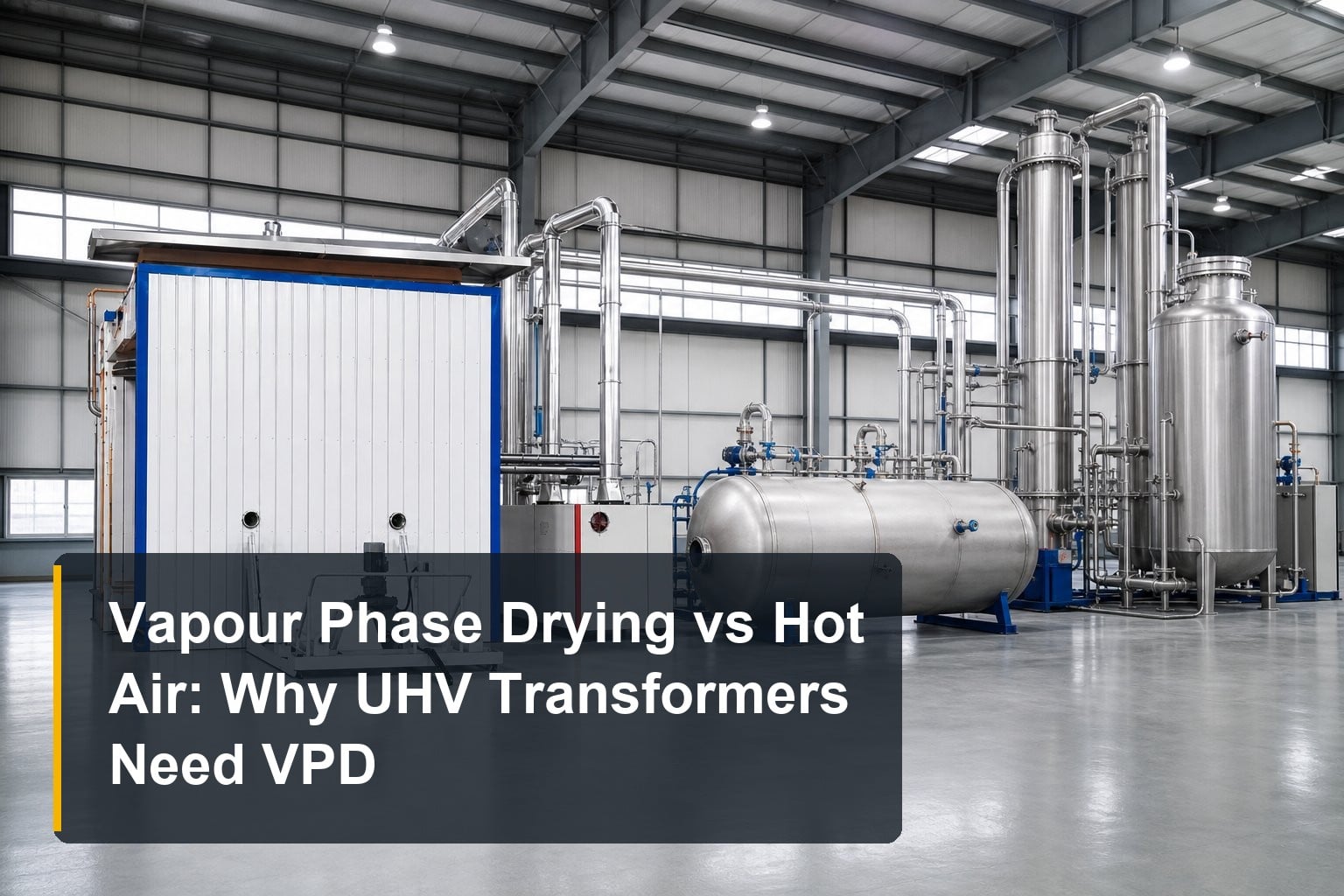
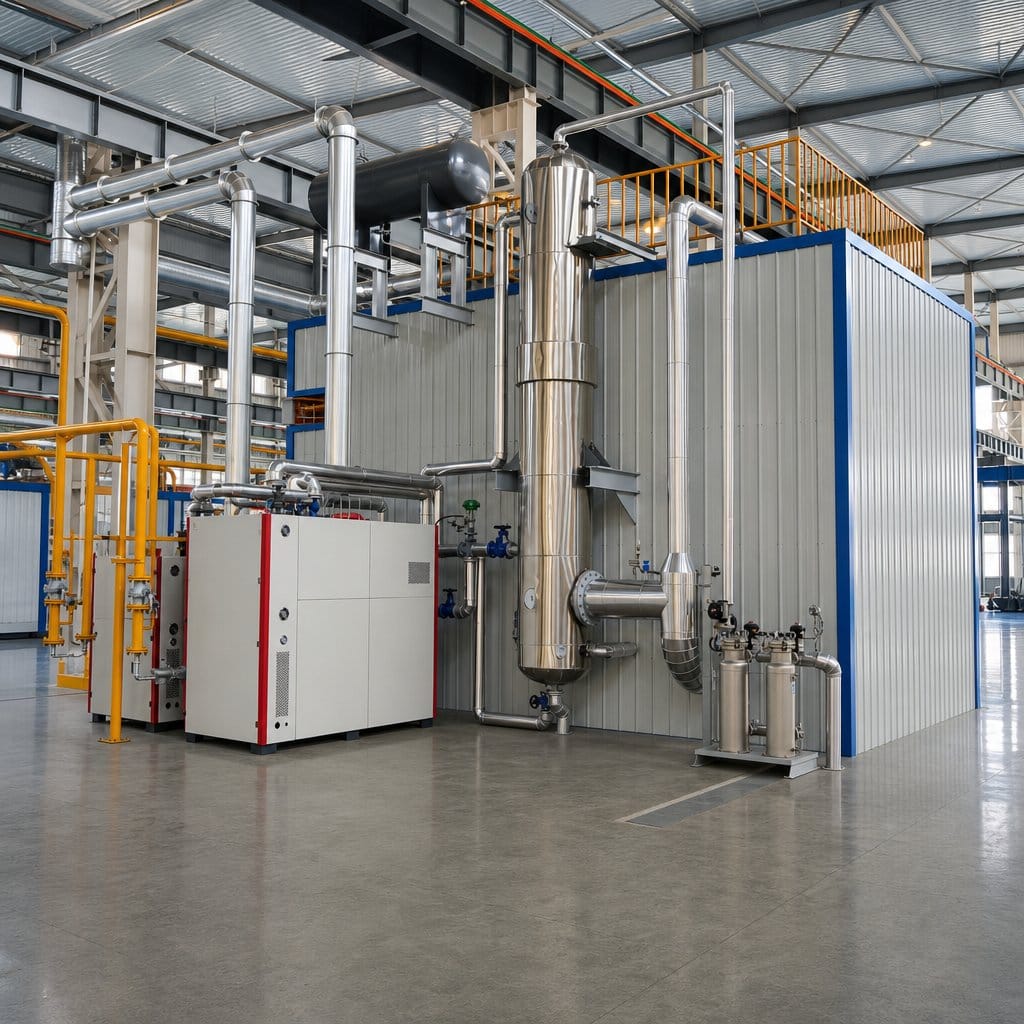
Vapour phase drying evaporates a solvent (a kerosene-type medium) and lets the hot vapour flow over the insulation inside the vacuum tank. Wherever the vapour touches a cooler surface, it condenses — and condensation releases the full latent heat of vaporization directly into that spot. The heat transfer coefficient is dramatically higher than hot air, and there is a built-in bonus: vapour condenses preferentially on the coldest, wettest zones, so heat goes exactly where the moisture is. The condensed solvent also washes the insulation — a cleaning effect that matters when reprocessing oil-impregnated repaired units.
Vapour Phase Drying vs Hot Air: Head-to-Head
| Dimension | Hot-Air Vacuum Drying | Vapour Phase Drying |
|---|---|---|
| Heat transfer | Low — convection through hot gas | Very high — latent heat released on condensation |
| Heating uniformity | Surface-first; core of large windings lags | Self-regulating — vapour condenses on the coldest zones first |
| Cycle time on large units | Long; grows steeply with unit size | Short and predictable, even on UHV units |
| Deep moisture removal | Adequate for thin insulation structures | Superior — heat reaches deep insulation fast, so moisture migrates out fully |
| Repaired / oil-impregnated units | Difficult — old oil blocks drying | Yes — the solvent vapour cleans as it dries |
| Investment and operating complexity | Lower; simpler system | Higher; solvent handling and distillation required |
| Best fit | Distribution and mid-size transformers | UHV transformers, instrument transformers, capacitor bushings, repair work |
Why UHV Transformers Specifically Need VPD
Three properties of ultra-high-voltage units push the decision toward vapour phase:
Insulation mass. A 500 kV winding carries many times the cellulose of a distribution unit. With hot air, the outer layers reach temperature hours before the inner structure does — and drying only finishes when the coldest point is dry. Condensation heating collapses that gradient, which is why VPD cycle times stay short and predictable as units grow.
Moisture limits. UHV insulation must reach extremely low residual moisture to survive factory tests and decades of service. Fast, uniform heating lets deep moisture migrate out before the surface case-hardens — the condition that traps water inside thick insulation under slower heating.
Economics of cycle time. A UHV active part is enormously expensive work-in-progress. Every day it spends in the drying tank is capital standing still. VPD’s shorter cycle directly increases the throughput of the most constrained station in the factory — and the same system can take in oil-impregnated repaired units that hot-air plants cannot handle, which is why repair and service operations standardize on vapour phase.
When Conventional Vacuum Drying Is Enough
VPD is not universal. For distribution transformers and mid-size power units, a modern vacuum drying system — hot-air circulation under vacuum, with micro-water monitoring and high-efficiency heating plates that cut cycles by 30–50% — dries thoroughly at a fraction of the investment and without solvent handling — see our guide to vacuum drying process and monitoring. The crossover point is roughly where insulation thickness and unit value make cycle time and deep-drying quality worth the solvent plant: in practice, 220 kV and above, instrument transformers, capacitor bushings, and any operation that reprocesses repaired units.
Whichever technology dries the active part, the next station is the same — vacuum oil filling equipment fills the tank before the insulation can re-absorb moisture from the atmosphere.
Selecting VPD Equipment: Specifications to Compare
Vapour phase plants are engineered systems, so compare on capacity ratings rather than catalog features. The standard VPD range scales by evaporator power:
| Model | Evaporator Power | Main Condenser Power | Drying Tank |
|---|---|---|---|
| VPD-250 | 250 kW | 200 kW | Square horizontal, -0.1~0 MPa, size customized |
| VPD-300 | 300 kW | 250 kW | Square horizontal, -0.1~0 MPa, size customized |
| VPD-400 | 400 kW | 300 kW | Square horizontal, -0.1~0 MPa, size customized |
| VPD-500 | 500 kW | 400 kW | Square horizontal, -0.1~0 MPa, size customized |
| VPD-600 | 600 kW | 500 kW | Square horizontal, -0.1~0 MPa, size customized |
Three points to verify beyond the table:
- Tank dimensions and vacuum rating — sized to your largest active part, with the pressure envelope (-0.1 to 0 MPa) confirmed for your process
- External evaporator option — enables independent distillation, so contaminated solvent from repair work can be processed without stopping production
- Parameter recording — full process records are what let you prove dryness to customers and auditors, cycle after cycle
Frequently Asked Questions
Why does vapour phase drying heat so much faster than hot air?
Condensation. When solvent vapour condenses on a cooler surface, it releases its full latent heat of vaporization directly into that spot — a far higher heat transfer coefficient than hot gas convection. The vapour also condenses preferentially on the coldest, wettest zones, so heat distribution is self-regulating.
Can vapour phase drying handle repaired transformers?
Yes — this is one of its signature strengths. The condensing solvent washes old oil out of the insulation while heating it, so oil-impregnated repaired units can be reprocessed. An external evaporator configuration adds independent distillation for the contaminated solvent.
Is vapour phase drying worth it for distribution transformers?
Usually not. Distribution-class insulation is thin enough that modern vacuum hot-air drying — especially with high-efficiency heating plates and micro-water monitoring — reaches target dryness economically. VPD earns its premium at high voltage classes, large unit sizes, and repair work.
What solvent does VPD use, and is it recovered?
VPD uses a kerosene-type heat-transfer medium circulating in a closed loop: evaporated, condensed on the insulation, collected, and re-distilled for reuse. The closed-loop design is what makes the process clean and economical despite the solvent volume.
Summary: Condensation Is the Difference
Both technologies dry insulation under vacuum; the difference is how heat arrives. Hot air creeps in from the surface, while condensing vapour delivers latent heat exactly where the insulation is coldest and wettest. Below the UHV threshold, modern vacuum drying is the rational choice; at 220 kV and above, on large units, and in repair work, vapour phase drying is the technology the industry standardizes on — for cycle time, for deep dryness, and for the cleaning action no hot-air system can match.
Deciding between vacuum and vapour phase drying? Tell us your voltage classes, largest unit dimensions, and monthly throughput — we will recommend the technology and the model size, with the specifications to put in your RFQ.
📞 Phone: +86-15958243831
📧 Email: sales@tranfovia.com
💬 WhatsApp: https://wa.me/8615958243831
🌐 Website: tranfovia.com