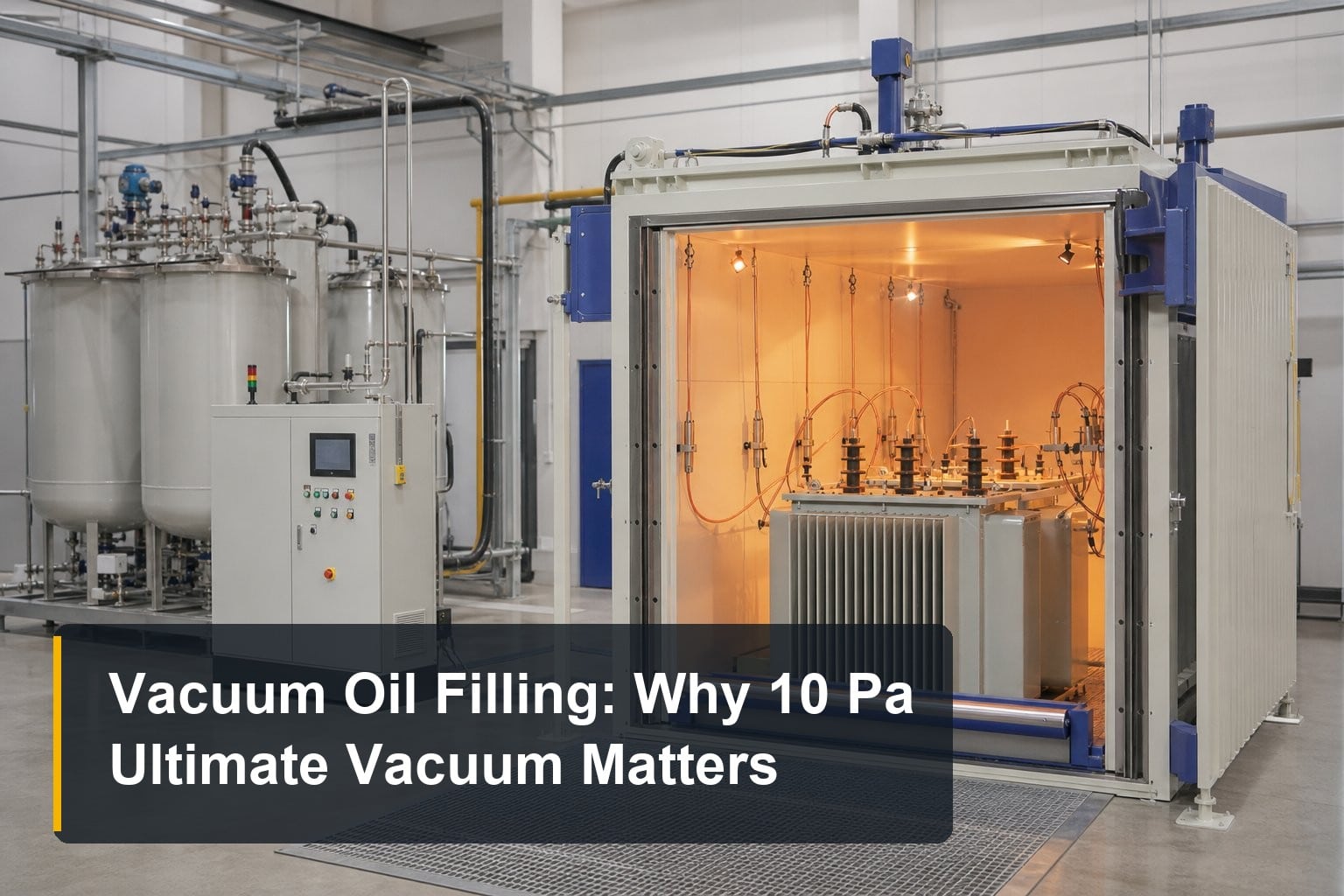
TL;DR: Vacuum oil filling equipment fills a transformer’s tank with insulating oil under deep vacuum so that no air or moisture re-enters the freshly dried insulation. The benchmark to look for is an ultimate vacuum of 10 Pa — at that pressure, the residual air left in the tank is small enough that partial-discharge risk drops away. Dual control by flowmeter and liquid level gauge, oil temperature management from room temperature to 60°C, and full parameter recording complete the specification. This guide explains why each of these numbers matters.
A transformer can spend days in the drying chamber getting its insulation moisture below target — and lose it all in an afternoon if oil filling is done carelessly. Filling at atmospheric pressure traps air bubbles in the winding structure and lets humid ambient air back into insulation that was just dried. Vacuum oil filling equipment exists to protect the investment the drying station just made. This article — part of our drying, impregnation and casting equipment guide — explains the process and the specifications that separate a real vacuum filling system from a pump and a hose.
Why Air in the Oil Is the Enemy
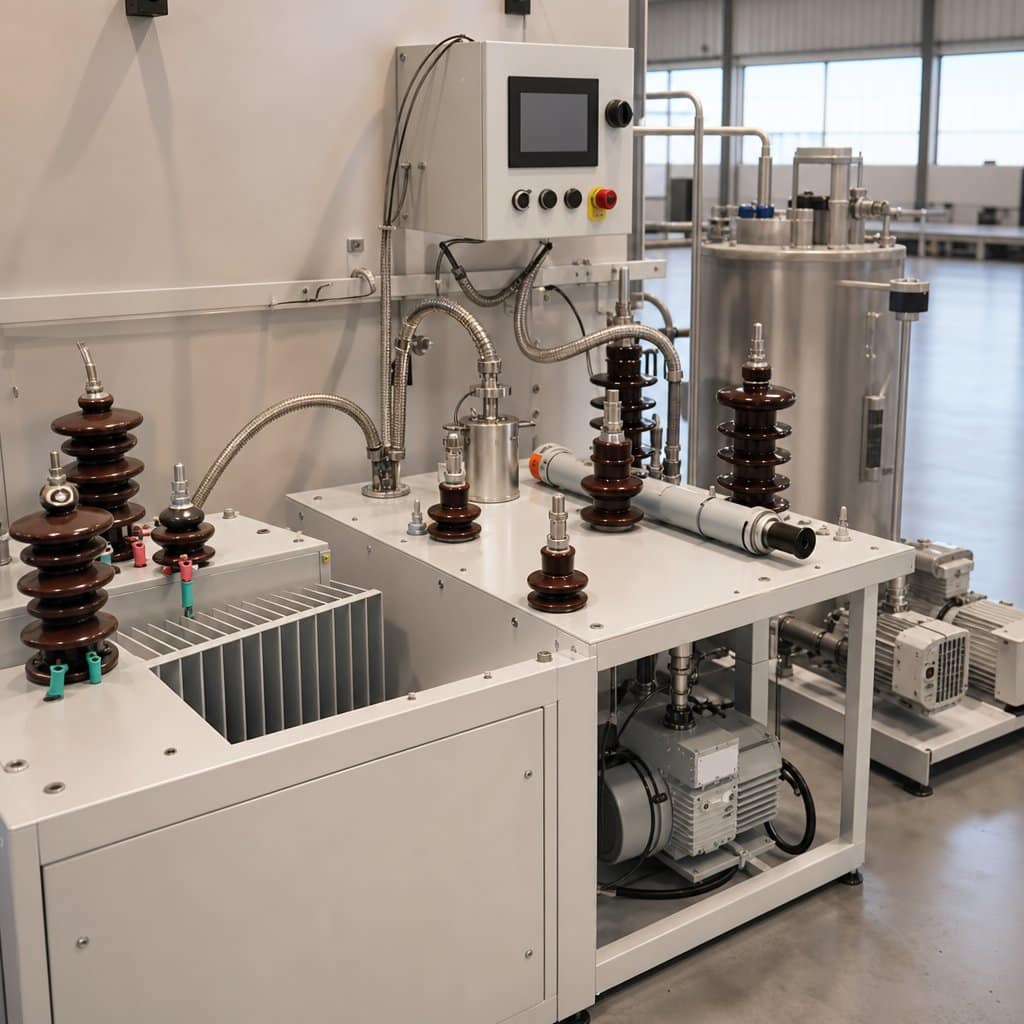
Insulating oil does two jobs: it insulates and it cools. Both fail where air intrudes. An air bubble trapped between winding layers has a fraction of the dielectric strength of the oil-impregnated pressboard around it — under operating voltage it becomes a partial-discharge site, and partial discharge erodes insulation a little every hour the transformer runs. Moisture rides in with the air as well, re-wetting insulation that the drying station just spent days drying. The factory test floor sees the consequences directly: failed induced-voltage tests, elevated partial-discharge readings, and dissolved gas results that raise questions no one wants to answer.
How Vacuum Oil Filling Works
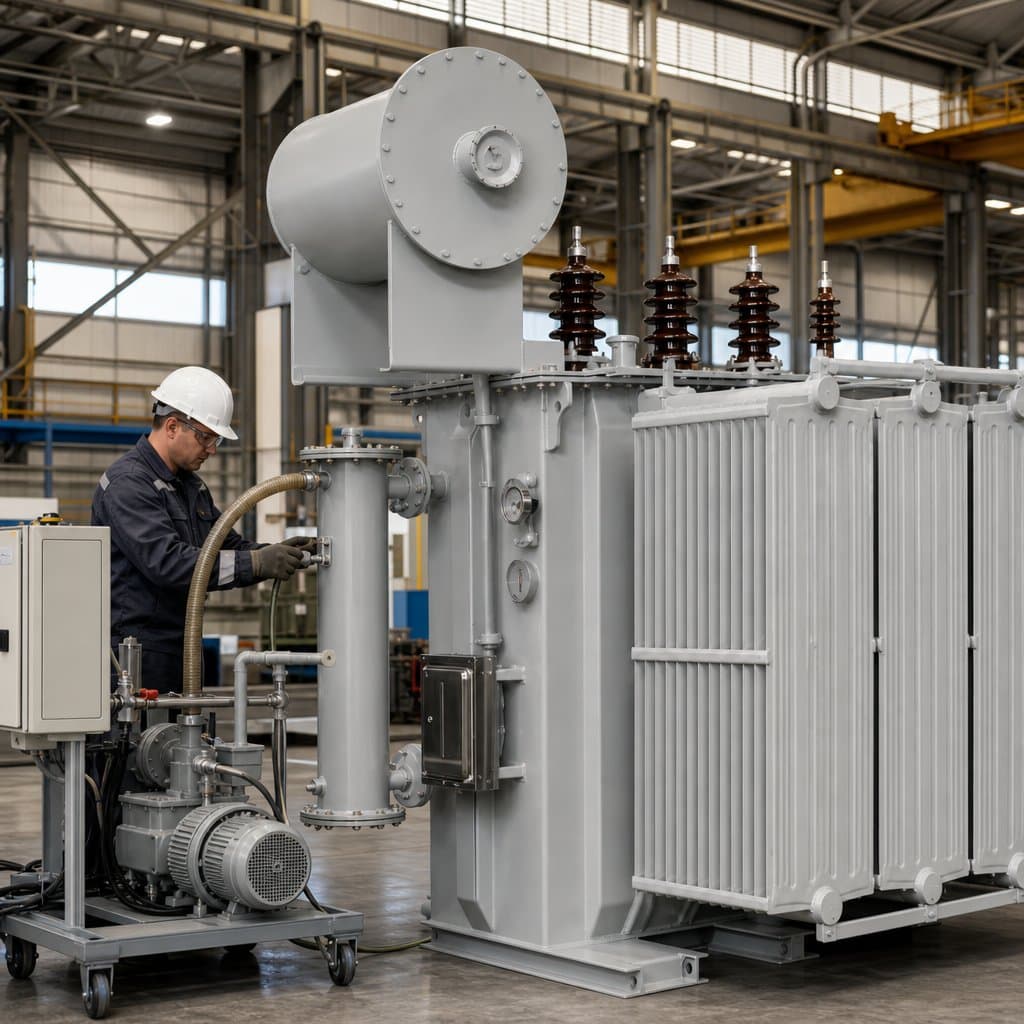
The process is a controlled sequence rather than simply “pumping oil in”:
- 1. Tank evacuation. The assembled transformer tank is evacuated first, removing the air occupying the winding structure and insulation clearances.
- 2. Oil preparation. The insulating oil itself is degassed and temperature-conditioned — oil temperature is managed from room temperature up to 60°C, because warm oil flows thinner, penetrates deeper into the insulation, and releases dissolved gas more readily.
- 3. Filling under vacuum. Oil enters the tank while the vacuum holds, so it displaces nothing but vacuum — there is no air left to trap. The oil rises through the winding structure and impregnates the insulation from the bottom up.
- 4. Precision cutoff. Dual control — flowmeter and liquid level gauge together — stops the fill at exactly the right volume and level, unit after unit.
- 5. Recording. The system logs the process parameters automatically, so every filled transformer carries its own traceable record.
The timing matters as much as the sequence: the dried active part should move from vacuum drying to filling without exposure to ambient air — which is why drying and oil filling are specified as one continuous process chain, as covered in our vacuum drying process guide.
Why the 10 Pa Ultimate Vacuum Benchmark Matters
“Ultimate vacuum” is the lowest pressure the system can actually achieve and hold — and it defines how much air remains in the tank when oil starts flowing. Atmospheric pressure is about 101,325 Pa. At 10 Pa, the residual gas is roughly one ten-thousandth of an atmosphere: the winding structure is, for practical purposes, empty of air before the first litre of oil arrives.
Compare the alternatives. A system that only reaches 1,000 Pa leaves a hundred times more gas in the tank — gas that the incoming oil compresses into bubbles lodged between winding layers and insulation sheets. No downstream vacuum treatment fully removes bubbles trapped that deep, which is why the filling vacuum is set before filling starts, not corrected after. When evaluating equipment, ask for the measured ultimate vacuum on the installed system with a tank connected — a pump datasheet figure without the piping, valves, and seals tells you little about what the transformer actually experiences.
Specifications to Compare
Standard configurations scale by oil storage capacity, with the key parameters constant across the range:
| Parameter | 3000 L | 4000 L | 5000 L |
|---|---|---|---|
| Oil storage tank volume | 3000 L | 4000 L | 5000 L |
| Oil temperature range | Room temp – 60°C | Room temp – 60°C | Room temp – 60°C |
| Ultimate vacuum | 10 Pa | 10 Pa | 10 Pa |
| Oil tank size | Customized | Customized | Customized |
Beyond the table, four points decide real-world performance:
- Dual control — flowmeter plus liquid level gauge together; single-sensor systems drift on exactly the large tanks where overfill and underfill are costliest
- Storage capacity vs throughput — size the tank farm (3000–5000 L per tank) against how many transformers you fill per shift and how much oil each takes
- Heating and degassing — confirm oil temperature control up to 60°C and degassing capacity match your oil volume per fill
- Traceability — automatic parameter recording in a format your quality system archives; this is what lets you prove fill quality during customer audits
Frequently Asked Questions
Can I fill transformers without vacuum if I fill slowly?
Slow filling reduces turbulence but cannot remove the air already inside the winding structure — that air stays trapped as bubbles regardless of fill speed. Only evacuating the tank before filling removes it, which is the entire point of vacuum oil filling.
Why heat the oil to 60°C?
Warm oil has lower viscosity, so it penetrates deep into the insulation structure faster and releases dissolved gas more readily during degassing. The 60°C ceiling stays well within the range that does not stress the oil or the insulation.
Which products need vacuum oil filling?
Oil-immersed distribution and power transformers, capacitors, and mutual inductors — any product where insulating oil must enter a dried insulation structure without reintroducing air or moisture.
How do I size the oil storage capacity?
Start from oil volume per transformer multiplied by fills per shift, then add margin for degassing turnaround between fills. Standard systems offer 3000, 4000, and 5000 L tanks; high-volume lines combine multiple tanks with centralized degassing.
Summary: Protect the Dryness You Paid For
Vacuum oil filling is the guardian station of the insulation process: it takes a freshly dried active part and hands it to a lifetime of service without letting air or moisture back in. The specification anchors are an ultimate vacuum of 10 Pa verified on the installed system, dual flowmeter-and-level control, oil temperature management to 60°C, and recorded parameters for every fill. Get those four right, and the drying chamber’s work is never wasted.
Planning a drying-and-filling line? Tell us your transformer sizes, oil volumes, and fills per shift — we will recommend the tank configuration and the vacuum specification for your RFQ.
📞 Phone: +86-15958243831
📧 Email: sales@tranfovia.com
💬 WhatsApp: https://wa.me/8615958243831
🌐 Website: tranfovia.com