TL;DR:
- A vertical coil winding machine winds large transformer coils with the axis upright, using a chuck elevation system so the operator platform stays fixed while the coil height adjusts.
- The specifications that matter most are tonnage class and torque, wire tension and presser capacity, and CNC/VF speed control quality.
- Match the model to your largest coil’s weight and diameter, choose between pit and over-floor configurations based on your building, and size for HV/UHV disc coil work.
- Verify winding stability, tension behavior, and braking with a test winding before accepting a quotation.
This article is part of our transformer coil winding machine guide — the pillar page covering all winding machine types, key specifications, and selection logic.
How to choose the right vertical coil winding machine comes down to matching tonnage, control quality, and configuration to the coils you actually wind. This article explores what a vertical coil winding machine is and how it fits into transformer manufacturing, which specifications to compare, how to match a model to your application, and the questions to ask any manufacturer or supplier, providing a practical framework for producers of large power transformer coils.
What a Vertical Coil Winding Machine Is and How It Fits into Transformer Manufacturing
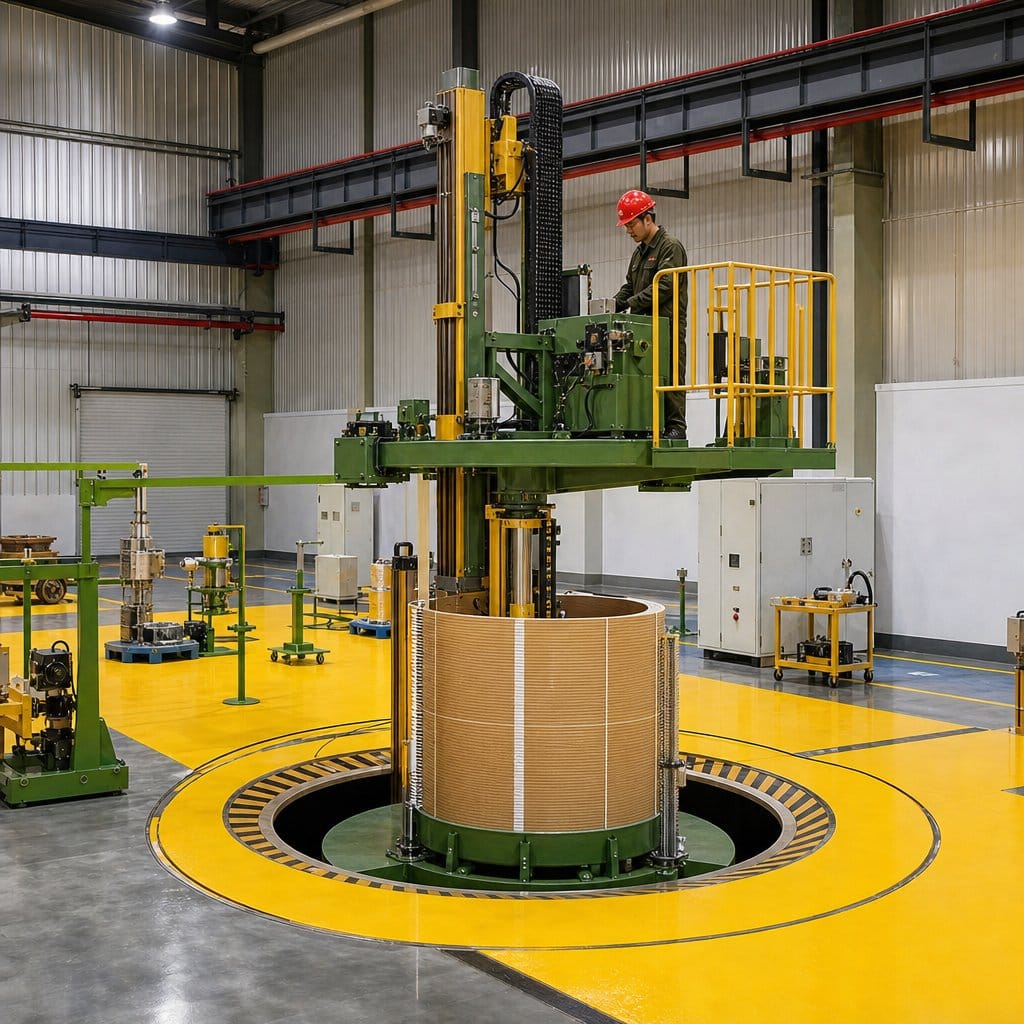
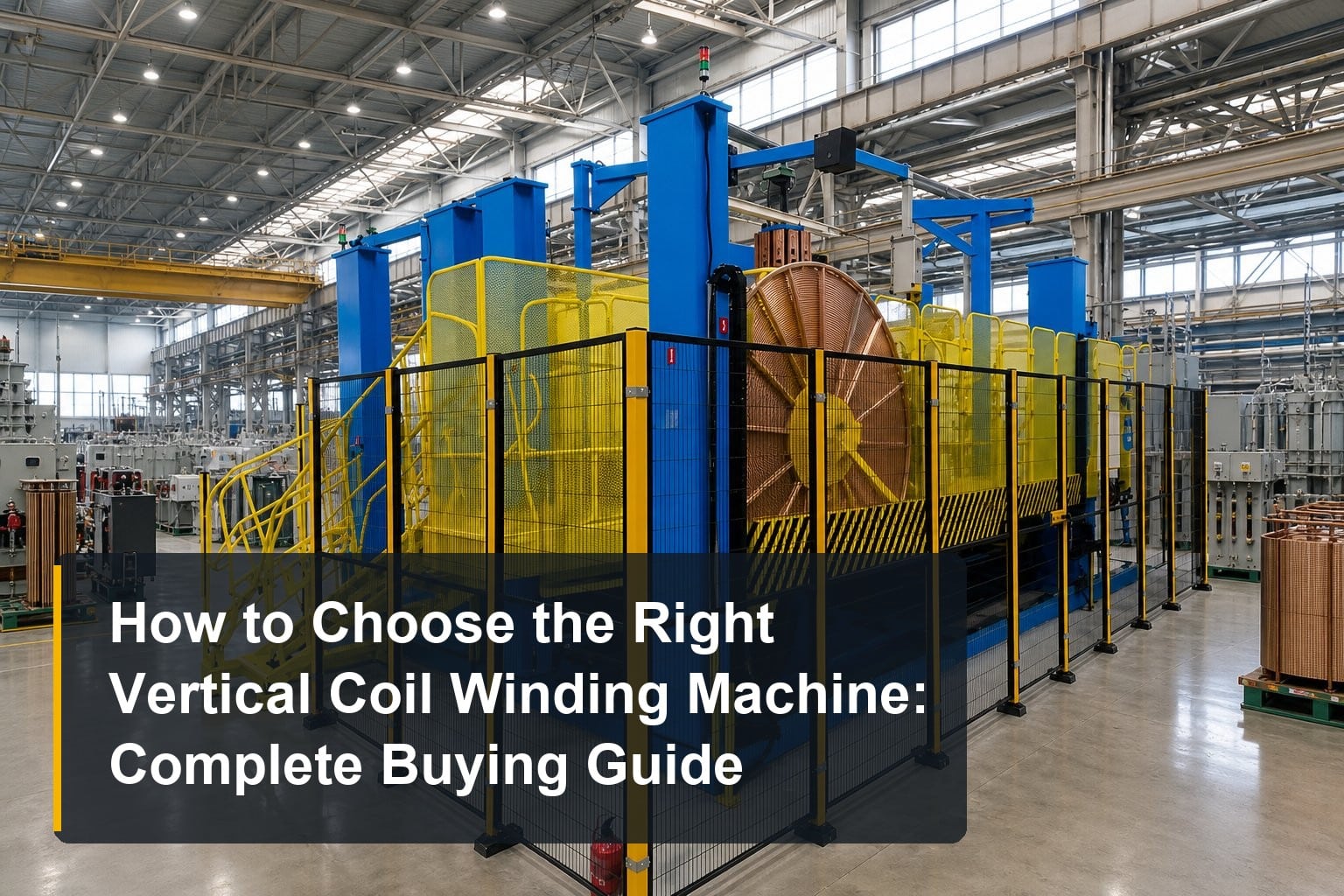
A vertical coil winding machine winds transformer coils with the coil axis upright, the conductor feeding horizontally onto a rotating vertical form. This orientation is the standard choice for large high-voltage and ultra-high-voltage disc coils, where coil weight and diameter make horizontal winding impractical.
Definition and Core Function
In simple terms, a vertical coil winding machine rotates a coil form on a vertical-axis faceplate while the operator guides conductor — copper or aluminum strip or wire — into place layer by layer or disc by disc. The chuck elevation system raises or lowers the rotating chuck as the coil builds, so the winding point stays at the operator’s working height throughout the job. On pit-type machines the chuck sinks into a floor pit as the coil grows; over-floor designs achieve the same effect with a raised structure where no pit can be built.
Where It Fits in the Production Flow
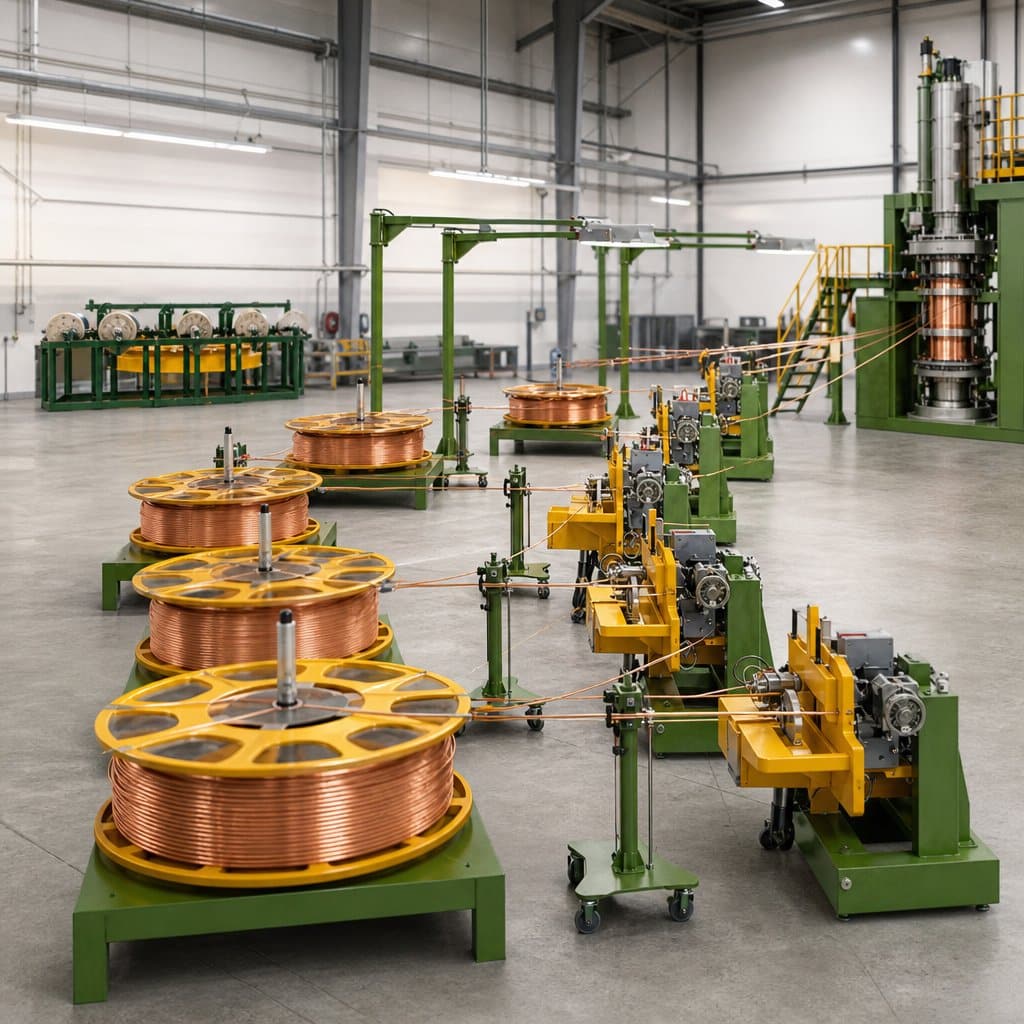
The machine sits at the heart of the winding shop, between conductor preparation and coil finishing. Large continuous disc coils for HV and UHV transformers — the coils that set a transformer’s voltage class — are its core workload. Conductor arrives from dereelers and tension pay-off stands, and the finished coil leaves for pressing, drying, and assembly. Because disc coil quality depends on consistent tension and precise turn placement, the winding machine’s control quality propagates directly into transformer dielectric performance.
Vertical vs. Horizontal Winding
Vertical winding wins when coils are large and heavy: gravity assists turn seating, the operator walks around a fixed platform instead of following a rotating horizontal axis, and coils up to 45 tonnes remain stable on the faceplate. Horizontal machines suit smaller layer-wound coils where loading and mandrel access matter more. Factories running both product families typically pair a vertical machine for HV disc coils with a horizontal winding machine for distribution-class work (sizing covered in our horizontal winding machine buying guide) — choosing one layout for both usually compromises one of them.
Key Specifications to Compare: Tonnage, Torque, and CNC Control
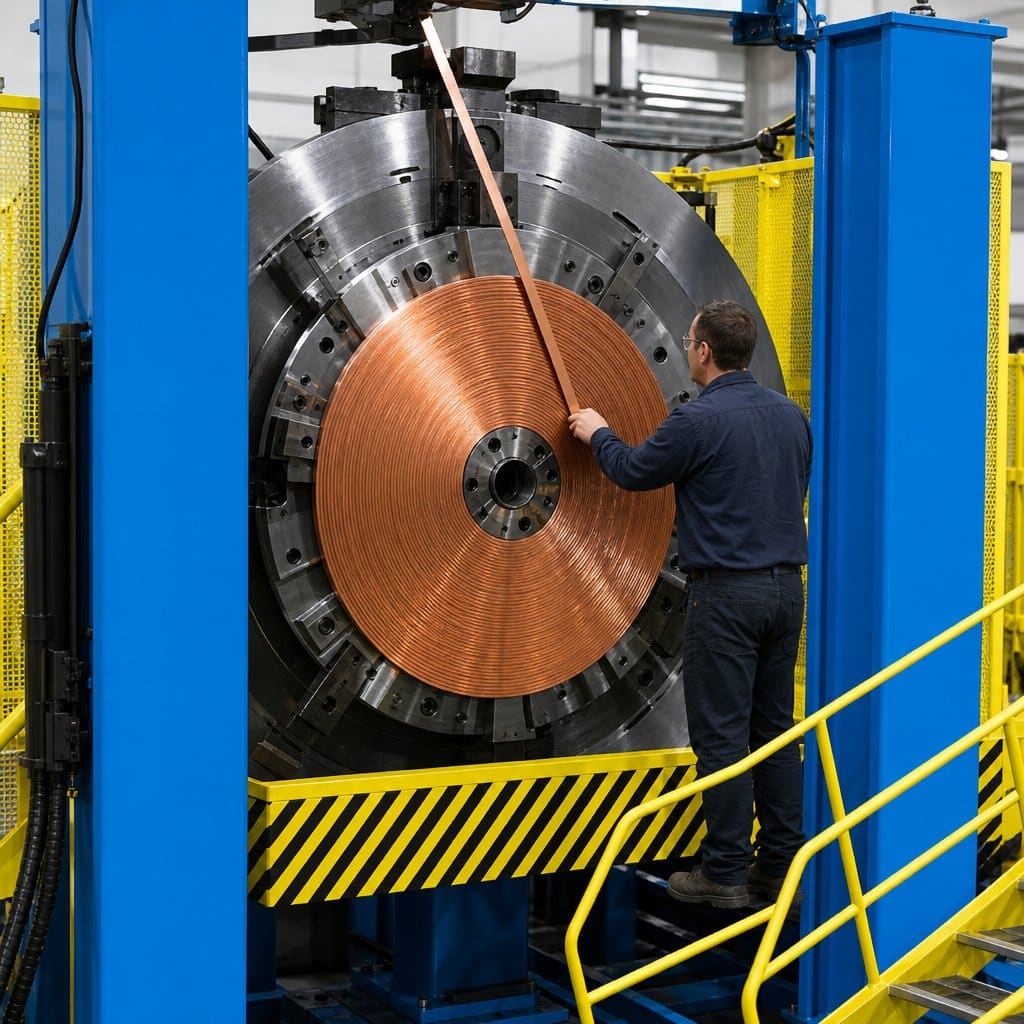
Vertical winding machine specifications look similar across suppliers until you examine what sits behind them. Three groups decide real performance: the load and torque figures, the tension and presser systems, and the quality of the speed control.
Tonnage Class, Torque, and Faceplate Diameter
Loading capacity defines the machine class — typical series run from 5 to 45 tonnes — but tonnage alone is not enough. Check the torque figure alongside it: roughly 4,900 N·m at the 5-tonne class rising to 45,000 N·m at 45 tonnes determines whether the machine accelerates and brakes a heavy coil smoothly or strains at it. Faceplate and running diameter, from about Φ1,500 to Φ3,500 mm, must clear your largest coil with margin for the winding form. Undersized torque shows up as speed sag during acceleration and long, unsafe braking distances.
Wire Tension and Presser Capacity
Consistent conductor tension — around 4,000 N on capable machines — is what keeps disc coils tight and dimensionally stable, while the presser system, at 10,000 to 30,000 N, consolidates windings as they form. Ask how tension is generated and regulated: passive brakes drift with temperature and spool diameter, while servo or closed-loop systems hold the setpoint through the whole coil. For HV disc coils, where loose turns become dielectric weak points, tension stability is a quality specification, not a comfort feature.
Speed Control, Counting, and Chuck Elevation
VF (variable frequency) control with smooth ramping and reliable braking is the baseline; evaluate what surrounds it. Turn counting should offer free setting, forward and reverse counting, and power-off memory so a mid-coil outage never loses the count. The chuck elevation system — lifting travel of 1,700 to 3,200 mm — should move smoothly and lock positively, keeping the winding point at platform height. CNC integration that links elevation, speed, and counting into per-coil recipes converts operator skill into repeatable process.
How to Match the Right Model to Your Application
Matching a vertical coil winding machine starts from your coil designs and your building, not from the catalog. Three factors drive the decision.
Coil Weight, Diameter, and Voltage Class
List your largest coils by finished weight and diameter, then add margin for the designs you expect within five years. A 10-tonne machine serves medium power transformer coils comfortably; UHV disc coils quickly demand the 20–45 tonne classes with their larger faceplates and higher torque. Resist sizing to your average coil: winding machines earn their cost on the largest jobs, and an undersized machine simply cannot take them.
Pit Type vs. Over-Floor Configuration
The configuration decision belongs to your building. Pit-type machines place the chuck in a floor pit with an adjustable cover that expands or shrinks to the coil diameter — the most ergonomic and rigid arrangement, but it requires a building that accepts civil works. Over-floor machines raise the structure instead, suiting rented buildings, upper floors, or sites where pits are impractical. Decide this early, because it shapes installation cost and schedule more than any machine option does.
Production Pattern and Operator Ergonomics
Large disc coils wind for days, not minutes, so ergonomics and shift patterns matter. A fixed operator platform with the winding point always at working height reduces fatigue across long jobs and multiple operators. If your shop winds several coil designs concurrently, ask about quick changeover of forms and recipe recall. And plan conductor supply: heavy strip dereelers and tension stands must keep pace with the machine, positioned so respooling does not stop a multi-day winding job.
Questions to Ask a Vertical Coil Winding Machine Manufacturer or Supplier
A vertical winding machine anchors a winding shop for decades, and its installation touches the building itself. These questions test whether a supplier understands heavy winding equipment and will stand behind it.
Can You Demonstrate a Full Load Cycle?
Ask for a demonstration winding at or near your target coil weight, showing acceleration, steady-state tension behavior, and braking from full speed. The machine should hold speed without sag under load and stop within a safe, specified distance. When evaluating a specific model such as a vertical winding machine, request the torque curve and tension regulation data in writing, plus references from factories winding coils of similar weight and voltage class.
Who Handles the Foundation, Pit, and Installation?
For pit-type machines, clarify responsibility for pit drawings, civil works supervision, machine leveling, and the adjustable pit cover. Ask what tolerances the foundation must meet and who verifies them before the machine ships. Installation scope — rigging, alignment, commissioning, and operator training — should be itemized in the contract, because ambiguity here surfaces as delay claims later.
What Does Long-Term Support Cover?
Clarify the wear-parts list — brake components, guide rollers, elevation drive parts — with recommended stock and replacement intervals. Ask whether the VF drive and control system use internationally serviceable components, whether remote diagnostics are supported, and how software recipes are backed up. A supplier offering documented maintenance plans and responsive technical support protects a machine that your production schedule will come to depend on.
Frequently Asked Questions
What coils is a vertical winding machine best suited for?
Large high-voltage and ultra-high-voltage transformer coils, especially continuous disc coils. The upright axis keeps heavy coils stable, lets gravity assist turn seating, and allows the operator to work from a fixed platform while the chuck elevation system adjusts coil height. Typical machines handle 5 to 45 tonnes with faceplates from Φ1,500 to Φ3,500 mm.
Should I choose a pit type or over-floor configuration?
Choose pit type when your building permits civil works: it offers the most rigid structure and the best ergonomics, with an adjustable pit cover matching the coil diameter. Choose over-floor when pits are impractical — rented buildings, upper floors, or restricted sites. Winding performance is equivalent; the decision is about your building and installation budget.
How important is the tension system?
Critical for HV disc coils. Consistent conductor tension — around 4,000 N, held by closed-loop control rather than passive brakes — keeps turns tight and dimensions stable through the whole coil. Tension drift shows up later as loose discs and dielectric weaknesses, so evaluate the tension system’s regulation quality, not just its peak figure.
What winding speed should I expect?
Faceplate speed ranges from about 0–29 rpm on 5-tonne machines down to 0–10 rpm on heavy classes, because larger coils demand lower rotational speeds. Effective productivity depends more on smooth ramping, reliable braking, and uninterrupted multi-day operation than on peak rpm. Judge speed together with torque, since torque determines whether rated speed holds under load.
Summary
Choosing the right vertical coil winding machine means matching tonnage and torque to your largest coils, insisting on closed-loop tension control and proven VF speed regulation, and choosing pit or over-floor configuration based on your building rather than preference. Verify a full load cycle on a demonstration coil, fix installation responsibilities in writing, and secure long-term support terms before you buy.
TRANFOVIA supplies vertical winding machines from 5 to 45 tonnes in pit and over-floor configurations, with foundation engineering, commissioning, and responsive after-sales support. For a model recommendation matched to your coil designs, contact TRANFOVIA today.
📞 +86-15958243831 📧 sales@tranfovia.com 💬 WhatsApp: https://wa.me/8615958243831 🌐 tranfovia.com
References
- IEC 60076-1:2011. Power transformers — Part 1: General. International Electrotechnical Commission. https://webstore.iec.ch
- IEEE Std C57.12.00-2015. IEEE Standard for General Requirements for Liquid-Immersed Distribution, Power, and Regulating Transformers. IEEE. https://standards.ieee.org
- IEC 60076-3. Power transformers — Part 3: Insulation levels, dielectric tests and external clearances in air. International Electrotechnical Commission. https://webstore.iec.ch
- Kulkarni, S. V., & Khaparde, S. A. (2004). Transformer Engineering: Design and Practice. Marcel Dekker.
- Georgilakis, P. S. (2009). Spotlight on Modern Transformer Design. Springer.
- Heathcote, M. J. (2007). The J & P Transformer Book. Newnes.