TL;DR: Static mixing vacuum casting equipment blends resin and hardener in a static mixer immediately before casting, then pours into molds under vacuum — producing the void-free epoxy insulation that dry-type transformers, CT/VT instrument transformers, and reactors depend on. Compared with batch pre-mixing, static mixing delivers a fresher, more consistent mix with less waste. Systems scale from 100 to 500 L tanks with material preparation of 3000–15000 kg per 24 hours and pouring rates up to 12 kg/min. This guide covers the process, the product fit, and the specifications to compare before you buy.
Dry-type transformers and instrument transformers live or die by their cast resin body. A single void or a poorly mixed pocket in the epoxy becomes a partial-discharge site — and the product either passes its routine tests or it does not ship. The machine that determines this is the casting line, and the technology that has become the industry standard is static mixing vacuum casting. This article — part of our drying, impregnation and casting equipment guide — explains how it works, why it beats batch mixing, and how to size a system for CT/VT, dry transformers, and reactors.
What Static Mixing Vacuum Casting Is
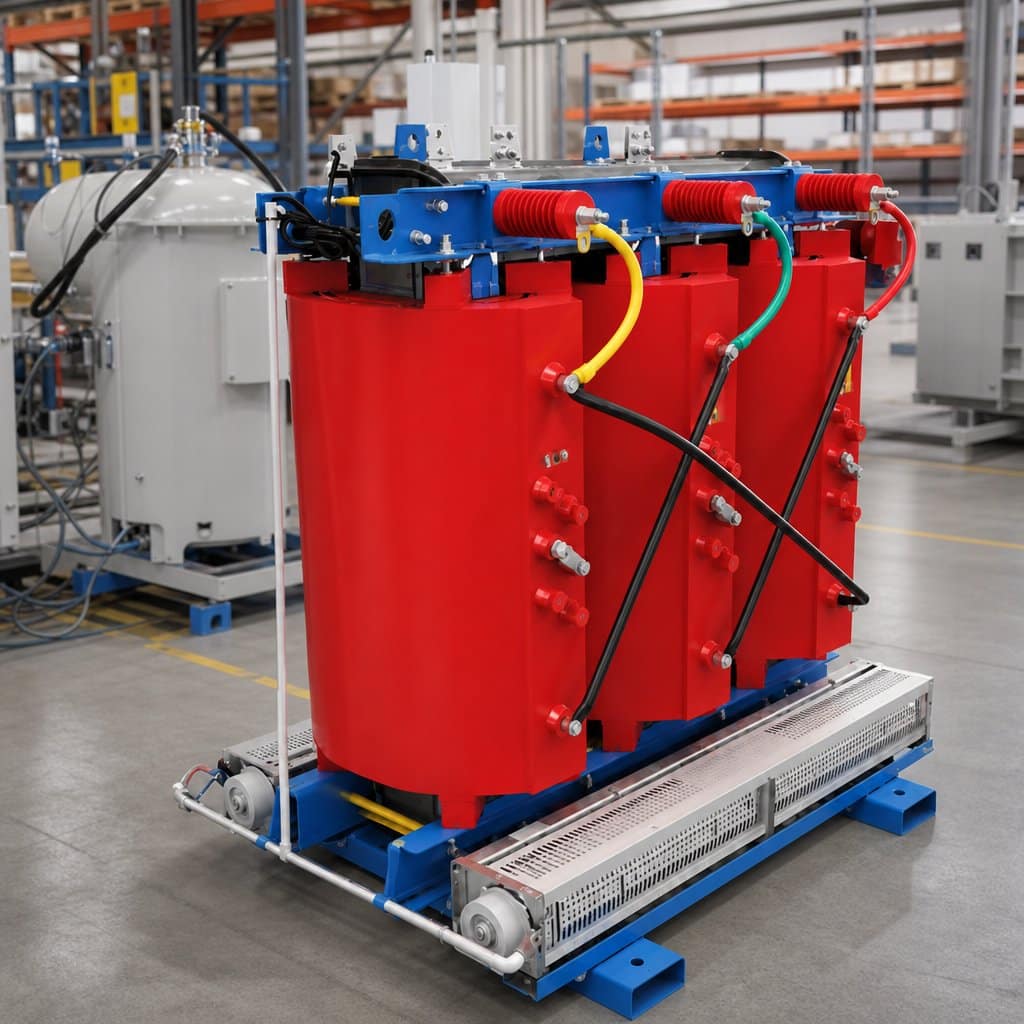
The name describes the two things that define the process. Static mixing: resin and hardener are pumped in precise ratio through a static mixer — a tube with fixed internal elements that blend the components as they flow, with no moving parts and no pre-mixed tank aging on a clock. The mix is made the moment before it is needed. Vacuum casting: the mold sits in a vacuum chamber, and the freshly mixed compound is poured under vacuum so no air is trapped in the winding as the resin rises around it. The part cures into a solid, void-free insulation body.
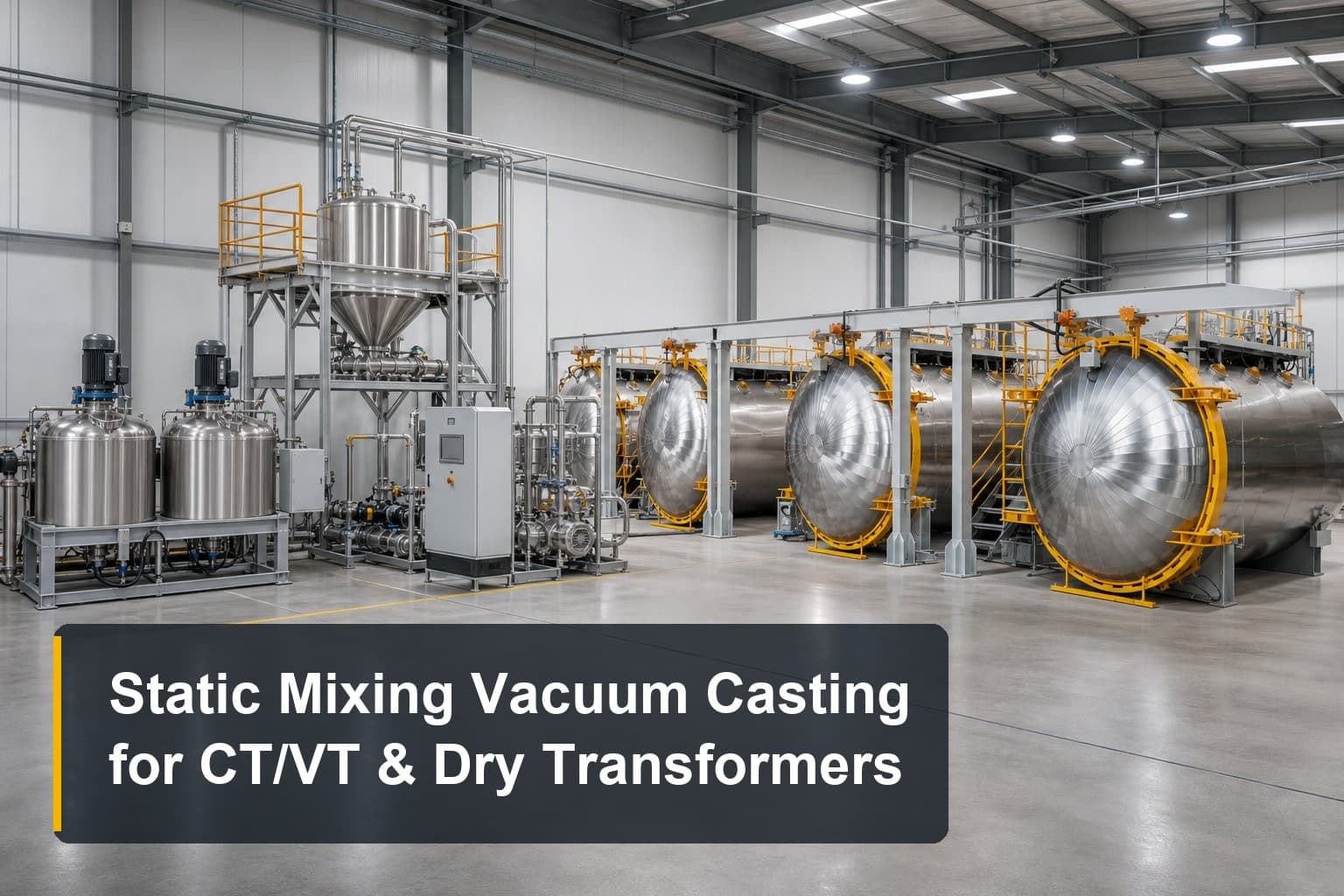
A static mixing vacuum casting system combines material preparation tanks, metering pumps, the static mixer, the vacuum casting chamber, and a pouring arm — with full process recording for traceability.
Why Static Mixing Beats Batch Pre-Mixing
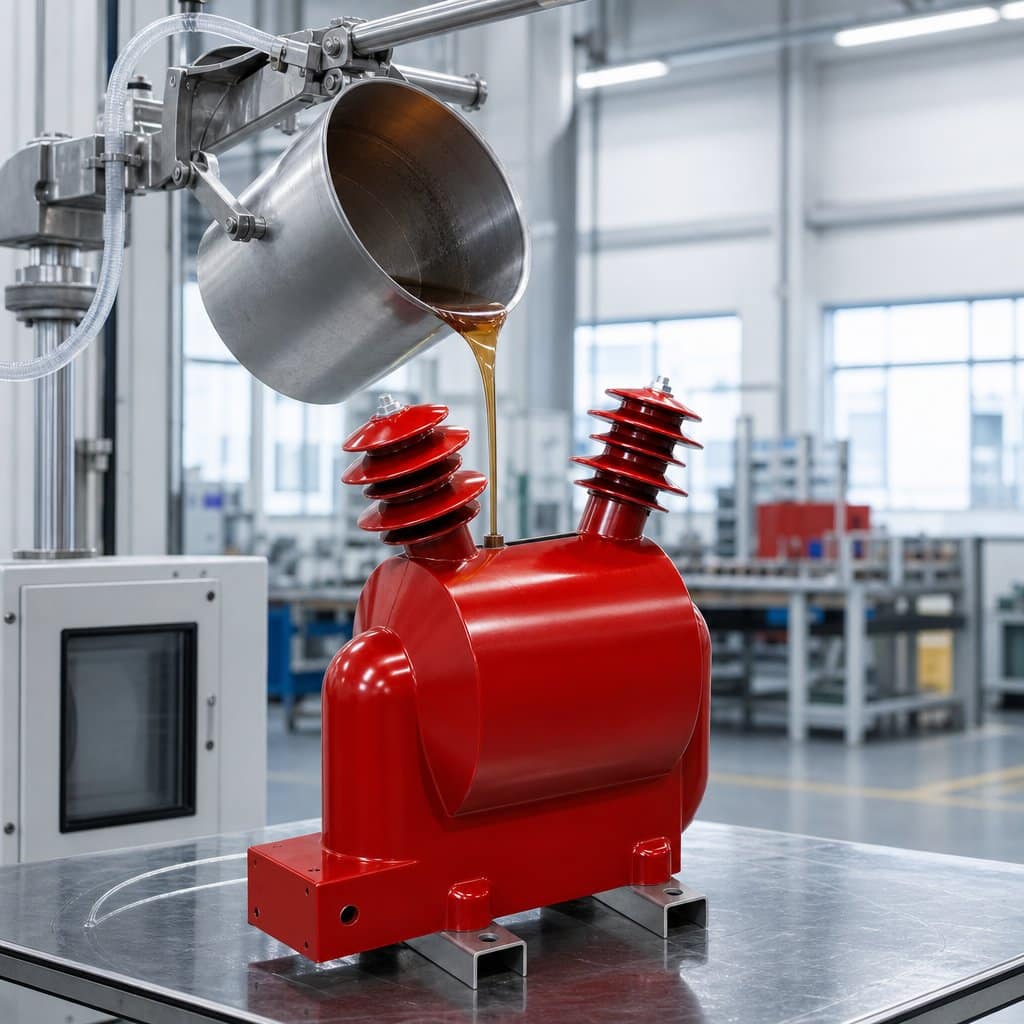
- Freshness at the mold. Pre-mixed resin starts reacting the moment hardener is added — pot life ticks down while the batch waits. Static mixing blends immediately before pouring, so every mold receives material at the same point in its chemistry.
- Ratio consistency. Metering pumps hold the resin-to-hardener ratio shot after shot; batch mixing drifts with operator weighing and tank depletion.
- Less waste. No leftover pre-mix to discard at end of shift — you mix only what you pour, which is a direct material-cost saving on expensive filled epoxy systems.
- Continuous production. Preparation tanks feed the mixer continuously, so casting does not pause while a new batch is weighed, mixed, and degassed.
The result is what test floors care about: consistent casting quality across shifts, with recorded parameters to prove it.
The Complete Casting Line: Preparation, Casting, Curing
The casting machine is the center of a three-station line, and quality is decided at the ends as much as the middle:
- Preparation. Resin and filler must be dried, degassed, and temperature-conditioned before mixing — wet filler becomes voids in the cured part. Centralized vacuum material preparation equipment handles this at 3000–15000 kg per 24 hours with filler drying tanks of 300–1200 kg.
- Casting. The static mixing vacuum casting machine pours into molds under vacuum at 2–12 kg/min and roughly 10 bar, with optional rotary or two-axis servo pouring arms for multi-mold layouts.
- Curing. Demolded parts move to a curing oven — the HB series curing oven holds ≤±2.5°C uniformity with full parameter recording, the figure that decides whether the resin reaches full strength everywhere in the part.
What to Cast: CT/VT, Dry Transformers, Reactors
The process fits any product whose insulation is a cast epoxy body:
- CT/VT instrument transformers — precision casting for coil encapsulation, where void-free insulation defines metering accuracy and dielectric life
- Dry-type transformers — the core product class: windings cast in resin under vacuum, from small distribution units upward
- Reactors and inductors — controlled casting for electrical insulation of air-core and iron-core coils
For high-volume epoxy components — solid-sealed poles, contact boxes, insulators, wall bushings — the related static mixing APG equipment injects into closed heated molds instead, trading chamber casting for in-mold gelation speed. And where the requirement is impregnating a winding rather than embedding it in a cast body, vacuum pressure impregnation (VPI) is the right process — the comparison is covered in our VPI guide.
Selecting a System: Specifications to Compare
Static mixing vacuum casting systems scale by tank volume. The standard range:
| Parameter | 100 L | 150 L | 200 L | 300 L | 500 L |
|---|---|---|---|---|---|
| Material preparation | 3000 kg/24h | 4500 kg/24h | 6000 kg/24h | 9000 kg/24h | 15000 kg/24h |
| Filler drying tank | 300 kg | 600 kg | 600 kg | 900 kg | 1200 kg |
| Max pouring speed | 2 kg/min | 6 kg/min | 6 kg/min | 12 kg/min | 12 kg/min |
| Max pouring pressure | ≈10 bar | ≈10 bar | ≈10 bar | ≈10 bar | ≈10 bar |
| Casting chamber | Square (-0.1~0 MPa) or round (-0.1~0.6 MPa), customizable | ||||
| Options | Rotary pouring arm or two-axis servo pouring arm | ||||
Three questions to answer before sizing:
- Daily resin throughput — match preparation capacity (kg/24h) to your production plan, not the tank label; the preparation line is the real bottleneck
- Mold size and layout — chamber shape (square vs round, vacuum vs pressure-capable) follows your largest mold; the pouring arm choice (rotary vs two-axis servo) follows how many molds you serve per cycle
- Recording format — confirm the parameter logging integrates with your quality system; traceability is a standard feature worth specifying explicitly
Frequently Asked Questions
What is the difference between vacuum casting and APG?
Vacuum casting pours into open molds inside a vacuum chamber — the standard for dry-type transformers and CT/VT. APG (automatic pressure gelation) injects pre-mixed resin into closed, heated molds where gelation happens in the mold; it is faster per part and suits high-volume components like insulators and solid-sealed poles. Many component factories run both.
Why does static mixing matter for casting quality?
Because resin chemistry starts at mixing. Batch pre-mix ages while it waits, so the first mold and the last mold of a shift see different material. Static mixing blends resin and hardener the moment before pouring — every mold gets the same fresh mix at the same ratio, which is what consistent partial-discharge results are made of.
How do I choose a tank size?
Work backward from daily resin consumption: preparation capacity runs from 3000 kg/24h (100 L tanks) to 15000 kg/24h (500 L). Choose the size whose preparation capacity covers your peak day with margin — undersizing preparation starves the casting chamber regardless of pouring speed.
Can the system handle different resin systems?
Systems are configured around your resin and filler combination — viscosity, filler loading, and gel profile all affect metering and temperature control. Specify your exact resin system in the RFQ; tank sizes, casting arms, and controls are customized around it.
Summary: Fresh Mix, Vacuum Pour, Recorded Proof
Static mixing vacuum casting earns its place as the standard for dry-type transformers, CT/VT, and reactors by solving the two problems batch casting cannot: mix freshness and trapped air. Size the line by preparation capacity, match the chamber and pouring arm to your molds, and specify recording that your quality system can archive. Done right, casting stops being the source of test-floor surprises and becomes the most predictable station in the factory.
Planning a resin casting line? Send us your product types, mold dimensions, and daily resin consumption — we will recommend the system size, chamber configuration, and pouring arm for your RFQ.
📞 Phone: +86-15958243831
📧 Email: sales@tranfovia.com
💬 WhatsApp: https://wa.me/8615958243831
🌐 Website: tranfovia.com