Ask a transformer factory where its cutting line loses money, and most point at the shear. Watch the line for a shift, though, and the real bottleneck is usually at the other end: people catching laminations off the conveyor, sorting them by hand, and stacking them for the core builders. A servo sorting core cutting line removes that bottleneck by automating what happens after the cut. Here is what the machine does and why the labor math is more compelling than it first looks.
What Is a Servo Sorting Core Cutting Line?
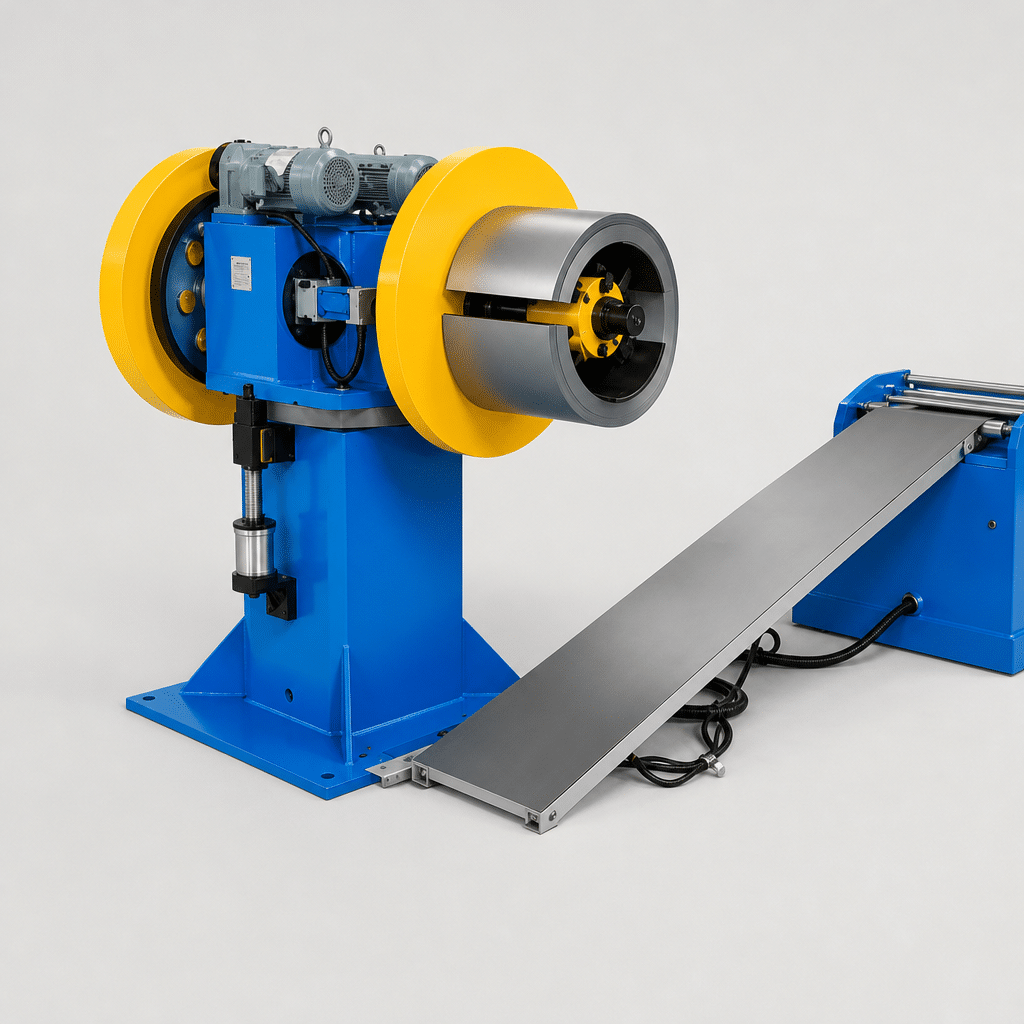
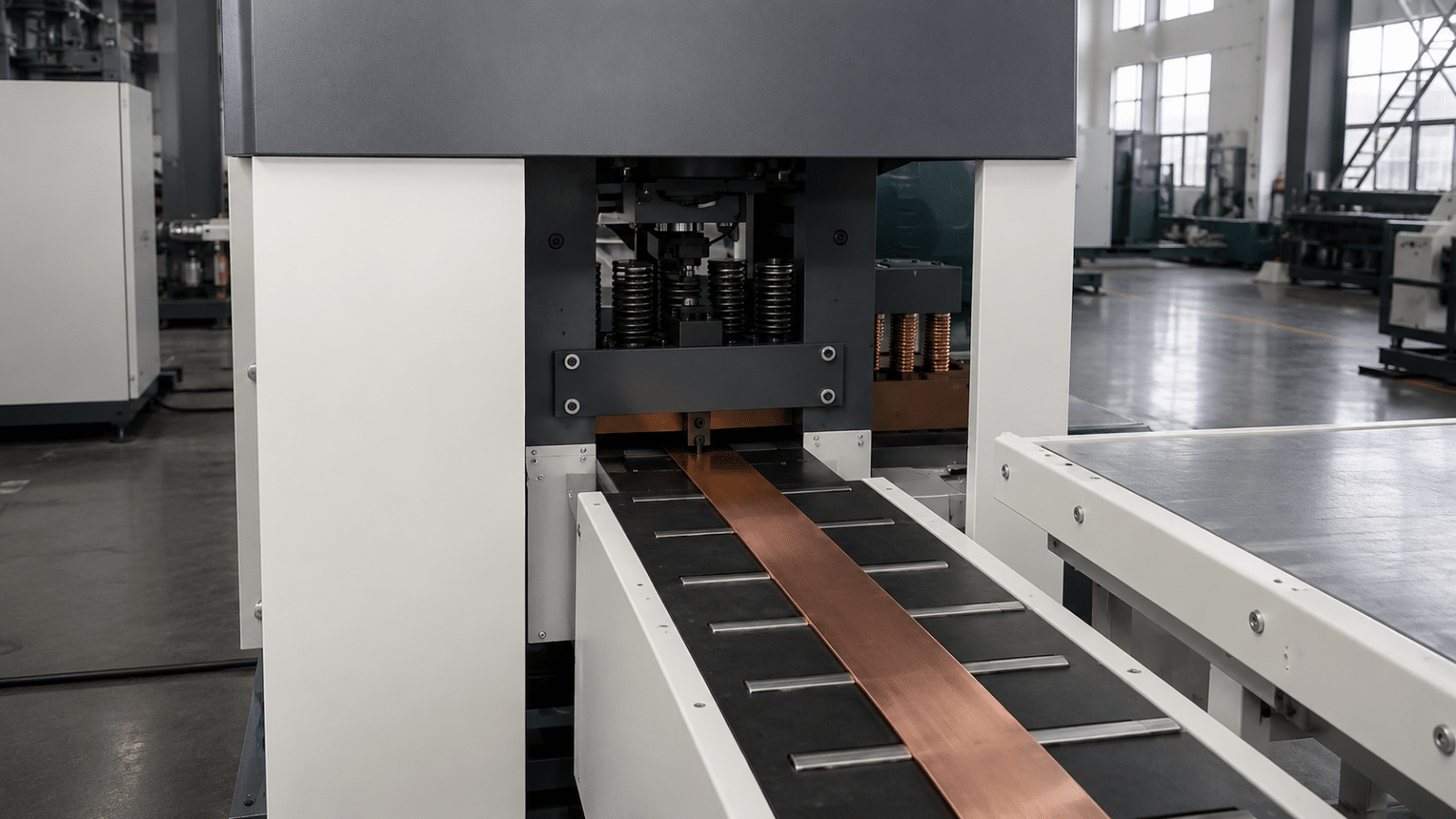
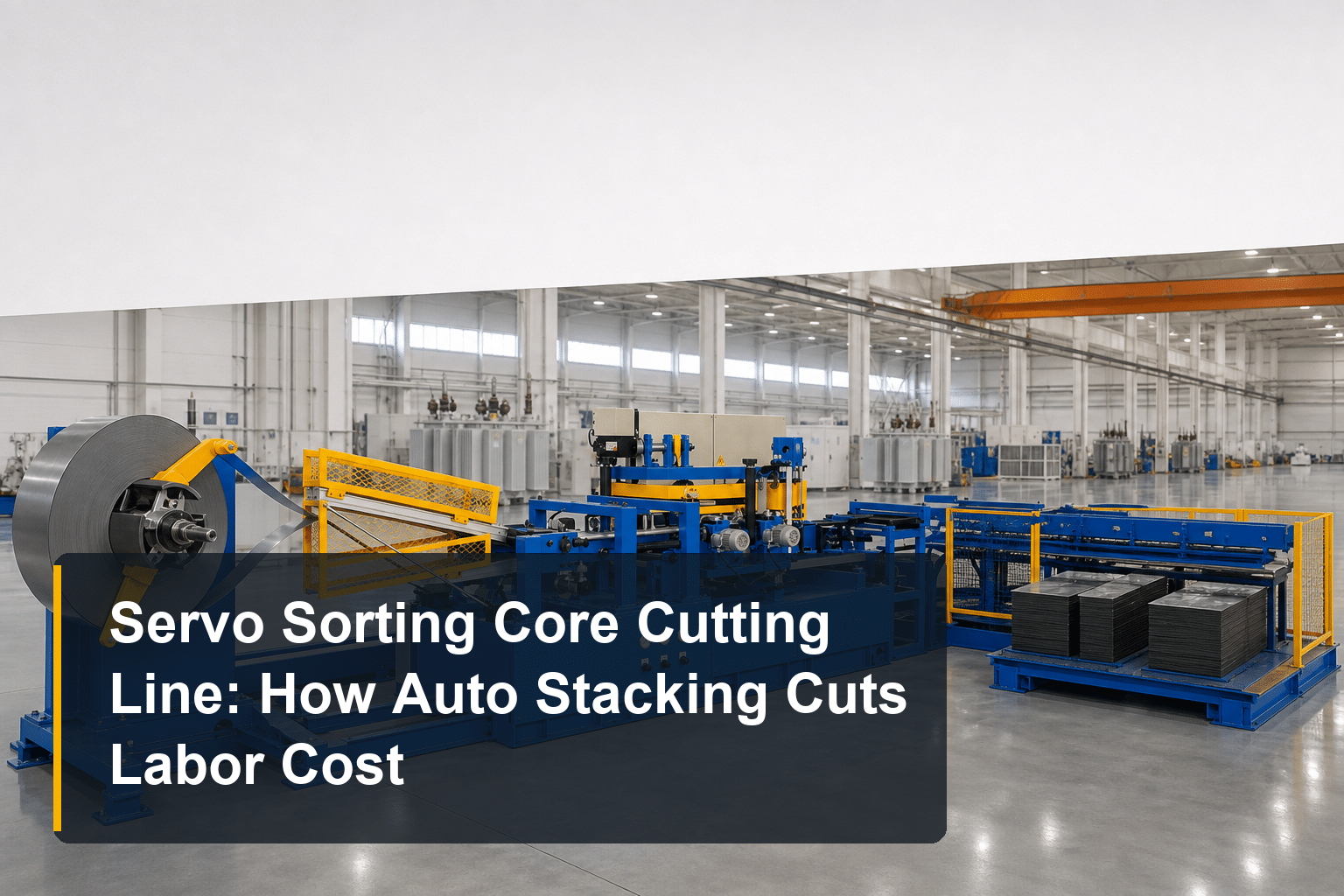
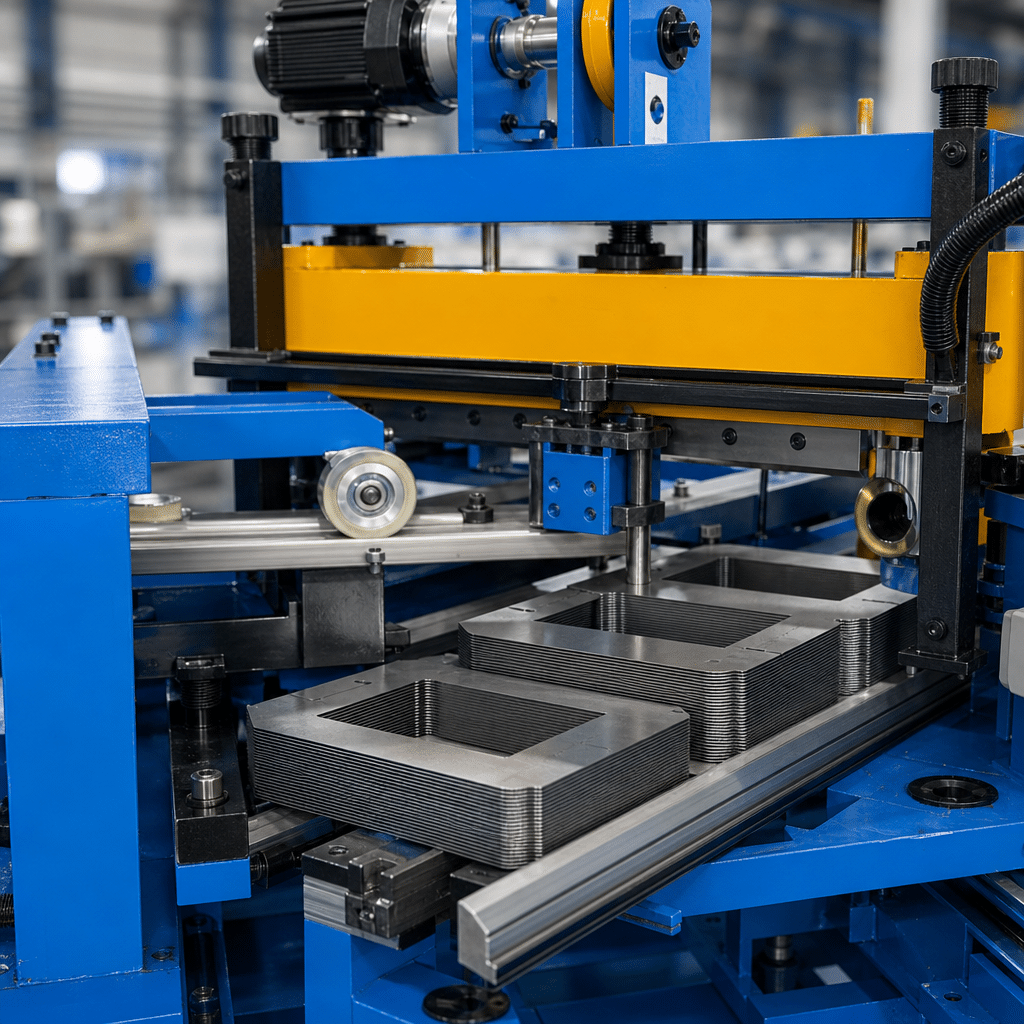
A servo sorting core cutting line is a transformer core cutting line with an automated, servo-driven sorting and stacking system at its output. The cutting section works like any precision line — decoil, level, feed, punch or miter where needed, shear — but instead of dropping finished laminations onto a conveyor for people to handle, the line classifies each piece and stacks it automatically, ready for core assembly.
It belongs to the same equipment family as center position and side position lines; the difference is downstream automation rather than the cut itself. Our guide to transformer core cutting lines compares all five configurations side by side.
The Hidden Cost of Manual Stacking
Manual sorting looks cheap because the workers are already on the payroll. The real costs hide elsewhere:
- Speed mismatch. A line feeding at 240 m/min produces a lamination every few seconds. Humans cannot sort accurately at that pace, so the line runs slower than it was built to — you pay for capacity you never use.
- Sorting errors. Side limbs, center limbs, and yokes look similar at a glance. A mis-sorted stack reaches the core builder, who either re-sorts (lost time) or builds with wrong pieces (a rejected core).
- Edge damage. Every manual touch is a chance to scratch the insulating coating or bend a lamination edge — damage that shows up later as higher core losses.
- Headcount drift. As volume grows, manual sorting grows linearly with it: more shifts, more people, more supervision. The cost curve never flattens.
Servo sorting attacks all four: the machine sorts at line speed, never confuses one piece type for another, touches each lamination once, and costs the same at double the volume.
There is a fifth cost that only shows up in audits: inconsistency between shifts and between workers. One operator stacks tightly and cleanly, the next shift stacks loosely, and the core builders compensate by re-aligning pieces as they work. That small, constant friction never appears on a cost report, but it caps the throughput of every process downstream of the cutting line.
How Servo Sorting Works
The sorting section replaces the human decision loop with a programmed one:
- Identification. The control system knows which piece type is being cut from the program — side limb, center limb, or yoke — and tracks each lamination through the shear.
- Classification. Servo-driven guides direct each piece to its designated lane or station, with positioning accuracy that manual placement cannot match.
- Automatic stacking. Laminations are stacked in ordered piles by piece type, aligned and ready for the stacking table or direct core assembly.
Because sorting follows the cutting program, switching from one core design to another is a recipe change on the control panel — no re-training, no re-arranging of workstations.
The servo drive matters more than it might seem. Laminations arrive from the shear at line speed, and decelerating a thin steel sheet without buckling or scratching it requires smooth, controlled motion profiles — exactly what servo axes provide. Pneumatic or purely mechanical diverters can match the speed, but not the gentleness, and gentleness is what keeps 0.18 mm material flat.
Specifications: XE-LL-300ZX, XE-LL-400ZX, and XE-LL-600ZX
Three models cover the range from distribution transformers to large power units:
| Item | XE-LL-300ZX | XE-LL-400ZX | XE-LL-600ZX |
|---|---|---|---|
| Cutting thickness | 0.18–0.35 mm | 0.18–0.35 mm | 0.18–0.35 mm |
| Cutting width | 40–300 mm | 40–400 mm | 60–600 mm |
| Cutting length | 350–2000 mm | 350–2500 mm | 500–3500 mm |
| Feeding speed | 240 m/min | 240 m/min | 240 m/min |
| Length accuracy | ±0.1 mm | ±0.1 mm | ±0.1 mm |
| Angle accuracy | ±0.025° | ±0.025° | ±0.025° |
| Cutting burr | ≤0.02 mm | ≤0.02 mm | ≤0.02 mm |
| Total motor power | 25 kW | 28 kW | 37 kW |
Two details stand out. First, 240 m/min feeding — a third faster than typical standalone machines — which is exactly why manual sorting cannot keep up. Second, the thickness window starts at 0.18 mm, covering the thinnest high-grade CRGO used in low-loss cores, where gentle automated handling matters most.
Model selection follows the same width logic as any cutting line: the 300ZX covers distribution-class strip, the 400ZX adds margin for mixed product ranges, and the 600ZX handles the wide, long laminations of large power transformers — its 3,500 mm maximum length is what EHV core yokes demand. The precision figures are identical across all three, so the decision is envelope, not accuracy.
Who Benefits Most from Servo Sorting?
The return on servo sorting scales with volume and labor cost:
- High-volume transformer factories running two or three shifts — the line pays back fastest here, because sorting labor multiplies with every shift.
- Factories with tight core-loss guarantees — automated handling removes the edge damage that quietly eats your loss margin.
- Plants struggling to hire and keep skilled workers — automation converts a staffing problem into a maintenance routine.
A low-volume workshop cutting a few hundred laminations a day may not justify the investment; the honest break-even test is your monthly sorting labor cost plus error and rework cost, set against the price step from a standard line. For that evaluation, our servo stacking line buying guide walks through the decision in detail.
The principle is proven in the field: a transformer plant in Tabriz, Iran replaced manual sheet handling with automated cutting and turned lamination preparation into a one-pass job — servo sorting extends that same logic through the stacking step.
Conclusion
A servo sorting core cutting line is not about cutting better — it is about stopping the slow leak of labor, errors, and edge damage after the cut. If your line is fast but your stacking table is crowded, the bottleneck is telling you where to invest. Full specifications are on our servo sorting core cutting line product page.