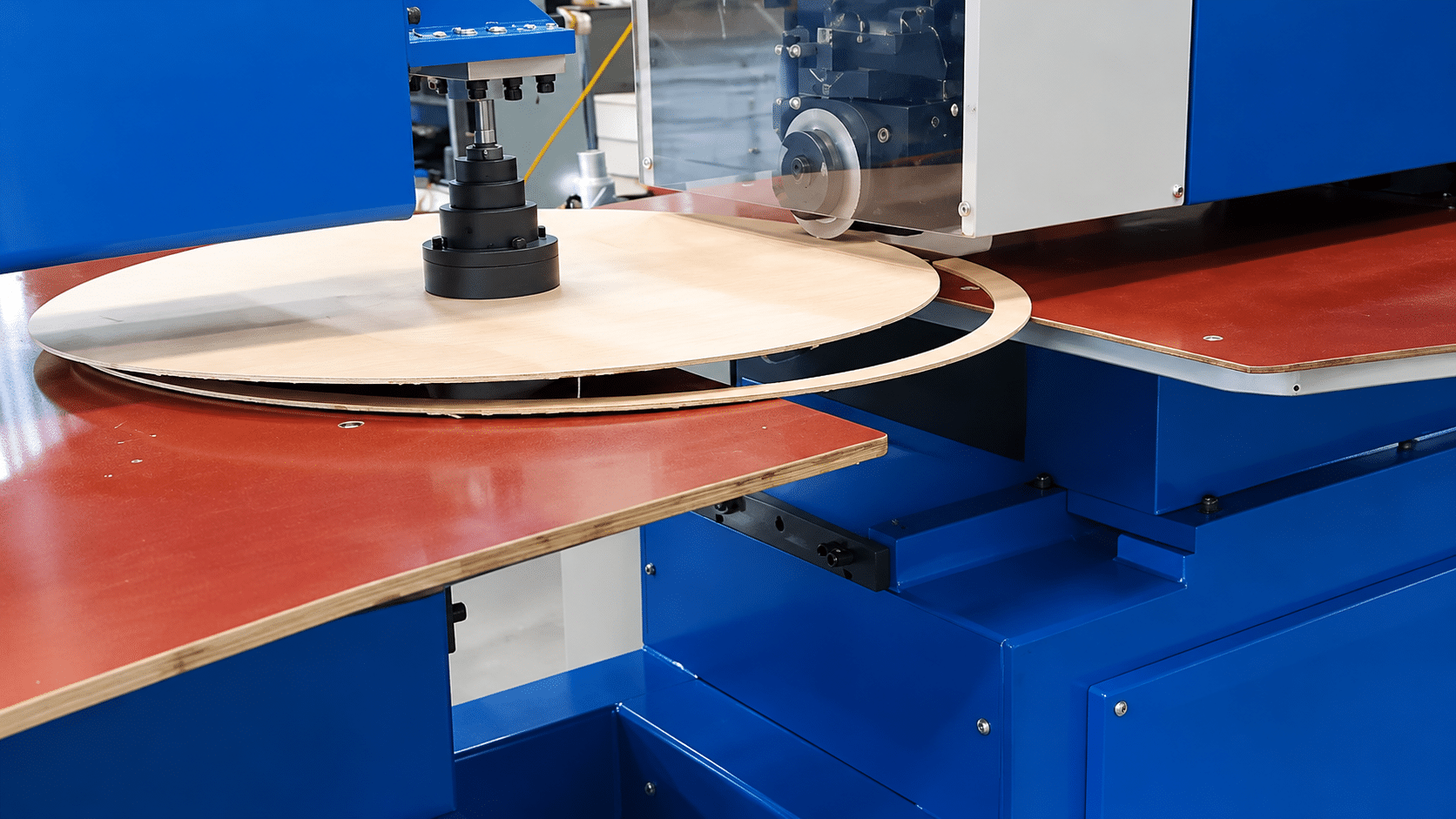
| Equipment | Pressboard Circular Shearing Machine YJΦ300-3000 (YJΦ300-2000 also available in the same series; conventional and CNC versions) |
| Customer | A power transformer and shunt reactor manufacturer in Belo Horizonte, Minas Gerais, Brazil (in-house insulation parts shop) |
| Application | Circular and annular cutting of Ø2200–Ø2800 mm insulation pressboard and epoxy board for cylinder end rings and large-diameter angle rings |
1. Customer Background
The customer is based in Belo Horizonte and builds 13.8–145 kV power transformers and shunt reactors for transmission and distribution projects in south-eastern Brazil. The larger the transformer rating, the larger the insulation cylinder, and the end rings at each end of the cylinder plus the angle rings running around it grow with it — past Ø2200 mm on the higher ratings. All of these large-diameter rings used to be bought in: a full Ø2800 sheet went out to a subcontractor, several rings came back four to six weeks later, and anything out of tolerance was reworked in the customer’s own shop. Once the order book moved up to the 145 kV class, subcontracted rings could no longer hold either the lead time or the consistency, so the customer decided to bring large-diameter ring cutting back into its own insulation shop.
2. Industry Pain Points
In large-diameter pressboard work the difficulty is not the cut itself; it is keeping a sheet more than two metres across from sagging and drifting while the cut travels around it. The customer’s original method had five problems that would not go away:
- The board sagged at its unsupported edge. On a Ø2800 sheet only the centre was clamped, so the outer edge dropped as the cut moved into the second half, and ellipticity drifted by whole millimetres.
- Bought-in lead time was out of the customer’s hands. A full sheet took four to six weeks to come back, so covering a power transformer delivery date meant ordering months ahead and holding the stock on the shop floor.
- Concentric rings could not be nested. Hand scribing allowed only one diameter at a time, so a Ø2800 sheet produced a single ring and the middle of the board became scrap.
- Cut edges furred and delaminated. Hand-sheared or sawn 1–3 mm pressboard needed a grinding pass on every part, which added dust and labour.
- Every diameter change depended on a skilled operator. A new size meant re-scribing, re-centring and trial cutting, and the first part of each batch was set by feel rather than by a setting.
3. Solution
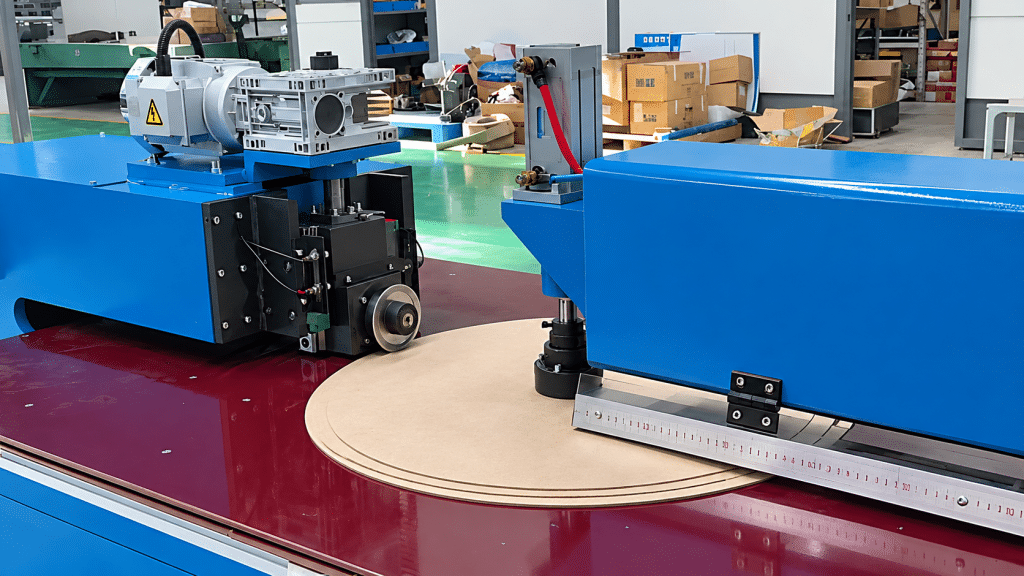
The customer selected the YJΦ300-3000. The objective was not to cut faster but to take the shape accuracy of two-metre pressboard parts away from the operator and give it to the supports and the positioning system:
- One clamping, one rotation. The workpiece is clamped on the worktable and rotates with it, shearing at 30 m/min linear speed, with an upper shear blade elevation above 20 mm and an upper pressing disc elevation above 15 mm — one revolution forms the outer and inner diameter of the ring in a single pass.
- One model covers the large diameters. Ø300–3000 mm is handled inside a single model range, so the Ø2200 end rings and Ø2800 angle rings of this project both fall inside the working range without a second machine for the largest part.
- Adjustable supports on both sides. The support rods on either side of the bed are height-adjustable, so the outer edge of a large-diameter sheet always has a rest under it and the board does not drop as the cut closes.
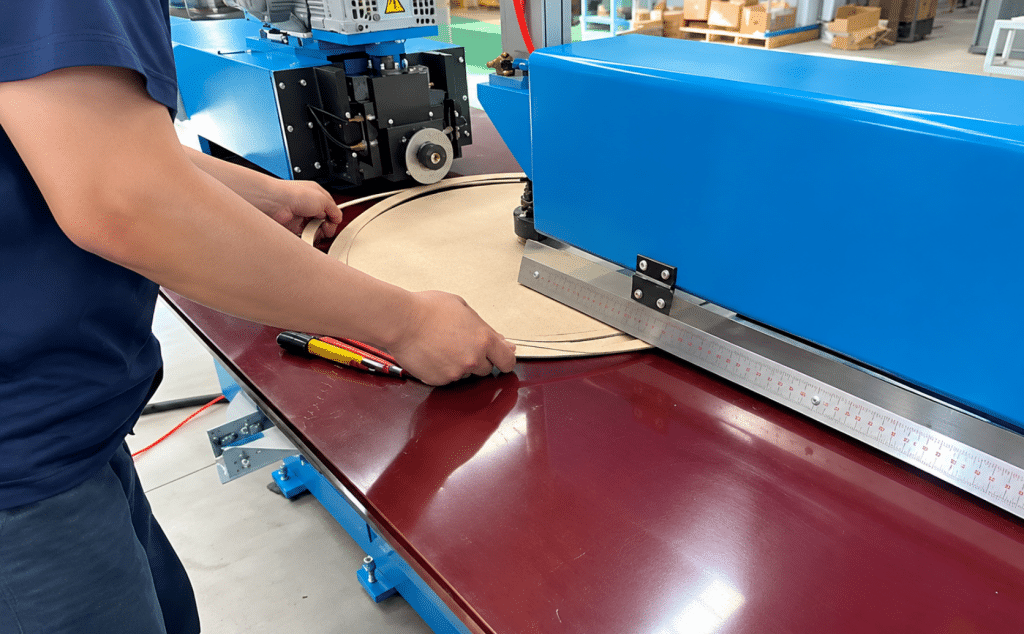
- Rear frame set on a scale and locked. The rear frame carries a graduated scale; it is set to the required diameter and locked, so batch production repeats without re-centring for every part.
- Clean edge and ±1 mm ellipticity. The sheared face is flat and needs no grinding pass, and the machine handles 1–3 mm insulation pressboard and epoxy board alike.
- CNC turns setting into an input value. On the CNC version, tailstock repeat positioning accuracy is ±0.1 mm, so a size change is entered as a diameter rather than found by trial cutting.
4. Implementation and Commissioning
After the machine arrived, TRANFOVIA engineers worked through three steps with the customer’s insulation shop. First, drawing and selection review: the largest end ring at Ø2200, the largest angle ring at Ø2800 and three pressboard thicknesses of 1.5, 2 and 3 mm were checked against the rotary table capacity and the support rod travel, and the rear frame scale was confirmed to cover every size in the range. Second, site work and dry running: the machine was levelled, the feet anchored and the power supply connected, and a dry run verified table rotation in both directions, blade and pressing disc travel, guarding and emergency stops. Third, trial shearing and acceptance: the customer supplied the three board thicknesses, Ø2200 end rings and Ø2800 angle rings were sheared, ellipticity and edge quality were sampled, the machine was confirmed to produce a good first part after a size change made on the scale, and operators were trained on setting to the scale, blade inspection and daily checks using the English documentation.
5. Acceptance Results
The machine was verified item by item against the technical agreement. Key parameters (design and acceptance reference values; actual figures depend on the configuration ordered):
| Parameter | Design and acceptance reference |
| Sheared pressboard diameter | Ø300–3000 mm (Ø2200–2800 mm in this project) |
| Sheared pressboard thickness | 1–3 mm |
| Shearing linear speed | 30 m/min |
| Main motor power | 0.4 kW × 2 |
| Upper shear blade elevation | >20 mm |
| Upper pressing disc elevation | >15 mm |
| Sheared pressboard ellipticity | ±1 mm |
| Tailstock repeat positioning accuracy | ±0.1 mm (CNC version) |
Three board thicknesses and two diameters ran back to back on the day of trial shearing. Every sampled ring sat inside ±1 mm ellipticity, the cut edges showed no delamination or furring, and the end rings went straight onto the insulation cylinders at assembly without re-fitting. The concentric rings were booked into stock by diameter: one Ø2800 sheet yielded the end ring first and the outer angle ring from the remaining material, which halved the scrap compared with the subcontracted route.
6. Customer Feedback
“Large rings used to come from outside — four to six weeks, and anything out of tolerance we ground ourselves. Now a two-metre-eight sheet goes on our own table, one turn gives one ring, the edge is clean and the ellipticity measures inside a millimetre. Once the rear frame is locked, the next part of the same size just runs.” — Customer insulation shop supervisor (at acceptance)
7. Summary and Next Steps
The value of a circular shearing machine is not that it can cut a circle; it is that large-diameter rings come back out of the subcontracting loop. Supports on both sides hold the outer edge of a Ø2800 sheet, so ±1 mm ellipticity no longer depends on how the operator supports the board by hand; the rear frame scale and lock turn a size change into one setting; and shearing at 30 m/min keeps a set of end rings in step with the insulation cylinder assembly line.
Next, the customer plans to build a nesting table for end rings and angle rings by inner and outer diameter, so that parts are cut by number and the remaining board is used instead of scrapped, and to evaluate a second machine of the same series for the smaller diameters alongside the cylinder line. To configure a large-diameter ring cutting solution around your maximum ring diameter and board thicknesses, contact the TRANFOVIA technical team for selection advice and a quotation.
- WhatsApp: +86-15958243831
- Email: sales@tranfovia.com
- Website: https://tranfovia.com/