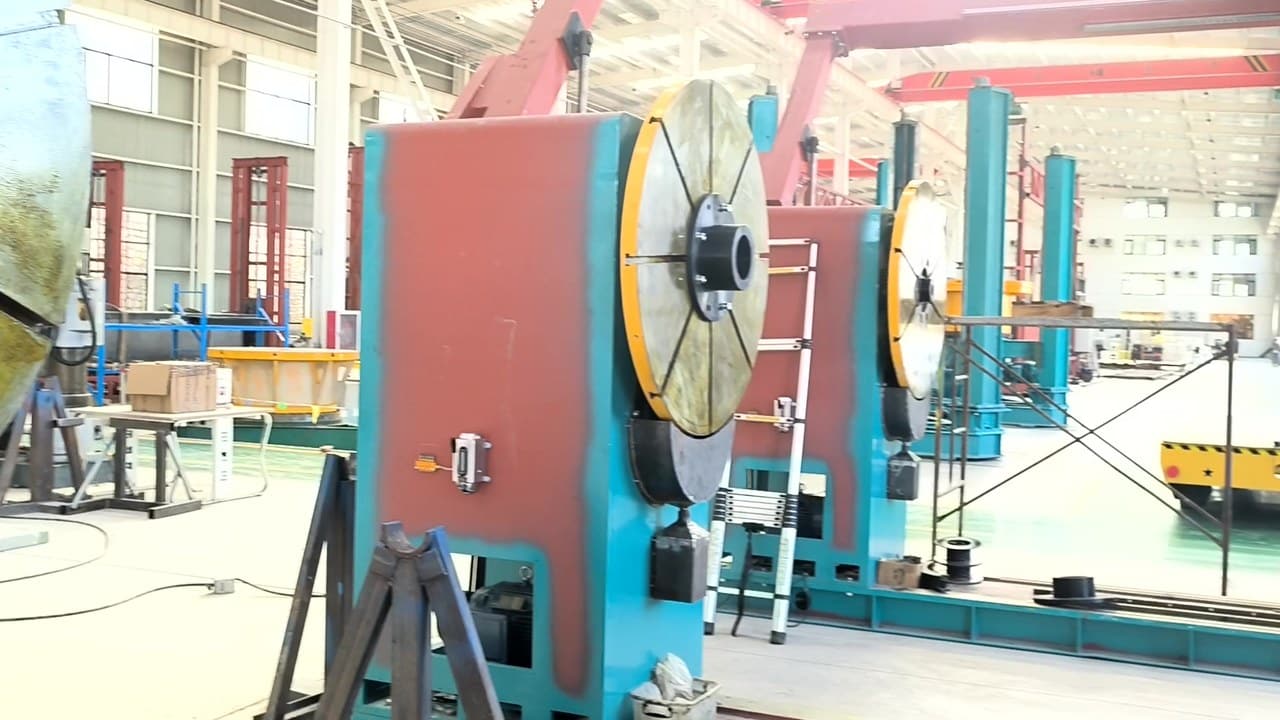
| Equipment | Horizontal Winding Machine (WR Series) |
| Customer | A dry-type reactor and dry-type transformer manufacturer in Dubai, United Arab Emirates (serving the Middle East and North Africa markets) |
| Application | High-torque precision winding of coils for 11–33 kV dry-type air-core reactors, grounding transformers, and series reactors |
Customer information has been anonymized; only regional and industry attributes are retained. Performance figures represent typical reference values under standard operating conditions and may vary depending on actual production line conditions.
Client Background
The client is a dry-type reactor and dry-type transformer manufacturer based in Dubai, United Arab Emirates, serving the Middle East and North Africa (MENA) region. Their product portfolio covers 11 kV–33 kV dry-type air-core reactors, dry-type grounding transformers, and series reactors, with an annual output of approximately 800 units.
Dubai serves as a major power equipment trading hub for the Middle East. In recent years, neighboring countries including Saudi Arabia, Oman, and Egypt have accelerated renewable energy grid integration programs, driving noticeable growth in demand for dry-type reactors. Reactor coils are characterized by heavy conductor diameters, high turn counts, and demanding inter-layer insulation requirements. A single coil typically weighs 1.5–3.5 tons and can exceed 2 meters in winding length. The client’s existing three aging horizontal winding machines suffered from violent start-up shocks, inaccurate counting, and slow changeover procedures, making them unable to keep pace with both order growth and precision requirements.
Industry Pain Points
In the winding of large-torque, long-dimension reactor coils, the client had long struggled with the following challenges:
- Start-up shock damages coil structure: Reactor coil layers are separated by insulation paper or epoxy resin pre-preg. The old machines started at full speed instantly, and the inertial impact caused inter-layer insulation displacement—in severe cases creating turn-to-turn short-circuit risks.
- Turn-count errors are hard to control: A single reactor coil commonly contains 300–600 turns across 10+ layers. Manual counting or simple mechanical counters were highly prone to error during layer changes and direction reversals. A single miscount scrapped the entire coil.
- Speed and torque mismatch: Large-diameter aluminum conductors (up to Φ3.5 mm) require low speed and high torque during winding, while smaller conductors need higher speeds. The old equipment offered only two mechanical gear speeds, making it impossible to handle the full product range optimally.
- Center-distance adjustment is time-consuming: Reactor coil lengths varied from 1.2 m to 2.2 m depending on specification. Each changeover required manually moving the tailstock and realigning the centers, averaging over 40 minutes.
- Unexpected power loss destroys position: Occasional grid fluctuations in the workshop caused complete loss of winding position. Realignment and turn-count verification took 20+ minutes, with a high risk of duplicate counting.
Solution
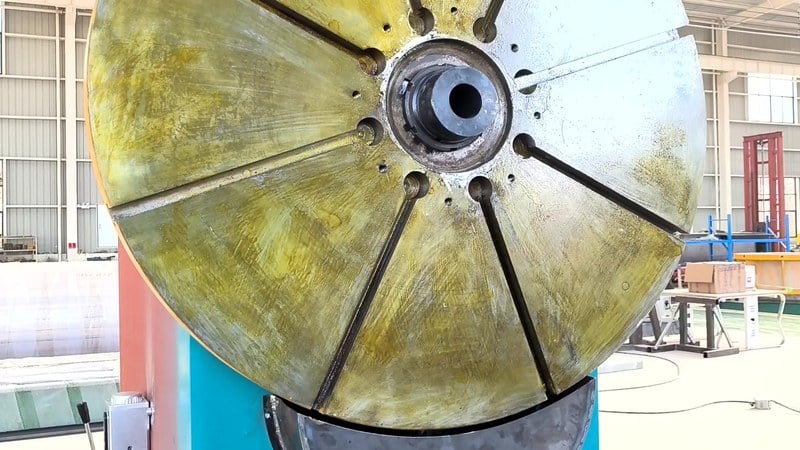
After technical evaluation, the client selected the WR-5 Horizontal Winding Machine (5-ton max load, 4000 N·m main spindle torque, 1400 mm chuck center height, Φ400 mm chuck diameter, 1600–2500 mm center distance). Key advantages of the solution included:
- Smooth soft-start protects coil structure: The machine features a smooth soft-start system that accelerates heavy inertial loads gradually from zero to set speed, with equally gentle braking. This effectively prevents inter-layer insulation displacement and conductor deformation.
- Variable speed with constant torque: A 7.5 kW main motor with variable-frequency drive delivers stepless speed regulation from 0–120 r/min. Large conductors benefit from low-speed, high-torque winding, while smaller conductors run at higher speeds—one machine covers the full reactor coil range.
- High-precision forward/reverse counting + power-off memory: A dedicated counting system supports separate forward and reverse turn counting with freely preset target values. After an unexpected power outage, the machine automatically resumes from the exact breakpoint, eliminating manual realignment.
- Button + pedal dual control: Routine operation is controlled via a button panel, while fine adjustments during threading and mold alignment use a foot pedal. Both hands remain free to guide the conductor, improving operator safety.
- High torque and load capacity: With a rated torque of 4000 N·m and a rated load of 5000 kg, the machine easily handles 3-ton reactor coils without requiring segmented winding and splicing.
Implementation
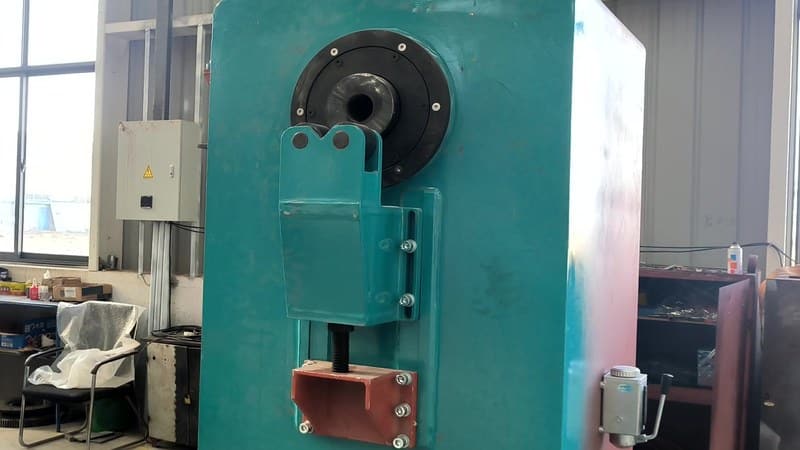
The machine was shipped from Ningbo Port to Jebel Ali Port, Dubai, with a sea transit time of approximately 25 days. As the WR-5 is floor-mounted, the client completed foundation bolt embedding and floor leveling two weeks before delivery, following our foundation drawings.
Upon arrival, our engineer conducted a 6-day on-site installation and commissioning program:
- Days 1–2: Main-body hoisting and positioning, main spindle levelness calibration (≤0.05 mm/m), electrical wiring and grounding.
- Days 3–4: VFD parameter matching (optimized acceleration/deceleration curves for aluminum conductor winding), counter sensitivity calibration, pedal-switch response testing.
- Day 5: First-article trial winding—a 33 kV dry-type air-core reactor coil with a preset turn count of 412. Actual count achieved zero deviation; the soft-start process showed no visible coil vibration.
- Day 6: Operator training (English manual + hands-on practice). Two local winding technicians independently completed the full process for a second coil.
Results and Impact
Four months after commissioning, the client’s winding shop reported the following changes (Results may vary):
| Metric | Before | After |
| Single reactor coil winding cycle | 2.5–3 days | 1.5–2 days |
| Inter-layer displacement from start-up shock | 1–2 out of every 10 coils | Virtually eliminated |
| Turn-count error / out-of-spec scrap | 3–4 coils per month | Zero scrap in past four months |
| Changeover centering time | 40+ minutes | 8–12 minutes |
| Power-loss recovery time | 20+ minutes | Resume directly |
| First-pass yield | ~91% | ~97% |
The client’s winding shop supervisor summed it up plainly:
“We used to dread the moment the thick aluminum wire started up—the whole coil would shake and the layer paper would shift. This machine’s soft start is so smooth you barely feel anything. What gives us the most peace of mind is the counter. Night shifts used to be when miscounts happened most, but now we just set the target turns and the machine stops automatically. Even if the power goes out, we switch it back on and it continues right where it left off.” — Client Winding Shop Supervisor (excerpt)
Why This Case Matters
The winding quality of reactor coils directly determines inductance accuracy, temperature rise performance, and long-term operational reliability. Turn-count errors cause inductance values to deviate from design specifications, while inter-layer insulation defects can lead to localized overheating during operation. A horizontal winding machine with soft start, constant-torque variable speed, and intelligent counting is not merely a productivity tool for reactor manufacturers—it is the foundational equipment that underpins quality assurance.
If you are facing challenges with large-torque coil winding, turn-count precision control, or changeover efficiency, contact us for detailed technical proposals and customization options for the WR Series Horizontal Winding Machine:
- WhatsApp: +86-15958243831
- Email: sales@tranfovia.com
- Website: https://tranfovia.com/