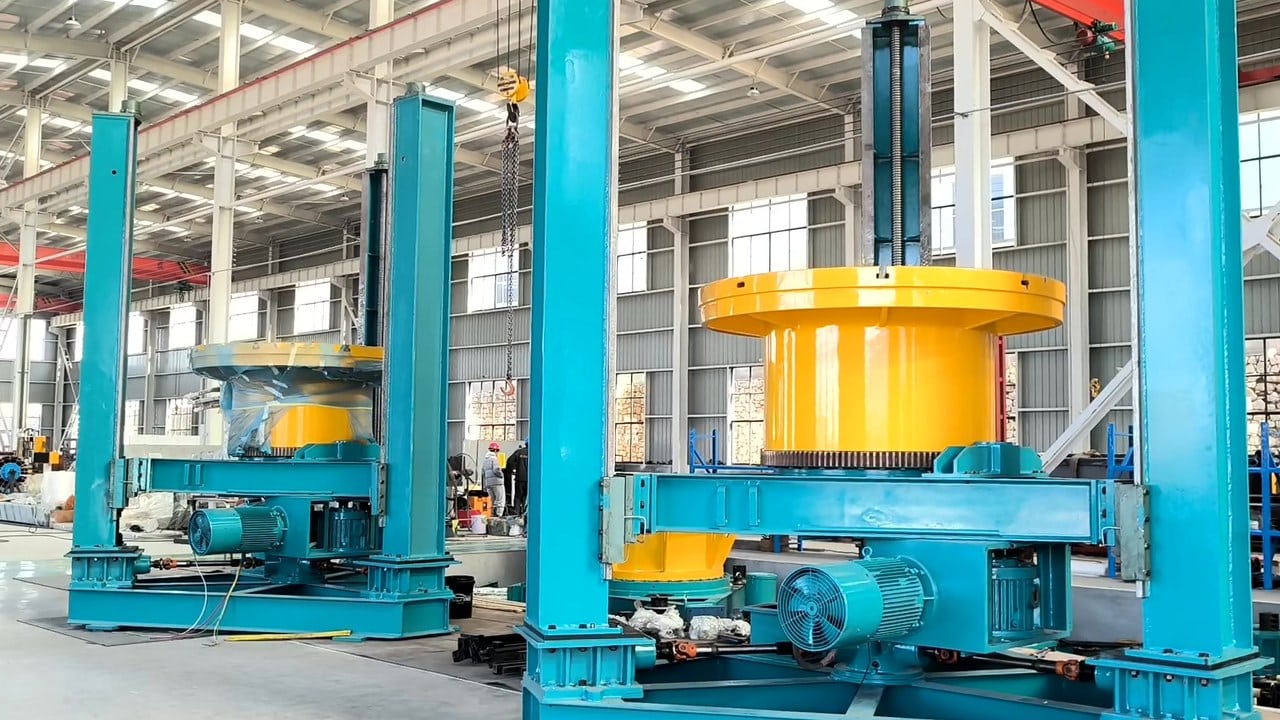
| Equipment | Vertical Winding Machine (LR Series) |
| Customer | A large power transformer manufacturer in Houston, Texas, USA (serving the North American utility grid market) |
| Application | Precision winding of large coils for 69–230 kV oil-immersed power transformers |
Customer information has been anonymized; only regional and industry attributes are retained. Performance figures represent typical reference values under standard operating conditions and may vary depending on actual production line conditions.
Client Background
The client is a large power transformer manufacturer based in Houston, Texas, serving the North American utility grid market. Their product portfolio covers oil-immersed power transformers from 69 kV up to 230 kV, with an annual output of approximately 300 large units. Their end customers include municipal power utilities, wind farm developers, and captive power stations for petrochemical facilities.
In recent years, driven by U.S. grid modernization programs and the surge in renewable energy interconnection demand, the client has received multiple orders for higher-capacity transformers. Unit ratings have grown from the previous 50 MVA standard to over 100 MVA. Higher capacity means significantly larger and heavier coils—a single high-voltage coil can weigh 8–12 tons, exceed 2.5 meters in outer diameter, and reach nearly 3 meters in winding height. The client’s existing two aging horizontal winding machines, with a load limit of only 10 tons, were no longer capable of handling these new requirements. Upgrading to a large vertical winding system became essential.
Industry Pain Points
In the winding of large HV/UHV transformer coils, the client had long struggled with the following challenges:
- Insufficient load capacity: The old machines maxed out at 10 tons. A 12-ton coil had to be wound in two sections and then spliced, adding joint points and increasing insulation risk.
- Severe start-stop shock: Large inertial loads (multi-ton coils plus tooling) caused violent shaking during acceleration and braking, leading to conductor jumping and insulation damage.
- Turn-count control difficulty: Continuous disc coils feature high turn counts per layer and many layers. Manual counting under fatigue inevitably led to errors; a single mistake scrapped the entire coil section.
- Tedious height adjustment: Coil heights ranged from 1.5 m to 2.8 m depending on the design. The old equipment relied on spacer blocks, requiring 2–3 hours of changeover preparation.
- Power-failure recovery: Unexpected outages caused loss of winding position. Realignment took over 30 minutes and introduced turn-count deviation risk.
Solution
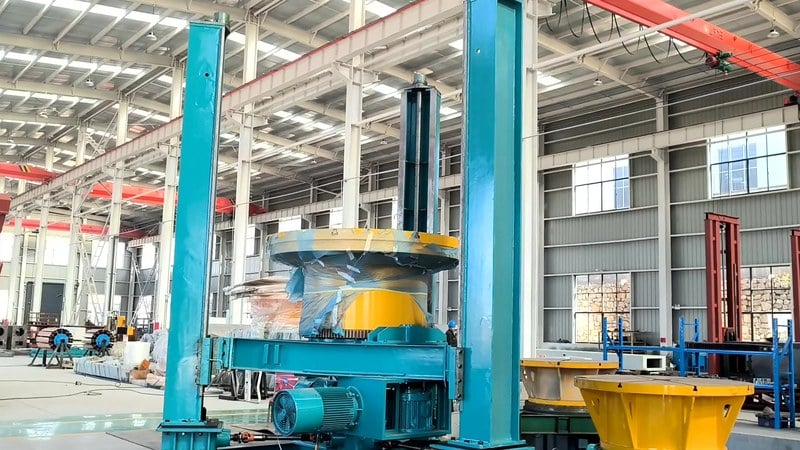
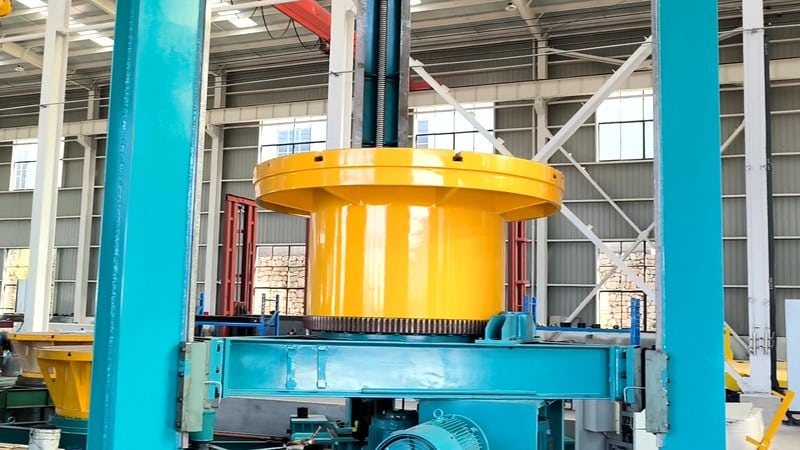
After technical evaluation, the client selected the LR-20 Vertical Winding Machine (20-ton load capacity, Φ2000 mm running diameter, 3000 mm lifting stroke). Key advantages of the solution included:
- Chuck elevation structure: The upper chuck travels vertically along the column via electric lift, allowing flexible coil-height adjustment while the operator platform remains fixed. Workers no longer need to climb or bend; switching between high and low coils takes only 5 minutes.
- VF control with smooth braking: The variable-frequency drive enables gradual acceleration from zero to set speed and shock-free deceleration, effectively preventing conductor jumping even with heavy inertial loads.
- Forward/reverse turn counting + power-off memory: Turn counts can be preset freely; forward and reverse rotations are counted automatically. After an unexpected power loss, the machine resumes precisely from the breakpoint, eliminating whole-section rework.
- Adjustable pit cover: The pit-type cover expands and retracts automatically with coil diameter, protecting operators while accommodating coil sizes from Φ1200 mm to Φ1800 mm.
- High torque with constant tension: Rated torque of 20,000 N·m, wire tensile force of 4000 N, and a presser force of 30,000 N ensure large-diameter coils are wound flat and tight even under low-speed, high-torque conditions.
Implementation
The machine was shipped from Ningbo Port to the Port of Houston, with a sea transit time of approximately 28 days. Because the unit is pit-mounted, the client completed foundation excavation and anchor-bolt positioning two months before delivery, following our foundation drawings.
Upon arrival, our engineer conducted a 7-day on-site installation and commissioning program:
- Days 1–2: Main-body hoisting and positioning, column verticality calibration, electrical wiring.
- Days 3–4: VFD parameter matching, chuck-lift stroke calibration, pit-cover interlock debugging.
- Day 5: First-article trial winding—a 110 kV high-voltage continuous disc coil with a preset turn count of 487. Automatic counting achieved zero deviation.
- Days 6–7: Operator training (English manual + hands-on practice). Three client winding technicians independently completed the full process for a second coil.
Results and Impact
Six months after commissioning, the client’s winding shop reported the following changes (Results may vary):
| Metric | Before | After |
| Single HV coil winding cycle | 5–6 days | 3–3.5 days |
| Coil load capacity limit | 10 tons | 20 tons (no segmentation) |
| Height changeover time | 2–3 hours | 5–10 minutes |
| Turn-count error | Occasional (manual) | Zero (automatic) |
| Power-loss recovery time | 30+ minutes | Resume directly |
| First-pass coil yield | ~92% | ~98% |
The client’s winding shop supervisor summed it up plainly:
“We used to wind 100 MVA coils in two sections because our old machines couldn’t handle the weight, and we were never fully confident about the splice joints. Now the LR-20 winds a 12-ton coil in one piece, and the variable-frequency start is so smooth you barely feel the inertia. What gives us the most peace of mind is the turn counter—night-shift miscounts used to be our biggest fear, but the machine tracks everything automatically, and we never lose position after a power outage.” — Client Winding Shop Supervisor (excerpt)
Why This Case Matters
The core performance of a large power transformer is largely determined by coil winding quality. Turn-count accuracy, conductor tension, inter-layer compactness, and insulation integrity directly affect load losses, short-circuit withstand capability, and long-term operational reliability. A vertical winding machine with ample load capacity and precise control is not merely a productivity upgrade—it is the foundational guarantee of product consistency and quality traceability.
If you are planning a capacity upgrade for large transformer coil winding, or if your current winding equipment is reaching its limits in load, precision, and automation, contact us for detailed technical proposals and customization options for the LR Series Vertical Winding Machine:
- WhatsApp: +86-15958243831
- Email: sales@tranfovia.com
- Website: https://tranfovia.com/