
| Equipment | Silicon Steel Slitting Line |
| Customer | A transformer core and distribution transformer manufacturer in Dhaka, Bangladesh |
| Application | Longitudinal slitting of CRGO silicon steel master coils into narrow strip coils for core lamination production |
Customer information has been anonymized; only regional and industry attributes are retained. Performance figures represent design and acceptance reference values and may vary depending on configuration and actual operating conditions.
1. Customer Background
The customer operates just outside Dhaka, building transformer cores and finished distribution transformers for the domestic Bangladesh market and for South Asia. The core shop releases several dozen lamination sizes a month, and CRGO silicon steel arrives as full master coils — typically 900–1250 mm wide, with 0.23 mm and 0.30 mm the two thicknesses used most.
Slitting used to be fully outsourced: the master coil went out on a truck, came back several days later, and both strip-width tolerance and burr height were whatever the subcontractor decided. From 2024 core output more than doubled, and outsourced slitting became the bottleneck for the whole core line.
2. Industry Pain Points
Master coil width does not match lamination width, so edge trim is written off as scrap. Core laminations are mostly 100–400 mm wide. Shear a 1250 mm master coil to length without slitting it first, and the full edge trim ends up on the scrap pile.
Outsourced slitting puts both lead time and burr height outside the plant. Burrs above spec create short-circuit paths between laminations in a stacked core, pushing no-load loss and temperature rise up together. When incoming inspection fails, the whole coil goes back and core production stops with it.
Strip-width tolerance drifts batch to batch, and the cut-to-length line follows. The shear positions by nominal width. Once the deviation accumulates, the stacking stage can only sort laminations by hand.
A 10 T coil cannot be lifted by hand, and recoil quality is judged by eye. Loading and unloading a coil of that weight is hazardous, and recoil tension set by feel leaves thin strip wavy or loose — which then tracks off-centre when it is uncoiled at the cut-to-length line.
3. Solution
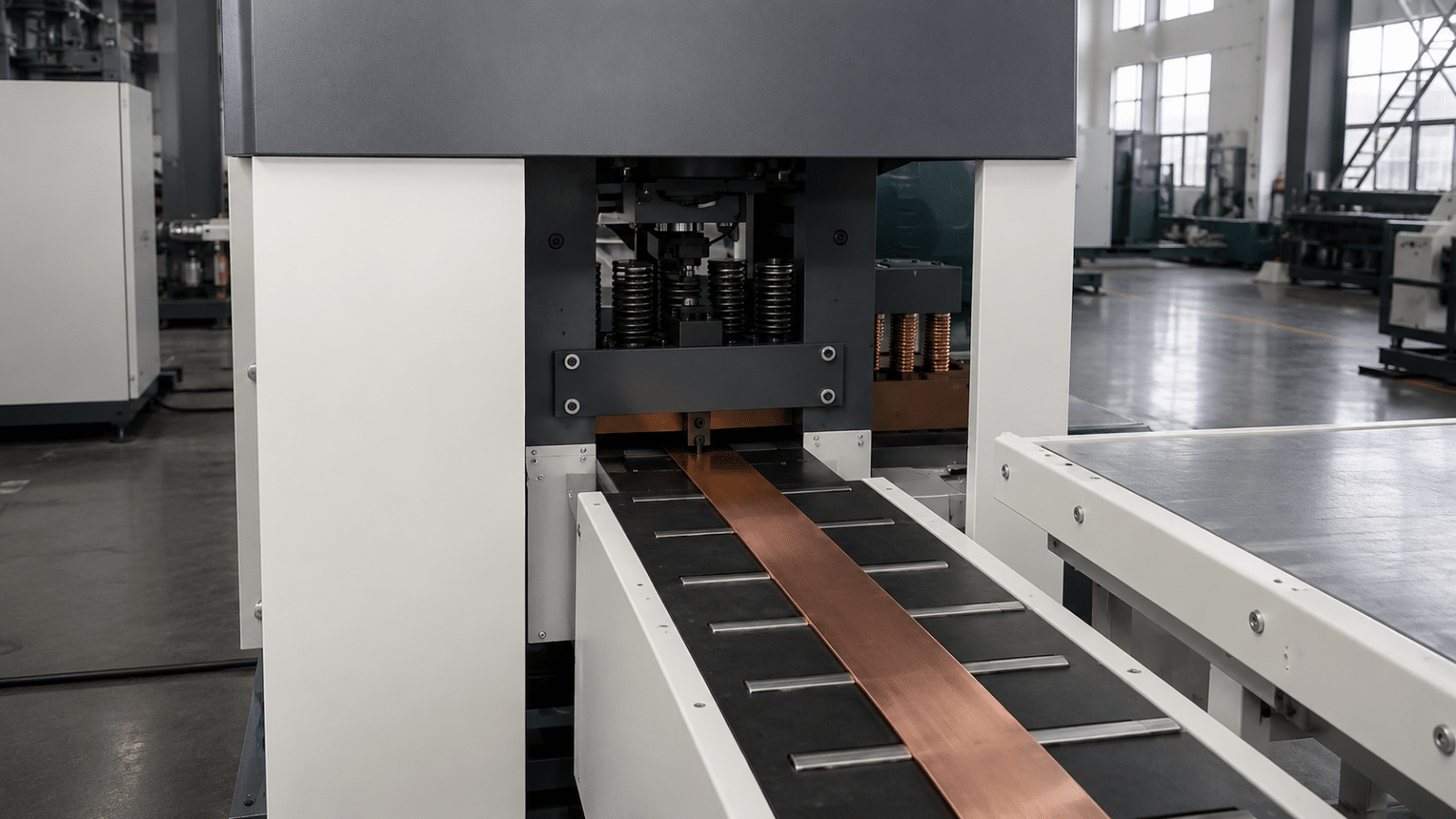
The customer selected the XE-ZJX-1250-10T, a silicon steel slitting line in the 10 T coil class. The point was not to slit faster — it was to take strip width, burr height and material yield back from the subcontractor.
One pass, many knives. Multiple circular blades are set on a single arbor at the target strip widths, and the master coil is divided into all the narrow strips in one pass. Strip width is set by spacers and blade position. A single master coil can be configured to produce the complete set of lamination widths the cut-to-length line needs next.
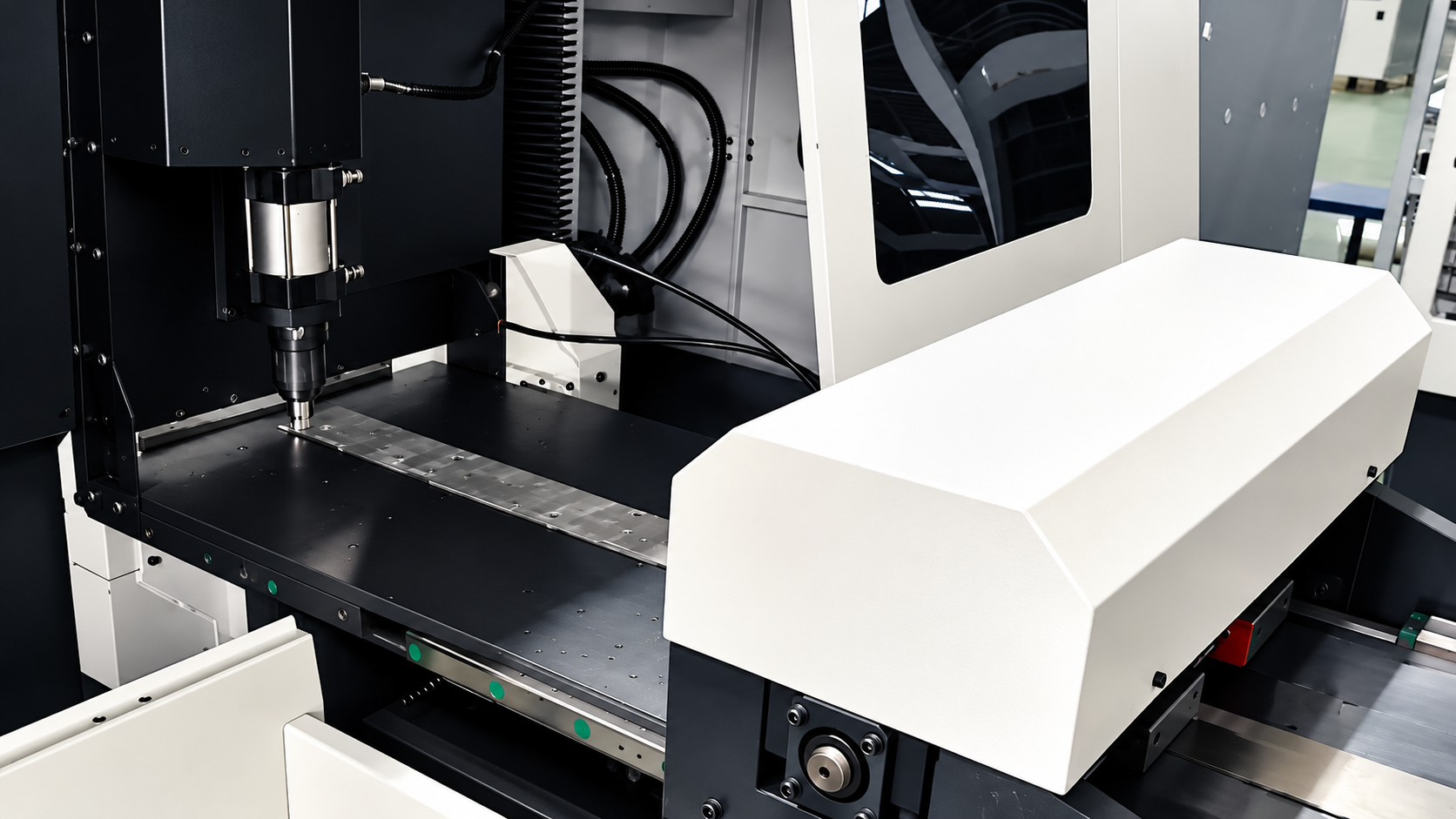
Burr ≤0.02 mm is the governing figure. Blade overlap and side clearance are set by material thickness, and the full 0.15–0.5 mm range holds burr within 0.02 mm. That number decides whether short-circuit paths form between laminations, and it matters far more than slitting speed.
200–1250 mm coil width and 10 T coil weight cover mainstream master coils. The same series also offers the XE-ZJX-1250-5T (5 T, 55 kW) and the XE-ZJX-500-3T (100–500 mm coil width, 2 T, 26 kW) for smaller core shops starting out.
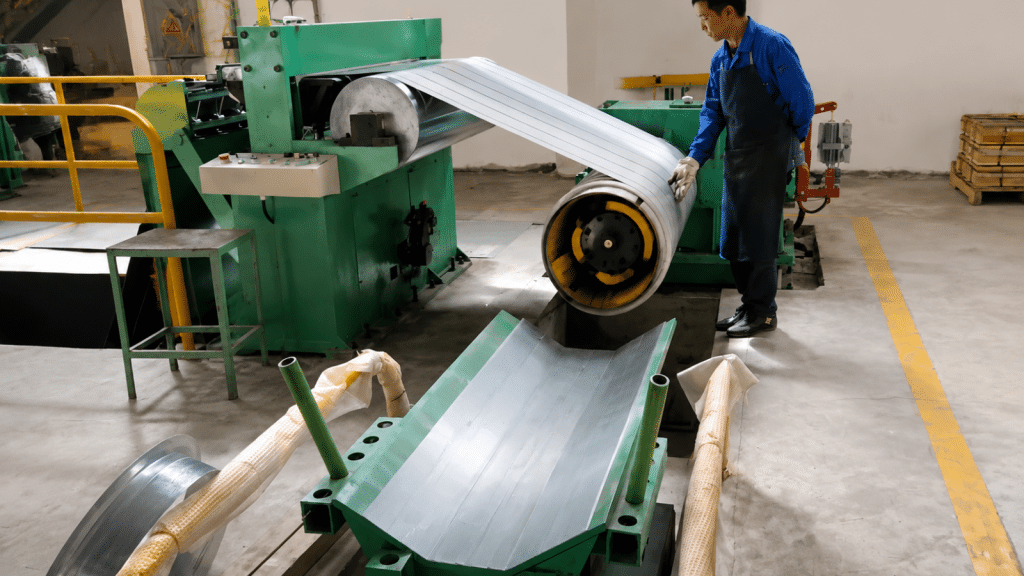
Hydraulic expanding mandrels mean no manual coil handling. Both master coil loading and finished strip coil unloading are handled by the hydraulic expanding mandrel and unloading arrangement.
4. Implementation and Commissioning
The line is laid out in the sequence decoiler, circular shear, recoiler, tying into the existing master coil storage area and the cut-to-length line infeed. Finished strip coils transfer straight to the cut-to-length loading position — no more round trip out of the plant.
Commissioning ran in three stages. No-load verification covered expand and collapse action, roller parallelism, and arbor concentricity and runout. Blade setting and calibration followed: spacers and blades were configured to the target strip widths, then 0.23 mm and 0.30 mm CRGO master coils taken from current production were slit, with every strip measured for width and burr height, and blade side clearance and overlap compiled into a table by material thickness. Finally the line ran with material across the 0–120 m/min range in steps, checking recoil tension and strip centring and confirming square coil faces with no loose wraps and no tracking drift, followed by training for two operators.
The item that needed the most adjustment was blade side clearance. 0.23 mm and 0.5 mm material call for noticeably different clearances; too little clearance leaves a squeeze mark on the strip edge, too much lets the burr rise. Recoil tension was also split into two ranges by thickness, with thin material run at low tension so the coil core does not take a wave set.
](https://tranfovia.com/wp-content/uploads/2026/09/silicon-steel-slitting-line-adjustable-width--1024x576.png)
5. Acceptance Results
With strip width and burr spot checks passed, the line was handed over against the following design and acceptance reference values.
| Item | Design and acceptance reference value |
| Model | XE-ZJX-1250-10T |
| Coil width | 200–1250 mm |
| Coil weight | 10 T |
| Slit strip width | 40–1200 mm |
| Strip thickness | 0.15–0.5 mm |
| Shearing speed | 0–120 m/min |
| Burr height | ≤0.02 mm |
| Installation capacity | 73 kW |
| Same-series options | XE-ZJX-1250-5T (5 T / 55 kW); XE-ZJX-500-3T (100–500 mm coil / 2 T / 26 kW) |
6. Customer Feedback
“A coil used to go out for slitting and take three or four days to come back, and then we still had to inspect the burrs — a failed coil went straight back. Now the master coil produces strip the same day it arrives, and the cut-to-length line no longer has to make up stacking differences from whatever width actually came in.” — Head of the customer’s core shop
7. Summary and Next Steps
What the project brought back are the three things that used to sit with the subcontractor: strip width, burr height and lead time. The master coil produces strip the day it arrives, burr is held within 0.02 mm, and the full width combination for the cut-to-length schedule comes off in one setup.
For a core shop, the value of a slitting line ultimately lands on material yield: whether the same master coil produces a little less edge scrap and needs one less manual sorting pass matters more to cost than the line’s running speed. Next, the customer plans to link slitting and cut-to-length scheduling so that strip configurations are derived backwards from lamination width combinations, and to record strip width and burr data as coil-level traceability files.
Get a Quote
- WhatsApp: +86-15958243831
- Email: sales@tranfovia.com
- Website: https://tranfovia.com/