| Equipment | Automatic Electrostatic Powder Coating Line |
| Customer | Transformer tank and distribution panel manufacturer in Pune, India (in-house coating shop) |
| Application | Continuous electrostatic powder coating and curing of large welded steel fabrications such as transformer tanks, compact substation enclosures and distribution/control cabinets |
Customer information has been anonymized; only region and industry attributes are retained. Figures are design and acceptance reference values and may vary with configuration and site conditions.
1. Customer Background
The customer builds distribution transformer tanks, compact substation enclosures and distribution panels in Pune, one of western India’s denser electrical and automotive manufacturing clusters. A tank here is a box-type welded fabrication up to roughly L3000 × W1000 × H2000 mm and no more than 250 kg per hook, with internal baffles, flange faces and deep weld cavities; the cabinets are multi-aperture sheet-metal parts on the same conveyor. Once export orders and local utility tenders started landing in the same quarter, the coating shop became the constraint on the whole plant — not because it could not spray, but because it could not spray evenly, could not cure fast enough, and could not stop wasting powder.
2. Indian Transformer Tank Manufacturer’s Coating Challenge
- Recesses depended on the operator. Flange backs, internal baffles and the roots of radiator stiffeners had to be chased by hand, with the sprayer walking around the workpiece to find an angle. Film build came out thick in some places and thin in others, and salt-spray testing failed first at exactly those thin spots. One rework meant stripping, re-spraying and re-curing, which threw the delivery schedule off.
- Overspray went straight to waste. The old booth had no effective recovery, so oversprayed powder went into the filters as scrap. Powder consumption per part was high, and a colour change meant stopping the line to clean the booth.
- The batch oven capped throughput. The old oven ran in batches: heat-up to 200°C took over an hour, a load held only two or three tanks, and the temperature spread across the load was wide enough to shift gloss and shade within a single batch.
- Safety and emissions. Powder clouds and static accumulation, on top of the regional pollution control board’s limits on particulate and VOC emissions, made the old line hard to defend: it had no flame detection, no explosion venting and no interlocking, so it could not clear a safety review.
- Dependence on skilled sprayers. Quality moved with whoever was holding the gun, and training a new sprayer took months.
3. TRANFOVIA Automatic Powder Coating Line Solution
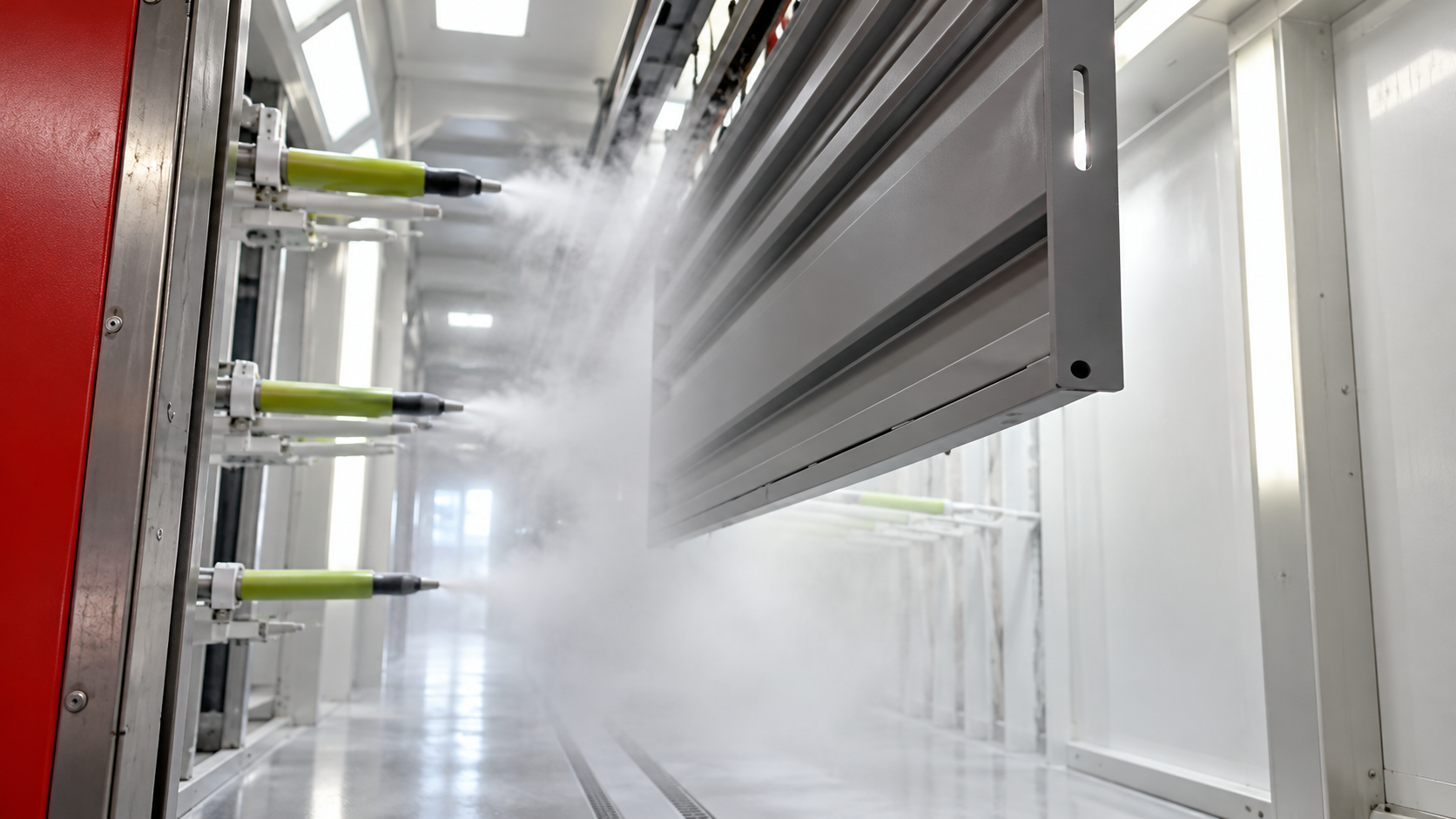
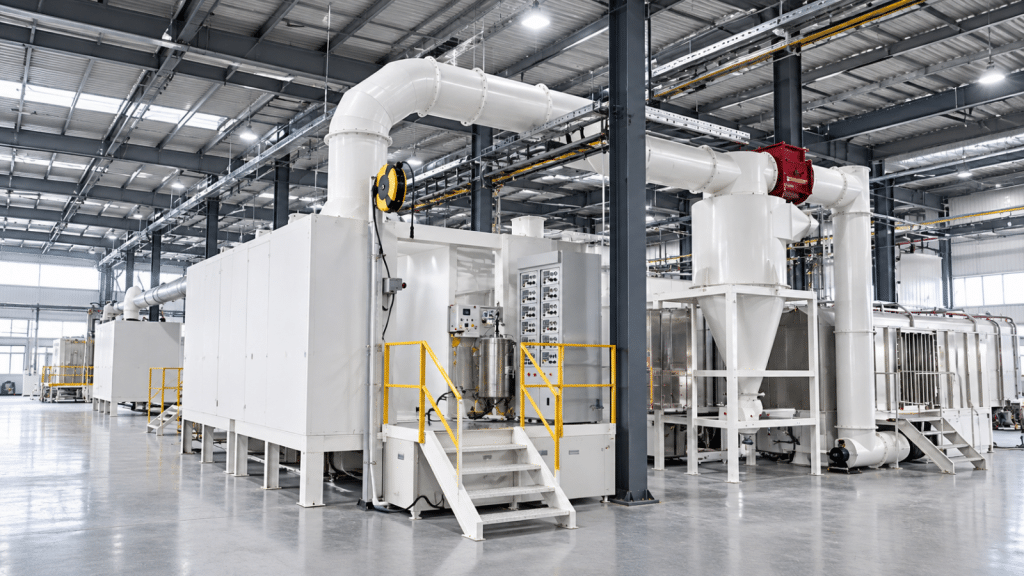
TRANFOVIA supplied a turnkey line: manual loading → electrostatic powder spraying (8 automatic guns plus 2 manual touch-up guns, about 2 minutes per hook) → powder curing (180–220°C for 20–30 minutes) → manual unloading.
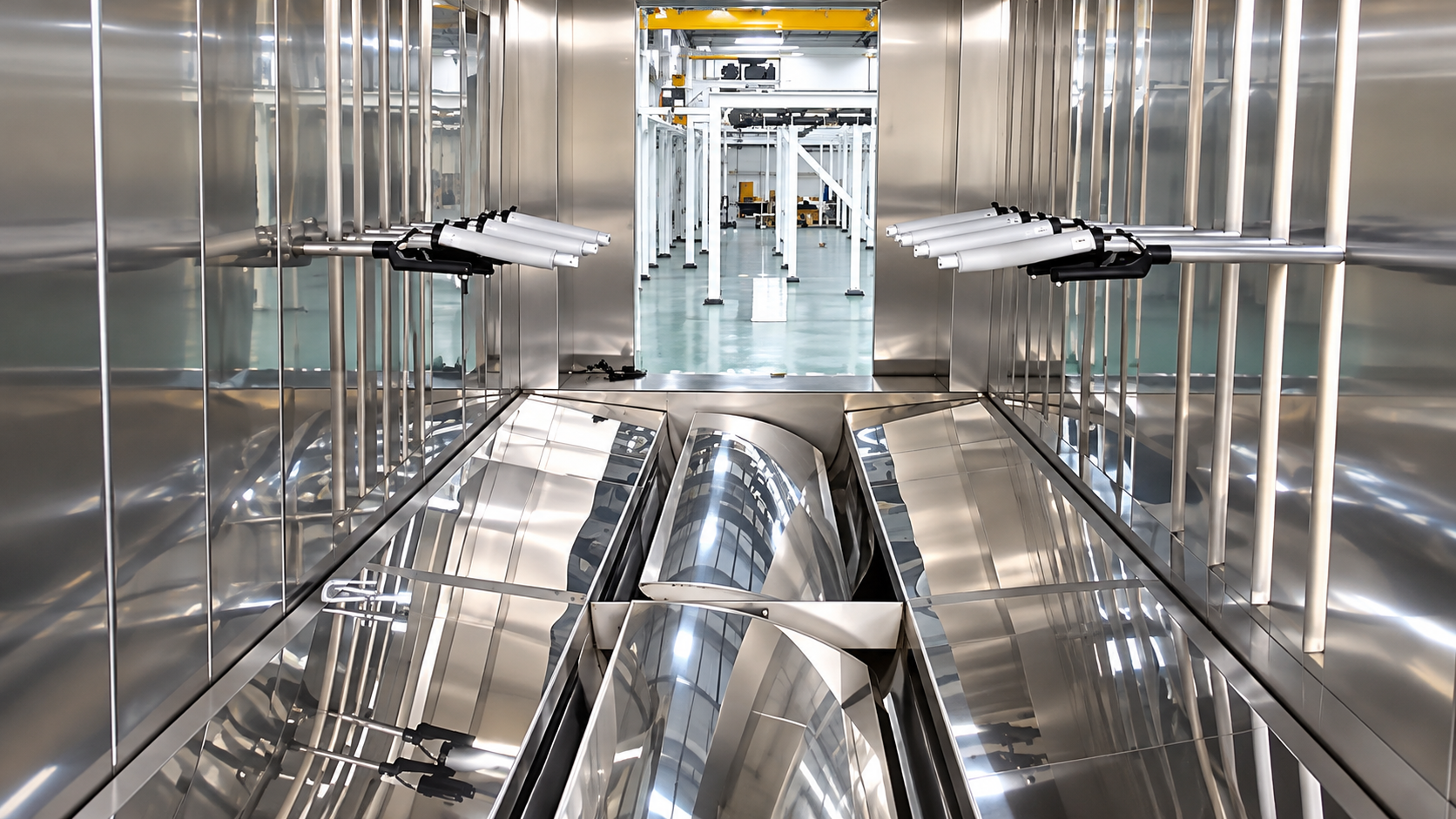
- Powder booth. L6500 × W2000 × H4200 mm, with 1.5 mm double-brushed stainless steel side and roof panels and a mirror-finish stainless floor for easy cleaning. Two sets of automatic and manual gun openings on each side, arranged in a staggered pattern. Explosion-proof LED lighting on the roof gives ≥400 Lux inside the booth, and the face velocity at the booth openings is held at 0.5–0.6 m/s so powder does not escape.
- Guns and reciprocators. Eight high-pressure electrostatic automatic guns delivering about 500 g/min, carried by two digital variable-frequency reciprocating elevators with a 2500 mm stroke and infinitely adjustable speed of 0.06–0.6 m/s; upper and lower limits can be preset to prevent collision. Two manual touch-up units (0–90 kV DC) cover flange backs and deep cavities.
- Powder recovery. A Φ1400 mm primary cyclone separates and returns powder at 95% recovery, feeding the hopper automatically in a closed loop. A secondary bank of 18 coated cartridges (Φ325 × 900 mm) with timed electronic pulse-jet cleaning handles 24,000 m³/h through a 30 kW dust-explosion-proof motor, keeping equipment noise at or below 80 dB(A).
- Curing oven. A 30 m bridge-type, dual-pass convection oven with 44 m of effective heated length. 120 mm rock wool insulation and a bolted-panel construction eliminate thermal bridging. A 500,000 kcal burner (biomass pellet with diesel ignition; electric heating optional) is controlled by PLC, with PID temperature uniformity of ±3°C. Heat-up from 15°C ambient to set point takes 40 minutes, and curing runs 20–25 minutes.
- Explosion-proof safety. An explosion isolation valve sits between the cyclone and the secondary filter. UV/dual-IR flame detectors with high-pressure water spray guard the booth openings. Flameless venting is fitted to the side of the cartridge bank, with an electric rotary airlock below. A duct spark detector and a PLC touch screen monitor nine signal channels and interlock them with the fan, powder feed and power supply.
- Exhaust treatment. A spray washing tower combined with a two-stage honeycomb activated carbon unit handles 8,000 m³/h, achieving ≥95% organic waste gas purification at ≤300 Pa resistance and ≤45 dB noise.
- Conveyor and controls. An XT-100 heavy-duty overhead suspension chain rated at 250 kg per hook, roughly 186 m long, running on national-standard I-beam track with counterweight tensioning and variable speed of 1.0–2.0 m/min (0–4 m/min unloaded). The oven, booth, explosion-proof system, exhaust treatment and conveyor are integrated into one PLC control system, with explosion-proof electricals in the hazardous zones.
4. Implementation and Commissioning
The line was laid into an existing bay: rail height 3200 mm, hook pitch 600 mm, and a 186 m chain routed as a closed loop around the oven and booth. Foundations and the cyclone/cartridge assembly went in first, then the oven was assembled from bolted panels so no thermal-bridge welding was needed on site. Ducting and water lines were routed overhead to keep the crane path clear.
Commissioning ran in sequence: dry run of the conveyor, airflow balancing until the booth face velocity sat at 0.5–0.6 m/s, calibration of powder output and gun distance, a no-load oven heat-up from 15°C ambient to set point within 40 minutes, PID tuning to ±3°C, then item-by-item testing of the safety interlocks — flame detection triggering the water spray, the isolation valve, and spark detection tripping the fan. Finally a tank and a cabinet were run as a first-article pair.
5. Acceptance Results
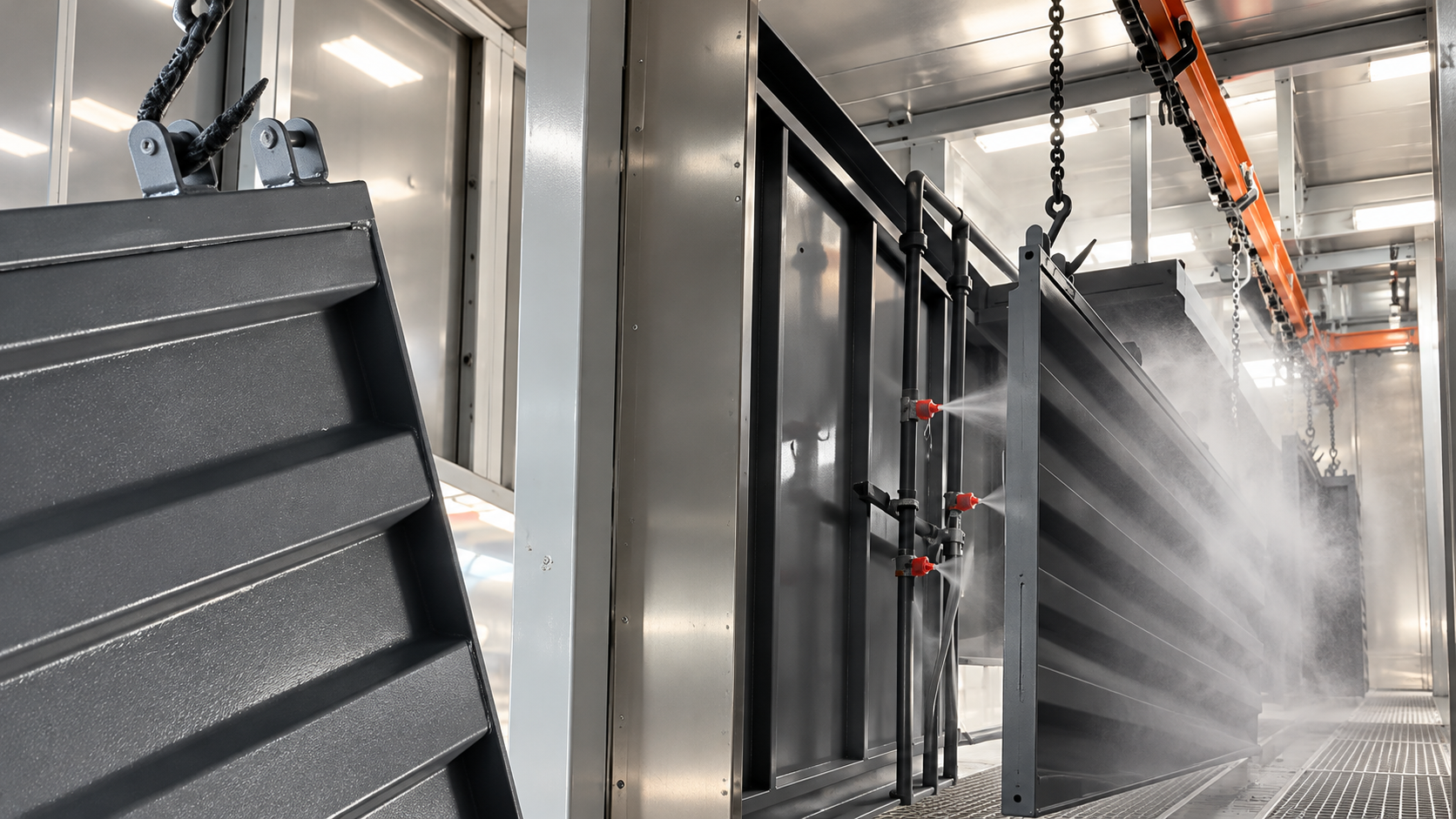
- Coverage. The eight automatic guns and reciprocators cover the large flat faces and radiator stiffeners; flange backs and internal baffles are handled by the touch-up guns at fixed positions. Tanks pass the booth in one run instead of being chased for film build.
- Recovery. The cyclone and cartridge filter run as a closed loop, returning 95% of overspray to the hopper, with no visible dust at the filter discharge.
- Curing. A 40-minute heat-up and a 20–25 minute cure, with ±3°C spread inside the oven, keep shade and gloss stable within a batch.
- Takt. At 600 mm hook pitch, the 1.0–2.0 m/min conveyor speed equals roughly 1.5–3 hooks per minute. The 44 m effective oven length holds about 70 hook positions, so at 1.2 m/min the curing dwell comes out at about 25 minutes — inside the 20–25 minute process window.
- Safety and environment. All nine interlock channels passed on test; organic waste gas purification reached ≥95%, with booth noise at or below 80 dB(A) and the exhaust unit at or below 45 dB.
6. Customer Feedback
“The curing oven used to be our bottleneck — coating is no longer what holds us back,” the customer’s coating supervisor said. The most visible changes, in their words, are a lower powder bill and fewer reworks, and “for the first time we can put appearance consistency for export orders into a commitment.”
7.Why This Project Matters for Transformer Manufacturers
Transformer tanks are difficult coating workpieces because they combine large flat surfaces with welded corners, flange areas, internal structures and recessed sections.
A successful automatic coating line therefore requires more than adding automatic spray guns.
The spraying system, powder recovery, workpiece transport, curing process and safety controls must operate as one coordinated system.
In this project, three areas delivered the greatest value:
Consistent one-pass coating coverage, supported by automatic and manual spray stations.
Closed-loop powder recovery, using the Φ1400 mm cyclone and secondary cartridge filtration system.
Stable curing, with controlled temperature distribution and continuous conveyor residence time.
Together, these improvements removed major constraints from the customer’s previous manual coating and batch-curing process.
8.Need a Powder Coating Line for Transformer Tanks?
TRANFOVIA provides customized transformer tank manufacturing equipment and automatic coating solutions according to workpiece dimensions, production capacity, coating process and factory layout.
For a suitable powder coating line configuration, provide your maximum workpiece dimensions, weight, required production capacity, powder type and available workshop layout.
- WhatsApp: +86-15958243831
- Email: sales@tranfovia.com
- Website: https://tranfovia.com/