| Equipment | Automatic Immersion Pretreatment Line for Transformer Tanks (gantry-type overhead hoist + total-immersion zinc phosphating; standard 7-tank version, 9-tank version available as upgrade) |
| Customer | Transformer tank and switchgear enclosure manufacturer in Colombo, Sri Lanka (in-house surface-prep shop) |
| Application | Degreasing, surface conditioning and zinc phosphating of large welded steel fabrications such as transformer tanks and switchgear enclosures, providing a clean phosphate base for powder coating / painting |
1. Customer Background
The customer manufactures distribution and power transformer tanks and switchgear enclosures in Colombo, running an in-house powder-coating shop. A transformer tank is a box-type welded fabrication with internal baffles, flange faces and deep weld cavities, so the quality of pre-treatment directly decides how long the coating survives outdoor salt-spray service. As export orders grew, the customer needed a stable, high-volume, environmentally compliant pre-treatment line that could bring every tank — inside and out — to a uniform phosphate state before painting.
2. Industry Pain Points
Box-type tanks expose the classic pre-treatment gaps of “shadowed cavities, inconsistent batches, and environmental pressure”:
- Spray tunnels leave shadows: the old spray line could not reach the internal baffles and deep weld cavities of tanks, so the phosphate film was incomplete and rust started from those blind spots after powder coating;
- Incomplete degreasing: large welded parts carry heavy, awkward oil and grease; a short single-tank dip left residues that caused patchy phosphating and poor adhesion;
- Manual hoist, chaotic rhythm: an operator-driven hoist gave inconsistent dwell times and cross-contaminated baths, so the same batch of tanks varied in finish;
- Environmental and hazardous-waste pressure: adding acid pickling would mean large wastewater and acid-fume treatment investment plus strict permitting; the customer wanted to avoid pickling first;
- Capacity bottleneck: manual loading plus a semi-automatic line capped output per shift and became the constraint on the powder-coating line after expansion.
3. Solution
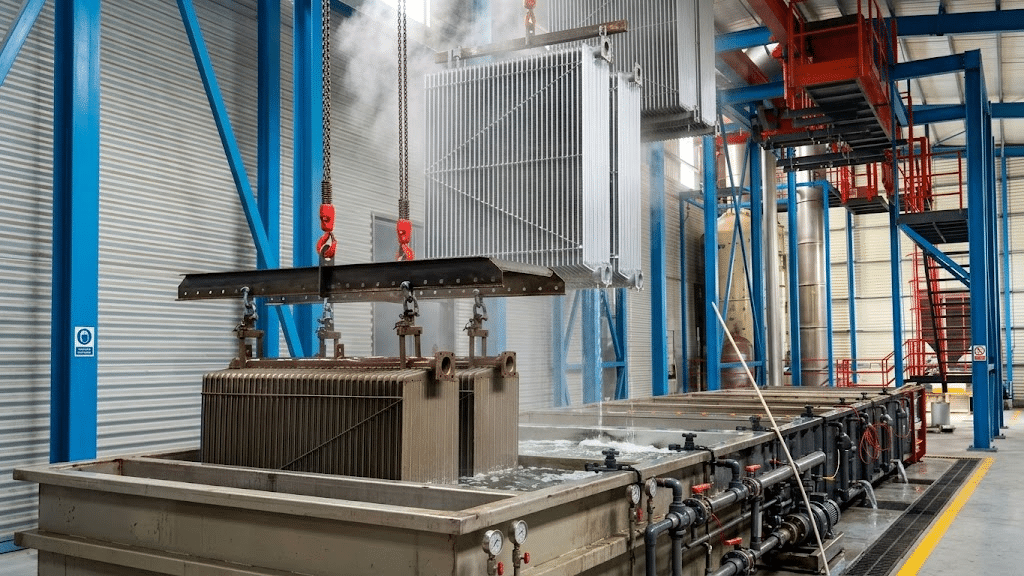
The customer chose the automatic immersion pretreatment line for transformer tanks, using a gantry-type programmed hoist to invert and dip each tank sequentially through every bath. The standard 7-tank version meets the no-acid-pickling environmental goal first, with the 9-tank version kept as an upgrade path for scale- and rust-bearing stock. Key points:
- Total immersion, full coverage: workpieces hang inverted and are two-point suspended, processed by total immersion so internal surfaces, baffles and weld seams all meet identical bath chemistry — no spray shadows;
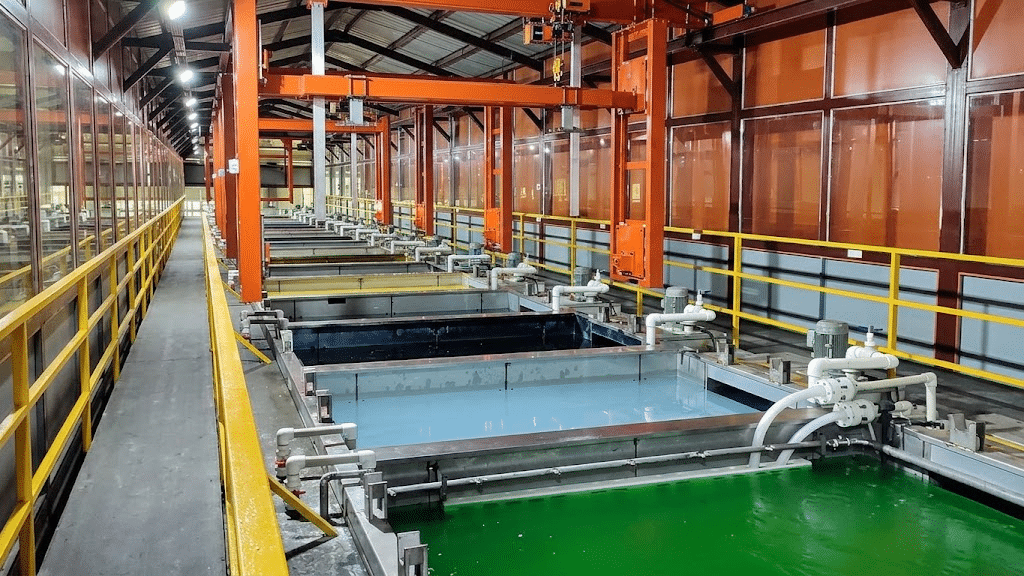
- Standard 7-tank process: pre-degrease (60°C) → main degrease (60°C) → water rinse (immersion + out-of-tank spray) → surface conditioning (60°C) → zinc phosphating (60°C) → water rinse → deionised final rinse, with zero acid pickling and minimal hazardous waste;
- Programmed overhead gantry hoist: 4–5 ton capacity with closed-loop encoder positioning (±5 mm repeatability), VFD speed control with automatic slowdown near stations, and a 2–3° tilt on lift for drainage and anti-cross-contamination;
- Siemens S7-1200 PLC + 10″ HMI: dwell time adjustable 0.1–99.9 min, with 7 automated dosing stations controlled by PID on online pH, conductivity and acidity signals;
- Zinc phosphate base: zinc phosphating coating weight 2–4 g/m² and salt-spray resistance ≥200 h, delivering an outdoor-grade adhesive base for powder coating;
- Closed-loop deionised final rinse: 2 t/h RO water (conductivity ≤10 μS/cm) with Cl⁻ <20 ppm red-line monitoring to keep residual ions from damaging the coating.
4. Implementation and Commissioning
After delivery, TRANFOVIA engineers and the customer’s surface-prep shop commissioned the line in three steps. Step one, confirm tank and rinse configuration against the drawing: verify the workpiece envelope L2500×W1500×H1850 mm and max 3000 kg, then set each 7-tank temperature and dwell time and program the hoist sequence. Step two, site preparation and no-load run: level the line, fix the free-standing steel structure, connect 230/400V 50/60Hz power and the pure-water RO system, then verify ±5 mm hoist positioning, the 2–3° drainage tilt, and upper/lower limits with audible-visual alarms. Step three, loaded trial and training: the customer supplied oily welded tanks and ran them through pre-degrease to final rinse, measuring coating weight and salt-spray panels, checking cross-contamination and conductivity; the team was then trained on process setting, automated dosing and daily inspection per the English manual.
5. Acceptance Results
The line was accepted item by item against the technical agreement; key parameters are below (design and acceptance reference values, actual depends on configuration):
| Item | Design & Acceptance Reference |
| Applicable workpiece | Transformer tanks and large welded steel parts (Q235B / SPCC) |
| Workpiece envelope | ≈ L2500×W1500×H1850 mm |
| Max workpiece weight | ≤ 3000 kg |
| Process stages | Standard 7 tanks (no pickling); 9-tank upgrade available |
| Designed output | 16–20 pieces/shift (≈ 50 min/piece) |
| Hoist capacity / positioning | 4–5 T, repeatability ±5 mm |
| Zinc phosphate coating weight | 2–4 g/m² |
| Salt spray resistance | ≥ 200 h |
| Power supply | 230/400V, 50/60Hz |
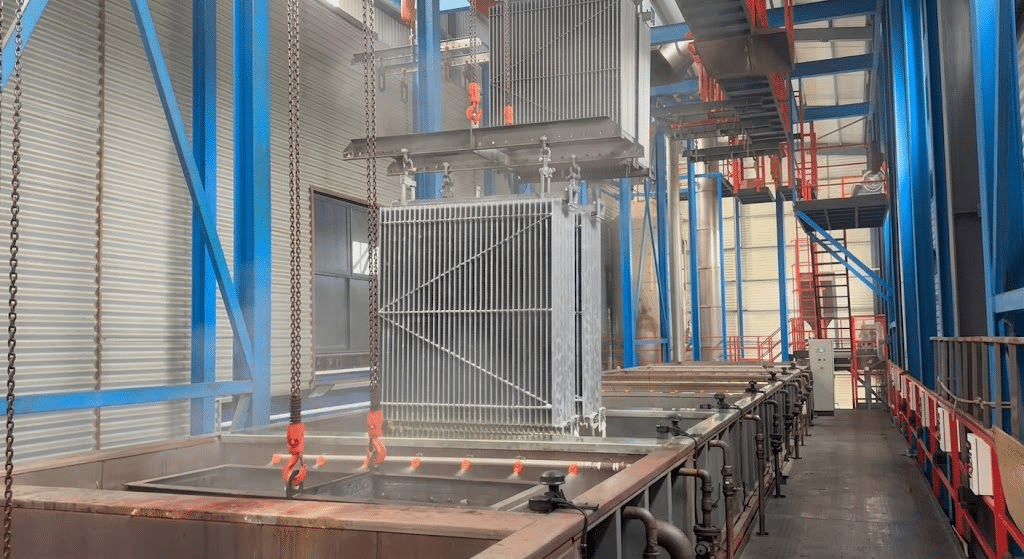
On the trial day tanks ran through all seven tanks consecutively: inverted hanging left no shadowed blind spots, the zinc phosphate film covered internal and external surfaces evenly at 2–4 g/m² with salt-spray panels ≥200 h, the deionised final rinse met conductivity limits, and the whole batch went straight to powder coating.
6. Customer Feedback
“With spray treatment the tank interior always had unreached spots and rusted from the cavities first. After switching to the gantry immersion line the tanks hang inverted and dip fully — inside and out are the same, the phosphate film passes 200 hours salt spray, first-pass powder-coating yield is up, and we generate less hazardous waste than with pickling.” — Surface-prep shop supervisor (acceptance stage)
7. Summary and Next Steps
The value of the gantry immersion pretreatment line is “full coverage + batch consistency + low environmental threshold”: the gantry-type programmed hoist inverts and fully immerses each tank, removing spray shadows; the standard 7-tank no-pickling version meets the customer’s low environmental-investment goal today, while the zinc phosphate film at 2–4 g/m² and ≥200 h salt spray backs up the powder coating; the Siemens S7-1200 PLC and 7 automated dosing stations keep every batch consistent.
Next, the customer plans to keep the 9-tank version (with HCl pickling, neutralizing and a dewatering oven) as an upgrade option for scale- and rust-bearing stock, and TRANFOVIA can size the wastewater and acid-fume treatment to local discharge limits. For a turnkey automatic immersion pretreatment line for transformer tanks, contact the TRANFOVIA technical team.
- WhatsApp: +86-15958243831
- Email: sales@tranfovia.com
- Website: https://tranfovia.com/