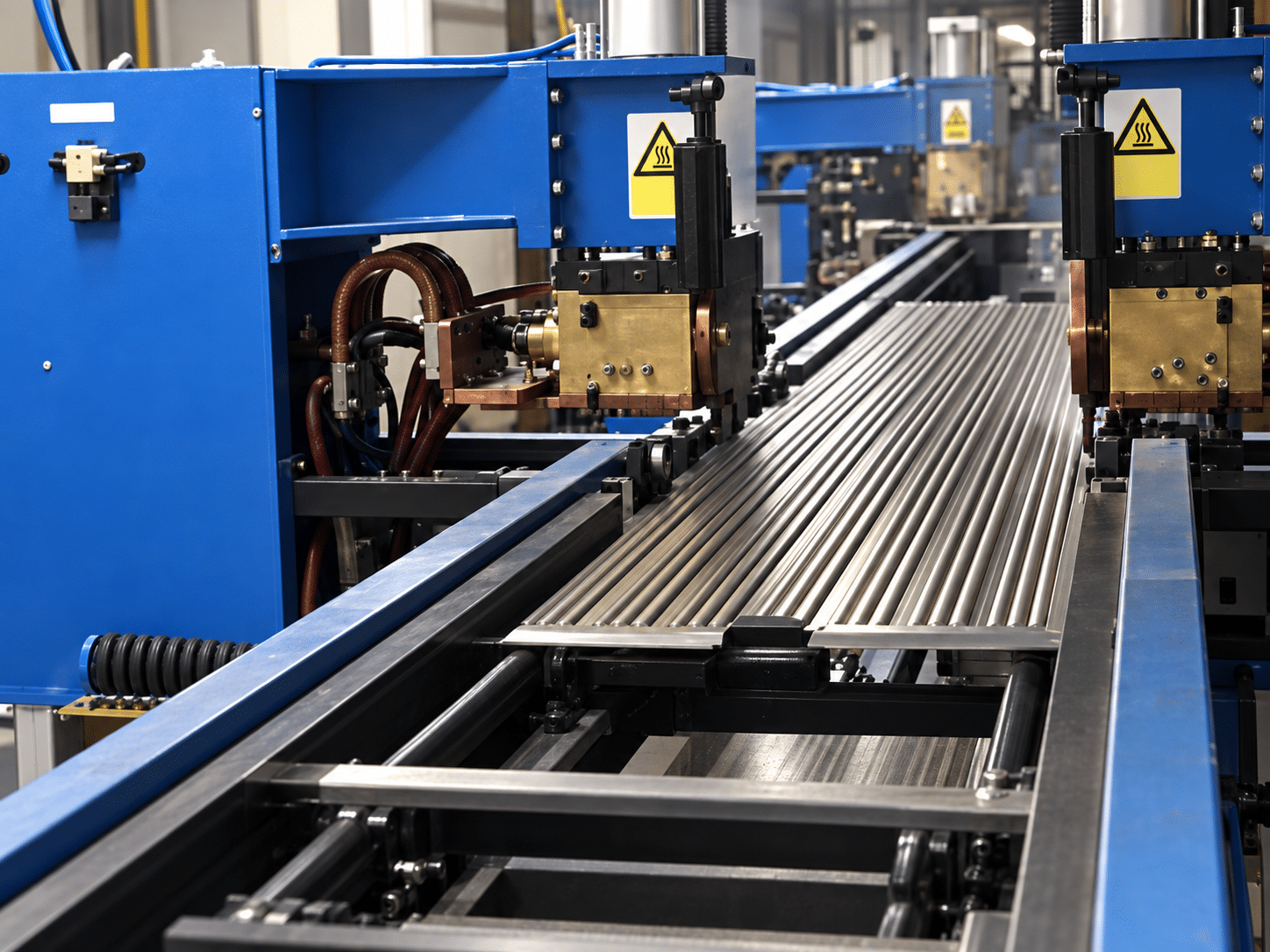
| Equipment | Transformer Radiator Production Line |
| Customer | A transformer panel radiator manufacturer in the United States (serving the North American market) |
| Application | Flexible automatic production of 520/380 dual-spec panel radiators with staged capacity expansion |
Customer information has been anonymized; only region and industry attributes are retained. Performance figures are acceptance and typical-condition reference values and may vary depending on line configuration.
1. Customer Background
This US customer supplies panel radiators to utility and industrial users across North America, built around two workhorse fin widths: 520 mm and 380 mm. Demand from grid renewal and industrial expansion kept order books full, and the plant did not want growth to depend on recruiting scarce skilled welders. With North American labor costs and delivery discipline, “fewer people” and “on time” are worth more than raw single-machine speed. The customer approached line investment in stages: prove the return on one line first, then add lines as orders grow. Order records show the customer has since configured multiple lines of the same type; this article follows the delivery and commissioning of one of them. For any manufacturer planning to expand radiator capacity, this “pilot first, then replicate” path is worth studying.
2. Industry Pain Points
Before the first line, the shop ran on stand-alone machines — the same pattern seen elsewhere, but each problem amplified by North American labor costs:
Transfer and alignment time. Crane moves between machines meant every panel went through repeated lifts, flips and manual alignment between rolling and welding.
Slow dual-spec changeovers. Production alternated between 520 and 380 sizes, and each changeover stopped the shop — unbearable inside tight shipping windows.
Weld quality swings. Seam and end welding depended on individual welders; leak rework hit shipping schedules directly.
Rising labor cost. Every station needed its own person, and peak-season overtime and hiring climbed together.
Expansion that could not be copied. In a stand-alone layout, more capacity only meant more machines and more people, with management span growing accordingly.
Each problem alone was manageable; together, they made every added order line feel like new overhead.
3. Solution
For dual-spec production and staged expansion, the line we configured emphasizes two ideas: one line carrying both specifications, and repeatability.
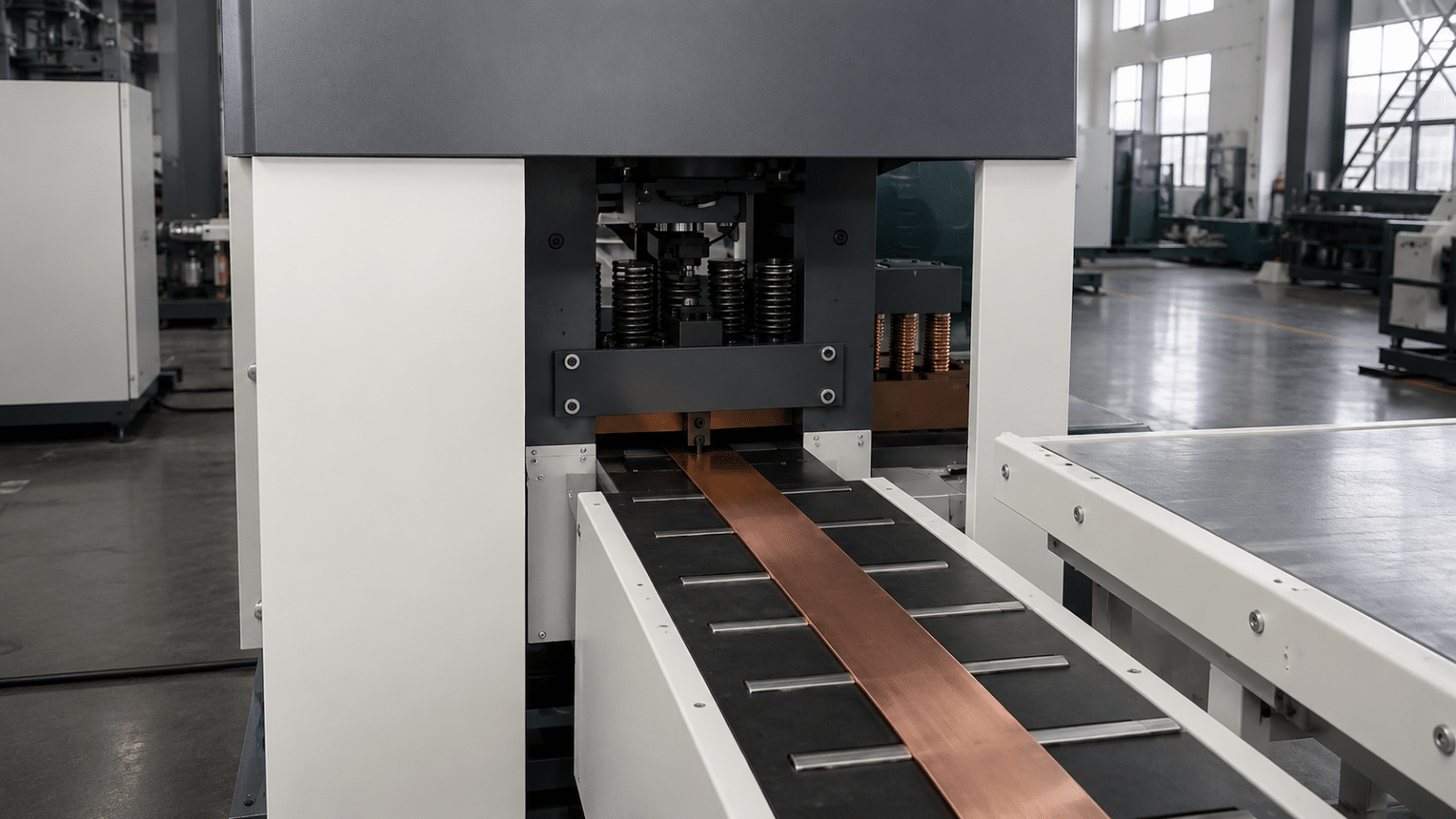
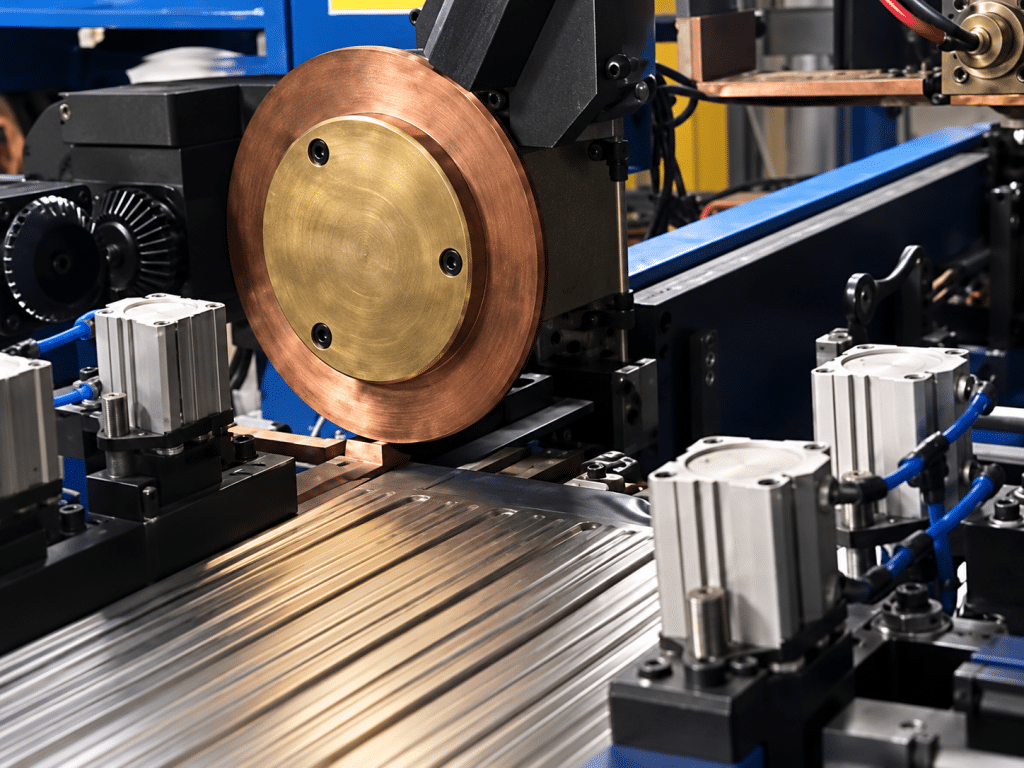
- Two specs, one line. Fin profile and counts are entered via the touch screen or PLC batch lists; 520/535 share one pair of roll stands and 380/310 share one press die set, so a changeover between the two main widths is a checklist-driven roll and die swap at rolling speeds of 9–12 m/min.
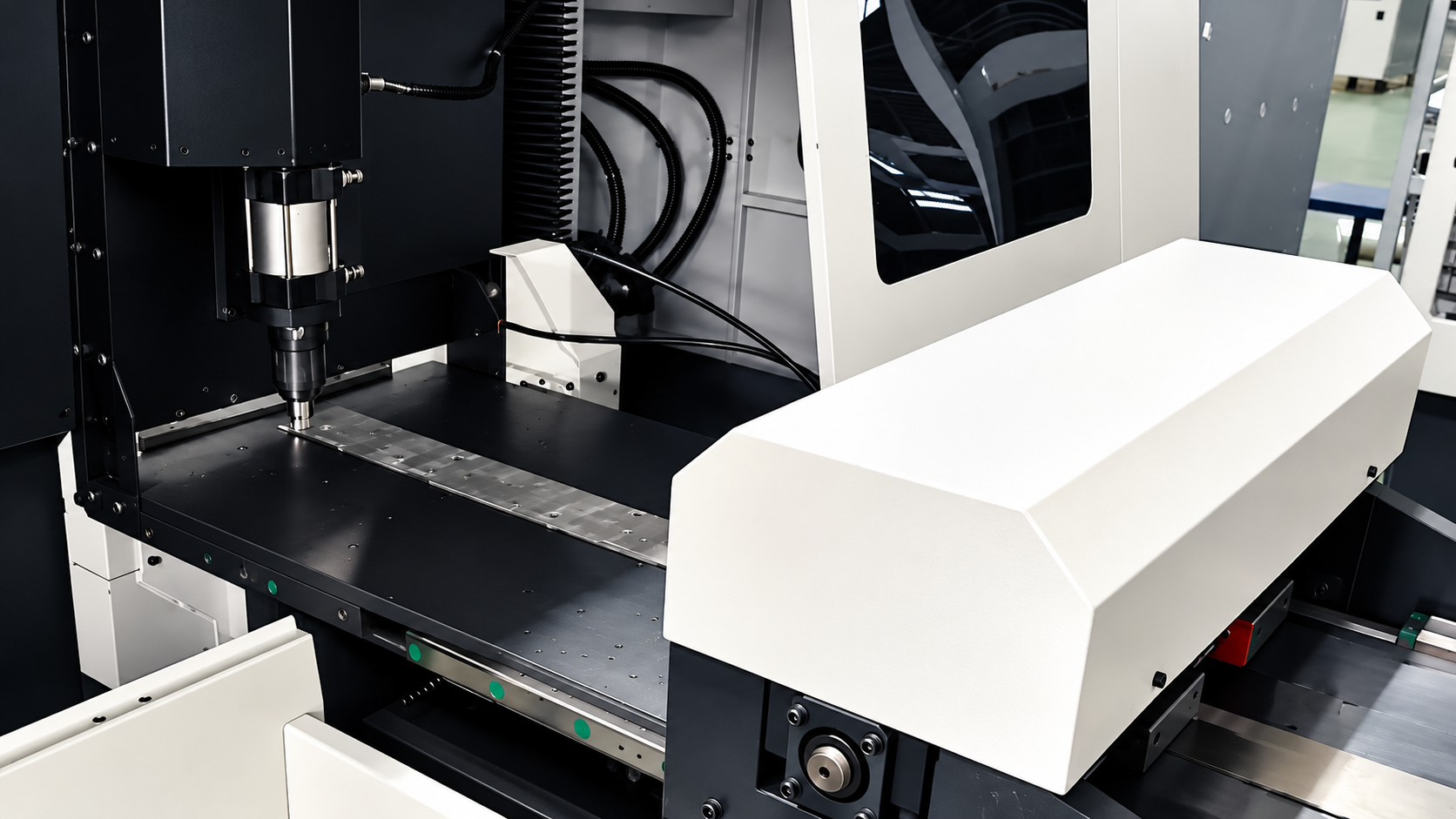
- Accuracy and tightness written into acceptance. Measuring wheel with encoder holds center distance within ±0.25–0.5 mm and diagonal error within 2 mm; single panels withstand 0.15–0.2 MPa positive and 133 KPa negative pressure; assemblies hold 0.2 MPa for 30 minutes. Every new line is accepted against the same standard, so expansion never dilutes quality.
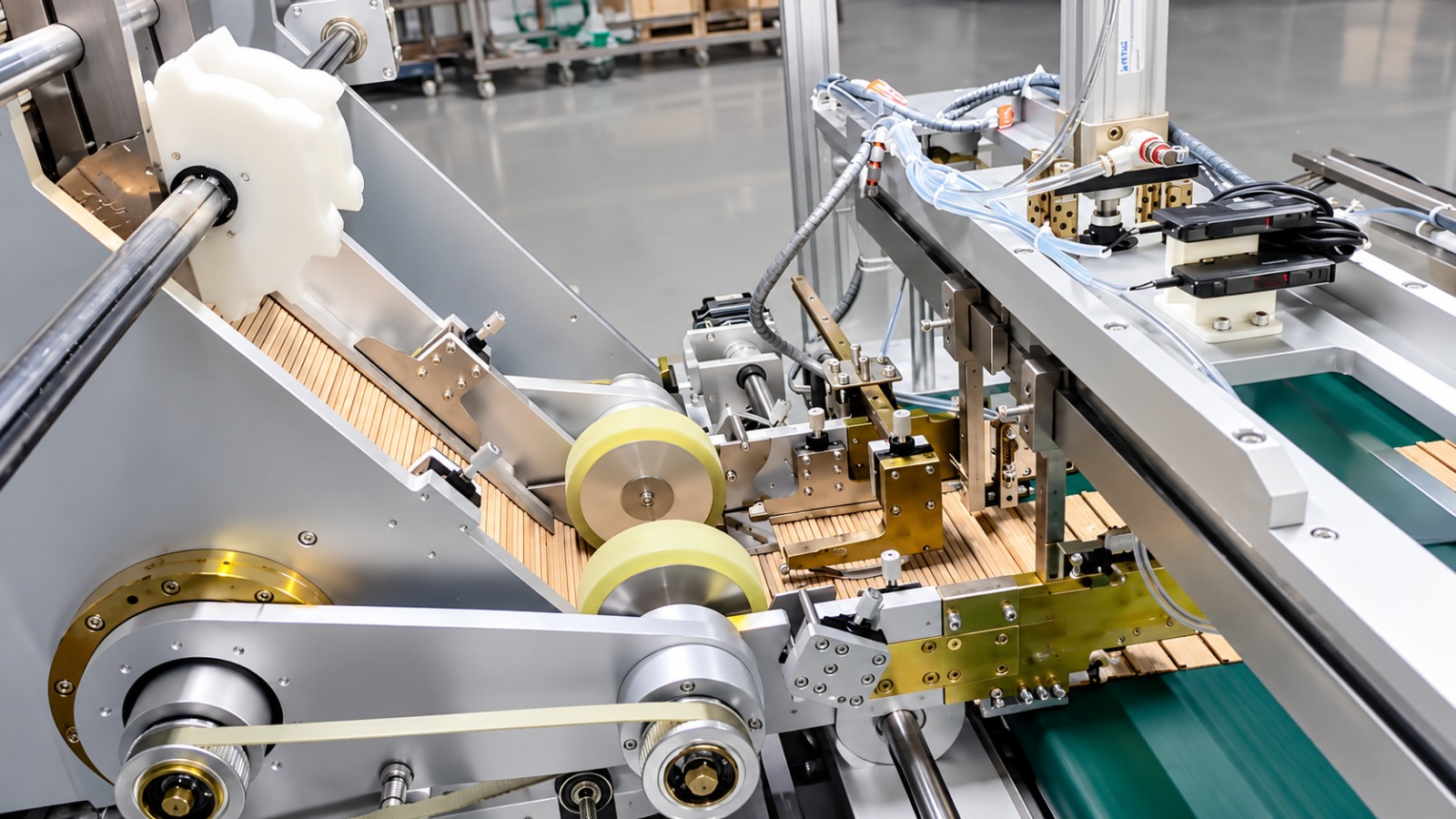
- Few people by design. A photoelectric loop auto-balances decoiler and forming speeds; the stacking machine picks panels by electromagnet and switches between two collection racks. One to two operators run the line, so added capacity no longer adds headcount one-for-one.
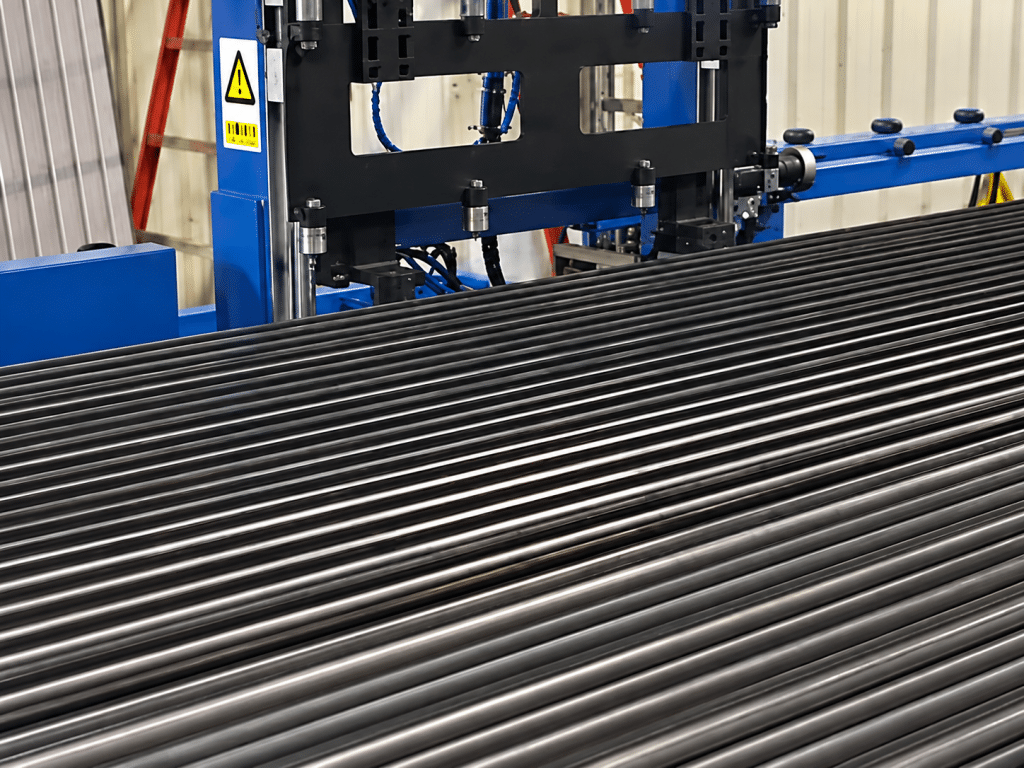
Around the core process, the line also standardizes the steps around it: coils are loaded by the hydraulic expanding-mandrel decoiler with photoelectric loop control; panels travel on chain conveyors between stations; and the gantry stacking machine inserts finished panels into comb racks across two shuttle-connected collection racks, so stacking never interrupts the flow. The result is a process where a new crew can reach the standard output curve within weeks, because every setting that matters lives in the recipe, not in someone’s memory.
4. Implementation and Commissioning
This delivery followed the process the customer had already validated: after sea freight, verify foundations, power supply (about 315 KVA) and cooling water, then run each machine empty. The 520 mm width was threaded through first for line commissioning, followed by a 380 mm changeover to prove the switchover routine, with rolling, pairing, spot welding and seam welding parameters tuned station by station. Acceptance used test cuts and welds per the technical agreement, with on-site training and English manuals. Wear parts — electrode caps, weld wheels, shear blades — were delivered with the line along with replacement intervals, and the customer’s maintenance team completed a supervised preventive-maintenance cycle before handover. Because the customer’s team already ran a sister line, this commissioning focused on establishing the new line’s parameter baseline and walking through the changeover checklist — production handover followed complete trial batches in both widths.
5. Acceptance Results
Key acceptance indicators (design and acceptance reference values; actual figures depend on the configured line):
| Indicator | Value / Result |
| Center distance error | ±0.25 to ±0.5 mm (by specification) |
| Diagonal error | ≤ 2 mm |
| Single-panel pressure test | Positive ≥ 0.15–0.2 MPa, negative ≥ 133 KPa, no distortion |
| Assembly tightness | 0.2 MPa held for 30 minutes |
| Dual-spec changeover | Checklist-based roll and die swap, no line re-alignment |
| Operators for the whole line | 1–2 people |
What the customer values most after start-up mirrors the earlier lines: changeover certainty — spec switches no longer steal unplanned downtime — and repeatability — each new line inherits the same parameter baseline and acceptance standard, so capacity lands on schedule.
6. Customer Feedback
“We proved the concept with one line, and now we replicate the same configuration. Changeovers follow a checklist, acceptance follows a standard — expansion no longer means starting from scratch.” — Customer Operations Manager
7. Summary and Next Steps
For North American manufacturers planning radiator capacity growth, the transferable lesson is not a single machine’s spec sheet but the pilot-and-replicate path itself: use one line that meets the acceptance baseline to prove the process and train the team, then let every following line land against the same standard. Dual-spec flexibility and low headcount make each added line independently accountable and fast to ramp up. The next line in the customer’s plan follows the same recipe, and the expectation is a ramp-up measured in weeks, not months.
To evaluate a first line or a replication plan, contact the TRANFOVIA technical team for a proposal.
Related guide: For the complete machine-by-machine breakdown of the line, see our transformer radiator production line guide.
- WhatsApp: +86-15958243831
- Email: sales@tranfovia.com
- Website: https://tranfovia.com/