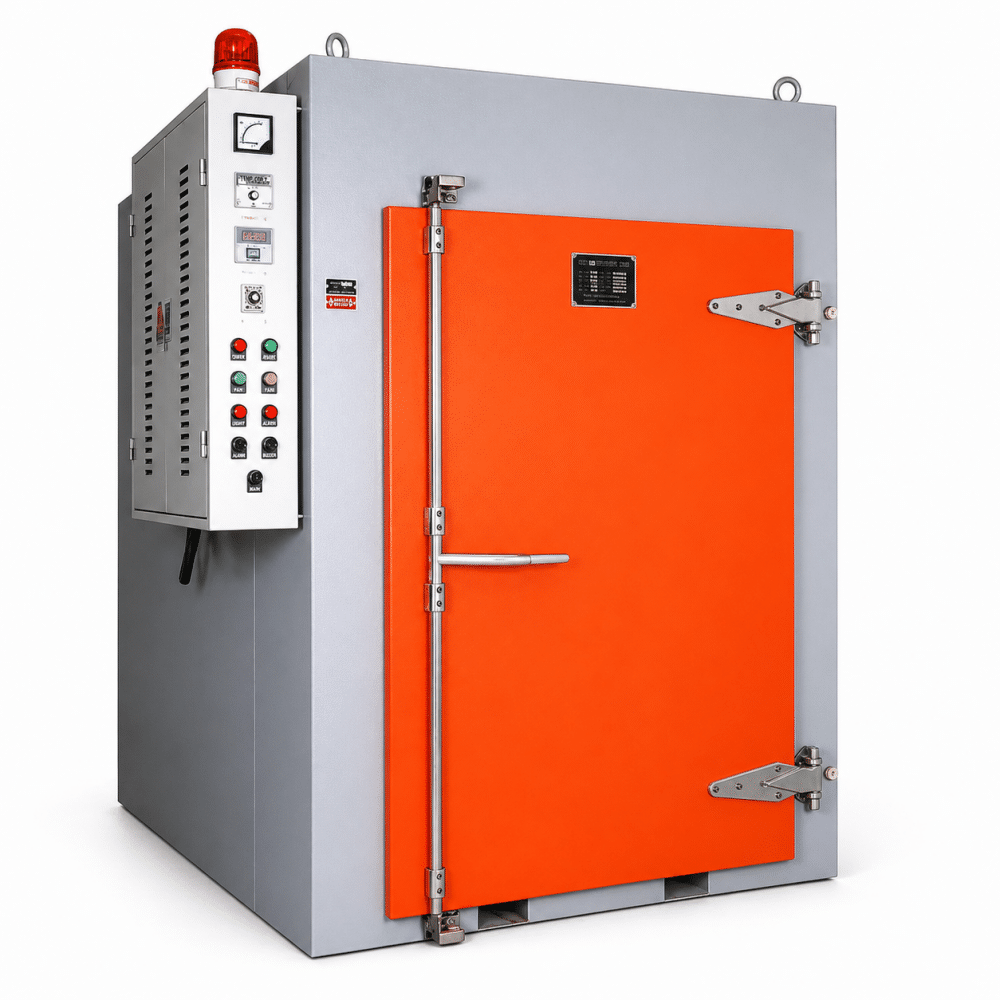
A Busbar Heat Shrink Sleeve Oven provides controlled chamber heating after a heat-shrink insulation sleeve has been fitted over a copper busbar. The HRS series uses high-volume hot-air circulation to keep the working chamber temperature uniform while sealed electric heating tubes provide the heat source. A digital temperature controller manages the setpoint, and an over-temperature alarm cuts the heating power and gives an audio-visual warning if abnormal temperature is detected.
The HRS series is mainly used in the insulation finishing stage of copper busbar production for power-distribution switchgear and related electrical assemblies. After the busbar has been cut, punched or bent and the insulation sleeve has been positioned, the workpiece is transferred into the oven for controlled heat shrinking.
The circulation system is designed to maintain a uniform chamber temperature so the insulation sleeve shrinks consistently around the copper busbar.
A brand-name digital temperature controller provides straightforward temperature setting and monitoring during the heat-shrink cycle.
When abnormal temperature is detected, the protection system cuts heating power and provides an audio-visual alarm.
The oven can be equipped with a ground-level trolley to simplify loading and unloading of prepared busbars.
The heating system uses sealed electric heating tubes designed for oxidation resistance and stable operation.
For continuous or production-line requirements, the oven can be engineered with a drying-channel structure according to the manufacturer’s process layout.
| Model | Chamber W x D x H (mm) | Working Temperature (°C) | Heating Power (kW) |
| HRS-1 | 850 x 800 x 1000 | Room temperature – 250 | 10.8 |
| HRS-2 | 1200 x 1200 x 1200 | Room temperature – 250 | 15 |
| HRS-3 | 1300 x 1200 x 1500 | Room temperature – 250 | 22.5 |
| HRS-4 | 2000 x 1800 x 1500 | Room temperature – 250 | 36 |
Common electrical data: AC380 V ±10%, 50 Hz. Temperature uniformity: ≤±2.5. Temperature fluctuation: ≤±1°C. Non-standard chamber sizes can be engineered to the required workpiece and production layout.
It is used after an insulation sleeve has been fitted over a copper busbar. Controlled heating shrinks the sleeve around the conductor to complete the insulation finishing step.
The listed HRS models operate from room temperature up to 250°C.
Standard chamber sizes range from 850 x 800 x 1000 mm to 2000 x 1800 x 1500 mm. Non-standard sizes can be engineered for the required busbar loading envelope.
Yes. A drying-channel structure can be designed for production-line requirements. The exact transfer and takt arrangement should be confirmed from the customer’s busbar flow.
No. Cutting, punching and bending machines shape the copper bar. The HRS oven is used later for heat-shrink insulation finishing.