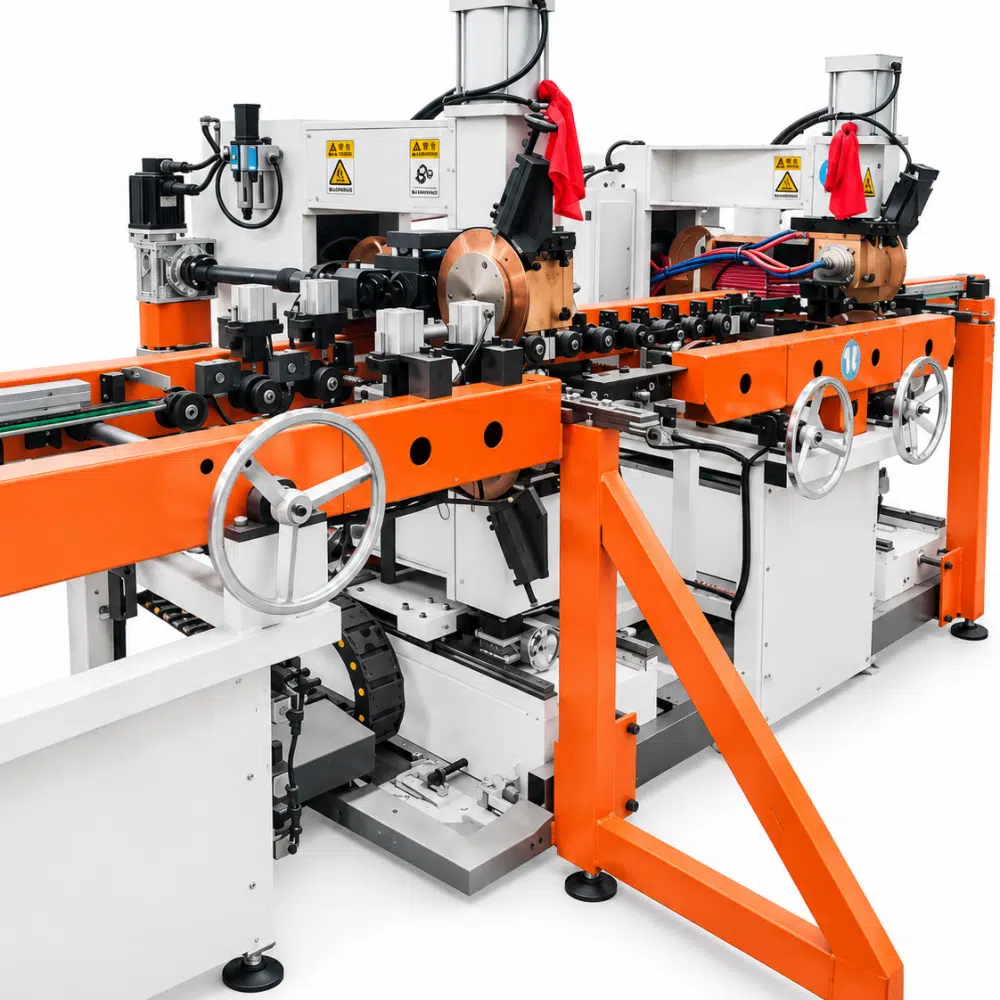
The Radiator Panel End Welding Machine is designed to seal both short ends of transformer radiator panels after the end cutting process.
Since the long edges are sealed by the seam welding process, the radiator panel ends require a dedicated welding operation to complete the oil-tight structure.
The machine supports three welding processes: TIG welding, MIG/MAG welding, and oscillating seam welding, allowing transformer manufacturers to select the most suitable solution according to production requirements.
With four symmetrical welding torches, precise positioning, and stable clamping, the equipment ensures reliable end welding quality and consistent radiator performance.
| Processes offered
TIG / MIG-MAG / oscillating seam |
Torches
4, two symmetrical pairs |
| TIG speed
600 mm/min |
Clamping
4 × Ø125 mm + 2 × Ø100 mm lift |
The Radiator Panel End Welding Machine is installed after the hydraulic end cutting process and before leveling and final assembly.
Typical production process:
Steel Coil Feeding → Hydraulic Mandrel Decoiler → Radiator Panel Roll Forming → Panel Turnover & Joining → Multi-Spot Welding → Dual Seam Welding → Edge Trimming → End Cutting → End Welding → Leveling → Header Pipe Assembly
After end cutting completes the final panel dimensions, this machine performs end sealing welding to close the remaining open sections of the radiator panel.
This step ensures the radiator panel achieves a complete oil-tight structure before pressure testing and assembly.
1. Multiple Welding Process Options
The machine supports:
Customers can select the welding method according to radiator design, production capacity, and quality requirements.
2. Four-Torch Symmetrical Welding System
The machine uses four welding torches arranged in two symmetrical groups, improving welding consistency and production efficiency.
3. Precise Positioning and Clamping
The panel is positioned through center locating holes and dual-side positioning, while clamping cylinders keep the welding area stable during operation.
4. Stable Welding Control
The PLC control system allows adjustment of:
5. Flexible Process Configuration
The same positioning and clamping platform can support different welding methods, allowing manufacturers to adapt the equipment according to future production requirements.
| Welding Process | TIG / MIG-MAG / Oscillating Seam Welding |
| Number of Torches | 4 units, arranged in two symmetrical pairs |
| Welding Speed | 600 mm/min (TIG) / ≥2.5 m/min (Seam Welding) |
| Torch Movement | Precision slide with ball screw and servo/stepper drive |
| Oscillation Angle | 0–7° adjustable (MIG/MAG) / ±5° (Seam Welding) |
| Positioning Method | Center locating + dual-side positioning |
| Lift Cylinders | 2 × Ø100 mm |
| Clamping Cylinders | 4 × Ø125 mm |
| Welding Power Source | Panasonic TX400 or equivalent |
| Control System | PLC + Touchscreen, Automatic / Manual Mode |
The long edges are sealed by seam welding, while the short ends remain open for processing and require end welding to complete the oil-tight radiator structure.
The machine supports TIG welding, MIG/MAG welding, and oscillating seam welding according to different production requirements.
The standard configuration includes four welding torches arranged in two symmetrical pairs.
The machine uses center positioning and dual-side clamping to ensure stable welding conditions.
Yes. The common positioning and clamping platform allows different welding process configurations.